


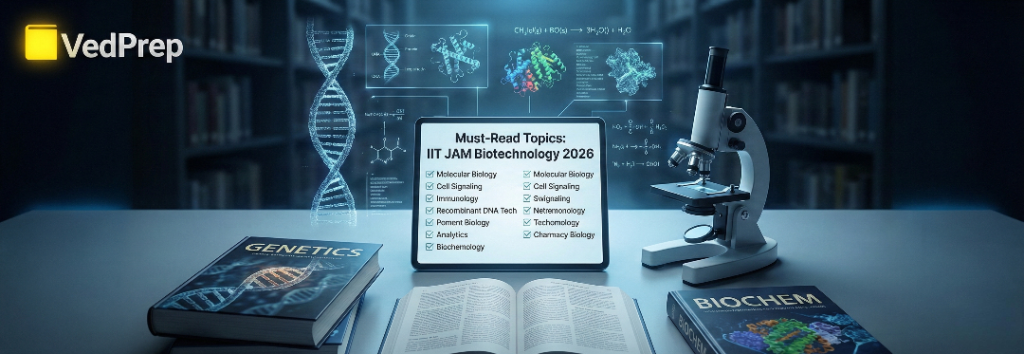

IIT JAM Biotechnology is the initial gateway for science candidates to secure M.Sc. and Integrated Ph.D. admissions in prestigious institutes like IITs and IISc. This exam includes in four core sections strictly: Biology (44%), Chemistry (20%), Mathematics (18%), and Physics (18%). Success needs mastering high-weightage Biology sections while strategically along with Physics and Mathematics to secure a top rank.
Analyzing the IIT JAM Biotechnology Chapter Wise Weightage
A clear analysis of the IIT JAM Biotechnology Chapter Wise Weightage reveals that the exam is not solely dependent on biological knowledge. While General Biology takes the largest portion of the paper, the inclusion of 10+2 level Mathematics and Physics creates a rare competitive landscape.
Historical information represents that Biology consistently commands 44–50% of the entire marks of this exam. Chemistry accounts for roughly 20–25% of the total, with emphasis on Organic and Physical Chemistry. Mathematics and Physics, frequently sidestepped by those in biology streams, together comprise 30–36% of the weighting. Understanding this IIT JAM Biotechnology Chapter Wise Weightage is the first step in moving from a passive study plan to an active, result-oriented strategy.
General Biology: The Core Anchor of Your Preparation
General Biology forms the backbone of the IIT JAM Biotechnology syllabus. This section is extensive, covering graduate-level concepts (10+2+3 level). However, distinct patterns in questioning allow aspirants to prioritize specific modules over others.
Biochemistry and Cell Biology
Biochemistry and Cell Biology represent core components of IIT JAM Biotechnology. The inquiries here tend to be idea-based and interconnected. In Biochemistry, focus primarily on enzyme reaction kinetics (Michaelis-Menten formulation), the way energy shifts occur inside living systems, and major pathways like Glycolysis and the Krebs cycle. For Cell Biology, central themes involve the structure and function of organelles, the processes for transporting materials through barriers, and cell signaling cascades (including GPCR and the cAMP pathway). Mastery of these topics is critical because they frequently appear across both single-best-answer and multiple-answer question types.
Molecular Biology and Genetics
Molecular Biology is another key area, often supplying much material for the leading IIT JAM Biotechnology subjects. Key concepts include the Central Dogma (encompassing Replication, Transcription, and Translation), regulation of gene activity (such as the Lac and Trp operons), and techniques for DNA repair.
Chemistry: The Rank Booster
Chemistry within the IIT JAM Biotechnology curriculum acts as a link connecting the life sciences and the physical sciences. The subject matter aligns with the 10+2+3 educational stage, much like Biology, yet the examination items frequently assess core concepts relevant to organic frameworks.
Organic Chemistry Essentials
Organic Chemistry usually holds the highest weightage in IIT JAM Biotechnology. The focus should be on reaction mechanisms (SN1, SN2, E1, E2), stereochemistry (R/S configuration), and the chemistry of biomolecules like amino acids and carbohydrates. Name reactions such as Aldol condensation and Cannizzaro reaction are also frequent candidates for direct questions.
Physical and Inorganic Chemistry
Questions in Physical Chemistry depends on formulas, representing the necessity of mathematical knowledge to get rank in IIT JAM Biotechnology numerical sections. Key areas includes like Chemical Kinetics (specifically rate laws), Thermodynamics (like Gibbs free energy calculations), and Solutions (concentrating on colligative properties).
The “Math-Physics” Paradox: A Critical Perspective
Mathematics and Physics together account for roughly 36 marks. Ignoring this chunk places a ceiling on your maximum possible score in IIT JAM Biotechnology, making it mathematically difficult to secure a top 100 rank. You do not need to master these subjects at an engineering level. The requirement is 10+2 level proficiency. Strategically preparing specific high-yield topics in these subjects is far more effective than striving for 100% mastery in Biology while scoring zero here.
Mathematics and Physics: Strategic Selection
Since the syllabus for these subjects is at the 10+2 level, the questions are standard and often repetitive.
Mathematics Focus Areas
Coordinate Geometry and Calculus are consistently important. Focus on limits, continuity, and basic differentiation. Matrices and Determinants (eigenvalues, rank) are also high-yield and relatively easier to grasp for biology students. Statistics, including mean, variance, and standard deviation, often appear and relate directly to biological data analysis.
Physics High-Yield Topics
Mechanics is a dominant unit, covering Newton’s laws and conservation of energy. However, topics like Modern Physics (Photoelectric effect, Bohr’s model) and Thermodynamics are often more scoring because they rely on direct formula application. Electricity and Magnetism should be targeted if you have a strong conceptual base, focusing on circuits and Coulomb’s law.
High Scoring Biology Topics for IIT JAM
To maximize efficiency, your revision should revolve around the High Scoring Biology Topics for IIT JAM. These are clusters of topics that have historically shown high frequency and mark density.
- Techniques in Biotechnology: PCR, Gel Electrophoresis, Chromatography, and Microscopy. These are practical techniques that frequently appear in Section B (MSQ) and Section C (NAT).
- Immunology: Antigen-antibody interactions, structure of immunoglobulins, and vaccine types.
- Microbiology: Bacterial growth curves and sterilization techniques are simple yet high-scoring concepts.
- rDNA Technology: Restriction enzymes, cloning vectors, and screening methods are staples of the exam.
Prioritizing these High Scoring Biology Topics for IIT JAM ensures you capture the “low-hanging fruit” before tackling complex, low-weightage areas like Taxonomy or Plant Physiology.
Emerging Trends: Modern Biotech and Analytical Questions
Recent trends in IIT JAM Biotechnology papers show a shift toward analytical and modern topics. Questions are increasingly testing knowledge of advanced techniques like CRISPR-Cas9, RNA interference (RNAi), and Next-Generation Sequencing (NGS).
However, a growing emphasis is being placed on “Numerical Answer Type” (NAT) inquiries throughout the Biology section. These might require determining exact proliferation rates in microbiology, calculating recombination fractions in genetics, or evaluating the net charge of a biomolecule like a peptide in biochemistry. Preparation for these analytical challenges involves practicing with quantitative problems, going beyond simple conceptual review.
Practical Application: Integrated Problem Solving
Aptitude for IIT JAM Biotechnology frequently stems from linking concepts across various fields. Take, for instance, an Enzyme Kinetics query. It transcends mere Biology; it necessitates a grasp of graph interpretation (hyperbolic versus sigmoidal shapes) alongside the chemical principles governing reaction speeds.
In a comparable vein, a DNA topology problem could draw upon Physics (specifically relating to stress and twisting forces) and Mathematics (for computing the linking number). During your preparation, resist segmenting your subjects. Utilize your physical chemistry knowledge to illuminate protein stability, and employ your mathematical proficiency to decode genetic likelihoods. This merged strategy cultivates the cognitive flexibility essential for performance in the test setting.
Conclusion on Strategic Preparation
Cracking IIT JAM Biotechnology 2026 is a function of disciplined planning and smart topic selection. Your strategy must be anchored in General Biology, supported by Chemistry, and differentiated by Mathematics and Physics.
Regularly consult the IIT JAM Biotechnology Chapter Wise Weightage to ensure your study time aligns with mark distribution. Do not neglect the High Scoring Biology Topics for IIT JAM like Techniques and Molecular Biology. Finally, for a structured approach that balances all four sections with expert guidance, platforms like VedPrep can provide the necessary edge. By treating the exam as a holistic science test rather than just a biology exam, you position yourself for a top rank and admission into India’s premier institutes.
Frequently Asked Questions (FAQs)
What is the subject weightage for IIT JAM Biotechnology 2026?
The IIT JAM Biotechnology paper typically follows a distribution of Biology (44%), Chemistry (20%), Mathematics (18%), and Physics (18%). While Biology holds the highest weightage, the combined contribution of Mathematics and Physics (36%) often determines the final rank.
Is Mathematics compulsory for IIT JAM Biotechnology?
Yes, Mathematics is a mandatory section of the IIT JAM Biotechnology exam. It constitutes approximately 18% of the paper. The syllabus covers 10+2 level topics, focusing on Calculus, Coordinate Geometry, and Statistics. Ignoring this section significantly lowers your chances of a top rank.
Which Biology topics have the highest scoring potential in IIT JAM?
Molecular Biology, Biochemistry, and Genetics are the most high-yielding areas. Specifically, focus on the Central Dogma, Enzyme Kinetics, and Mendelian Genetics. Techniques like PCR and rDNA technology are also high-scoring "must-read" topics due to their frequency in MSQ sections.
Does IIT JAM Biotechnology have negative marking?
Yes, negative marking applies to Section A (Multiple Choice Questions). Incorrect answers deduct 1/3 mark for 1-mark questions and 2/3 mark for 2-mark questions. However, Section B (MSQ) and Section C (NAT) do not have negative marking.
What is the syllabus level for Physics in IIT JAM Biotechnology?
The Physics syllabus is strictly at the 10+2 (Higher Secondary) level. Key topics include Mechanics, Thermodynamics, Electrostatics, and Modern Physics. You do not need graduate-level physics knowledge; conceptual clarity of basic laws and formulas is sufficient.
What is the best strategy for the Chemistry section?
Focus on Organic Chemistry mechanisms (SN1, SN2, Aldol) and Physical Chemistry formulas (Kinetics, Thermodynamics). These areas align well with biological concepts. In Inorganic Chemistry, prioritize Coordination Chemistry and Bonding, as these chapters offer a high effort-to-reward ratio.
Which reference books are essential for IIT JAM Biotechnology?
Standard recommendations include Lehninger for Biochemistry, Bruce Alberts for Cell Biology, and Griffiths for Genetics. For the 10+2 level subjects (Physics, Chemistry, Math), NCERT textbooks are often sufficient for building the required conceptual base.
How do I handle Multiple Select Questions (MSQs)?
MSQs require precise conceptual clarity because partial credit is not awarded. You must identify all correct options. To prepare, focus on deep reading of topics like Techniques (PCR, Microscopy) and Cell Signaling, where statements can be nuanced and multifaceted.
Is it necessary to study Plant Physiology for IIT JAM BT?
While Animal Physiology often carries more weight, Plant Physiology is still part of the syllabus. Focus on major processes like Photosynthesis (C3/C4 pathways), Nitrogen Fixation, and Plant Hormones. You can afford to be selective, but do not ignore it completely.
Why am I scoring low in the Physics section?
Low scores in Physics often stem from a lack of formula application practice. The questions are rarely theoretical. Create a formula sheet for Mechanics and Modern Physics, and solve at least 5 years of past papers to understand the standard question patterns.
Are emerging topics like CRISPR included in the syllabus?
Yes, recent trends show an increase in questions on modern biotechnological tools. Topics like CRISPR-Cas9, RNA interference (RNAi), and Next-Generation Sequencing (NGS) are now critical for the "Techniques" portion of the exam.
How deep should I study Immunology?
Stick to the core concepts: Antigen-Antibody interactions, Immunoglobulins structure, MHC complex, and Hypersensitivity. Avoid deep clinical immunology unless it relates to basic biological mechanisms. The focus is on the molecular basis of immune responses.
Can I use a calculator in the IIT JAM exam?
Yes, a virtual scientific calculator is provided on the computer screen. You cannot carry a physical calculator. Practice using the virtual interface beforehand to ensure speed and familiarity during the actual exam.