




CSIR NET Physical Science Exam Pattern plays a crucial role for every candidate preparing for the Joint CSIR-UGC NET. Since the exam is conducted twice a year June and December, knowing the exact paper structure helps aspirants plan their preparation smartly and score efficiently. The exam is conducted by the National Testing Agency (NTA) on behalf of CSIR and UGC. For those targeting a future in research, JRF, or Assistant Professorship in Physical Sciences, a clear understanding of the CSIR NET Physical Science Exam Pattern 2025 becomes essential. The question paper is divided into three parts: Part A, Part B, and Part C, each designed to test different abilities of the candidate.
Part A: General Aptitude
Part A tests a candidate’s overall reasoning ability. It includes:
- Logical reasoning
- Numerical ability
- Data interpretation
This section is common for all CSIR NET subjects and is meant to assess analytical and problem-solving skills.
Part B & Part C: Core Physical Science
Part B and Part C are the heart of the CSIR NET Physical Science Exam Pattern 2025, focusing entirely on the Physics syllabus.
- Part B includes conceptual questions from core Physical Science topics.
- Part C features higher-order analytical and application-based problems, requiring deep conceptual clarity and strong problem-solving skills.
CSIR NET Chemical Science Syllabus

CSIR NET Exam Overview
CSIR NET (Council of Scientific and Industrial Research National Eligibility Test) is a national-level competitive examination that evaluates candidates’ knowledge in core scientific disciplines. Understanding the CSIR NET Physical Science Exam Pattern is especially important for aspirants who wish to qualify in the Physical Sciences category, as the exam structure directly influences preparation strategy and scoring potential. Conducted jointly by the CSIR and the University Grants Commission (UGC), the exam helps select qualified professionals for research and teaching roles across India. The CSIR NET is applicable only to science-based subjects, and candidates who understand the CSIR NET Physical Science Exam Pattern clearly are better positioned to qualify for the Junior Research Fellowship (JRF) or apply for Lectureship (LS)/Assistant Professor posts in recognized universities and colleges. Those who crack the exam by aligning their preparation with the CSIR NET Physical Science Exam Pattern can pursue fully funded PhD programs, secure top government fellowships, or build successful academic and research careers in prestigious institutions across the country.
| CSIR NET Full Form | Council of Scientific & Industrial Research, National Eligibility Test |
| Who conducts the CSIR NET Exam? | National Testing Agency (NTA) |
| Exam type | Computer Based Test (CBT) |
| Opportunities offered | Candidates can apply for Junior Research Fellowship(JRF) and Lectureship |
| Number of questions | 75-150 (Varies according to the subject chosen by the candidates) |
| Total marks | 200 |
| Type of questions | MCQs (Multiple Choice Questions) |
| Exam duration | 3 Hours |
| Eligibility Criteria | Minimum 55% in Bachelor’s Degree |
CSIR NET Mathematics Sciences Syllabus
CSIR NET Physical Science Exam Pattern Paper Detailed
CSIR NET Physical Science Exam Pattern provides a clear and detailed understanding of the paper structure, marking scheme, and distribution of questions that candidates must follow during the examination. A strong command over the CSIR NET Physical Science Exam Pattern helps aspirants plan smart strategies, manage their time effectively, and focus on high-weightage areas to maximize their score. . Understanding how each section contributes to the overall CSIR NET Physical Science Exam Pattern is crucial for scoring well and meeting the eligibility criteria.
| Part | Total Questions | Max Questions to Attempt | Marks per Correct Answer | Negative Marking |
| A | 20 | 15 | 2 | 0.5 |
| B | 25 | 20 | 3.5 | 0.875 |
| C | 30 | 20 | 5 | 1.25 |
| Total | 75 | 55 | — | — |
|
Related Topics |
|
| important topics for csir net Physical Science | important topics for csir net Life Science |
| important topics for csir net Chemistry | important topics for csir net Mathematics |
CSIR NET Physical Science Marking Scheme
CSIR NET Physical Science Marking Scheme is an essential component of understanding how the final score is calculated and how each section contributes to overall performance. Since the marking structure is closely linked to the CSIR NET Physical Science Exam Pattern, candidates must clearly understand how Parts A, B, and C carry different weightage, different marks per correct answer, and different levels of negative marking.
The marking scheme in the CSIR NET Physical Science Exam Pattern is designed to reward accuracy while discouraging random guesswork, ensuring that only well-prepared candidates score score high.
As the level of negative marking increases from Part A to Part C, aspirants must follow a balanced strategy, prioritizing accuracy, time management, and selective attempts to match the demands of the CSIR NET Physical Science Exam Pattern.
Understanding this marking scheme helps students:
- Estimate expected scores
- Plan number of attempts
- Avoid unnecessary negative marking
- Improve accuracy in high-weightage sections
| Part | Marks per Correct Answer | Negative Marks per Wrong Answer |
| A | 2 | 0.5 |
| B | 3.5 | 0.875 |
| C | 5 | 1.25 |
CSIR NET Earth Science Syllabus
CSIR NET Physical Science Negative Marking
Understanding the CSIR NET Physical Science Exam Pattern also requires knowing its negative marking system. In CSIR NET Physical Science Negative Marking 2025, all three parts A, B, and C carry 25% negative marking. This means a wrong answer deducts a quarter of the marks assigned to that question.
Because Part C has the highest marks per question, even a single mistake can cost heavily. Therefore, aspirants must avoid random guessing, focus on accuracy, and choose questions wisely to maximise their final score.
Below is the properly structured and corrected table based on the official CSIR NET Physical Science Exam Pattern:
| Part | Negative Marks per Wrong Answer | Percentage of Marks Deducted |
| A | 0.5 | 25% |
| B | 0.875 | 25% |
| C | 1.25 | 25% |
CSIR NET Physical Science Syllabus
CSIR NET Physical Science Exam Pattern PYQs PDF Download
Practicing CSIR NET Physical Science Previous Years’ Question Papers (PYQs) is one of the most effective ways to prepare for the exam, especially when you want to understand the CSIR NET Physical Science Exam Pattern in a real and practical manner. Solving PYQs helps you analyze the actual question style, marking scheme, difficulty level, and pattern followed by NTA.
- Regular practice not only familiarizes you with the CSIR NET Physical Science Exam Pattern, but also improves speed, accuracy, and problem-solving skills.
- It allows candidates to identify important chapters, repeated concepts, and weak areas that need more focus. This consistent practice boosts confidence and significantly increases the chances of qualifying for JRF or Assistant Professor.
- Candidates can download the CSIR NET Physical Science Previous Year Question Papers PDFs from multiple years and shifts to strengthen their preparation and understand question trends as per the latest CSIR NET Physical Science Exam Pattern.
Click here to download CSIR NET Previous Year Question Papers PDF.
Commonly asked question

Also check – CSIR NET Life Science Question Papers Download Pdf 2025
CSIR NET Physical Sciences Previous Year Question Papers & Answer pdf
June & December Exam Cycles 2025 to 2017
| Exam Year | June – Question Papers | June – Answer Keys | December – Question Papers | December – Answer Keys |
| 2025 | Physical Sciences Question Papers | Final Answer Keys | — | — |
| 2024 | Physical Sciences Question Papers | Final Answer Keys | Physical Sciences Question Papers | Final Answer Keys |
| 2023 | Physical Sciences Question Papers | Final Answer Keys | Physical Sciences Question Papers | Final Answer Keys |
| 2022 | Physical Sciences Question Papers | Final Answer Keys | — | — |
| 2021 | Physical Sciences Question Papers | Final Answer Keys | — | — |
| 2020 | – | – | Physical Sciences Question Papers | Final Answer Keys |
| 2019 | Physical Sciences A | B | C | Physical Sciences | ||
| 2018 | Physical Sciences Question Papers A | B | C | Final Answer Keys | Physical Sciences A | B | C | Physical Sciences |
| 2017 | Physical Sciences Question Papers A | B | C | Final Answer Keys | Physical Sciences Question Papers A | B | C | Final Answer Keys |
How to Use CSIR NET Physical Science Previous Year Papers Effectively
Using last year’s question papers smartly can significantly boost your CSIR NET Physical Science preparation. Follow these structured steps to make the most of them:
- Start by Understanding the Exam Pattern
Before solving any paper, take time to study the CSIR NET Physical Science Exam Pattern. Know how many questions come in Part A, Part B, and Part C, and understand the marking scheme. This helps you plan how much time and effort to invest in each section. - Practice with Proper Time Management
Use a timer while solving papers to simulate real exam conditions. Try to complete:- Part A in 30 minutes
- Part B in 70 minutes
- Part C in 100 minutes
- Go through multiple previous year papers and note down frequently appearing topics. These usually indicate high-weightage areas. Chapters like Thermodynamics, Statistical Physics, Quantum Mechanics, and other core concepts are regularly asked, especially in Parts B and C. Prioritize revising these themes thoroughly according to the CSIR NET Physical Science Exam Pattern.
- Review Solutions Thoroughly
After attempting the papers, spend time analyzing the solutions. Understand the logic, formulas, and shortcuts used in solving numerical and conceptual questions. This helps you improve techniques and avoid repeating mistakes, aligning your preparation with the CSIR NET Physical Science Exam Pattern. - Use the Papers as Full-Length Mock Tests
Solve each previous year paper as a complete mock test under strict exam conditions with no breaks or distractions. This will help you:- Build exam stamina
- Improve accuracy
- Track your progress over time
Regular mock test practice also helps you adapt to the pressure and pace of the real CSIR NET Physical Science Exam Pattern, making you more confident and exam-ready.
Also check – How to Prepare CSIR NET Exam 2025: Complete Strategy, Books,Tips for
CSIR NET Physical Science Syllabus Overview
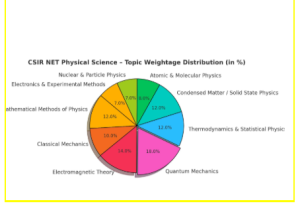
CSIR NET Physical Science syllabus forms the foundation for one of the most competitive national-level exams in India. It comprises nine major units, each designed to test different levels of theoretical understanding, analytical problem-solving, and conceptual application. However, not all topics carry equal weight; certain units frequently dominate the question paper and are considered the most important areas for preparation. When these high-weightage topics are studied in alignment with the CSIR NET Physical Science Exam Pattern, candidates gain a clearer strategy and a stronger chance of scoring well in the exam.
CSIR NET Dec 2025 Application Form | Step-by-Step Guide & 5 Mistakes to Avoid
| Unit | Topic Area | Importance Level |
| Mathematical Methods of Physics | 12% | Very High |
| Classical Mechanics | 10% | Very High |
| Electromagnetic Theory | 14% | High |
| Quantum Mechanics | 18% | High |
| Thermodynamics & Statistical Physics | 12% | High |
| Condensed Matter / Solid State Physics | 12% | Moderate |
| Atomic & Molecular Physics | 8% | Moderate |
| Nuclear & Particle Physics | 7% | Low |
| Electronics & Experimental Methods | 7% | Low |
CSIR NET Physical Science Best Books
CSIR NET Physical Science, selecting the right books can make all the difference. Below is a curated list of core textbooks and study aids, each aligned with high-weight units and the analytical depth required for the exam, helping you prepare more effectively according to the CSIR NET Physical Science Exam Pattern. Also Check CSIR NET Note
| Topic | Book / Author | Remarks |
| Mathematical Methods | Arfken & Weber | Comprehensive coverage for derivations |
| Classical Mechanics | Goldstein / Marion | Great for Part B conceptual questions |
| Electrodynamics | Griffiths / Jackson | Griffiths for basics, Jackson for advanced |
| Quantum Mechanics | Griffiths / Sakurai | Ideal for CSIR NET analytical problems |
| Statistical Physics | Reif / Pathria | Conceptual clarity with solved numericals |
| Solid State Physics | Ashcroft & Mermin | Excellent for band theory and magnetism |
| Atomic & Molecular Physics | Bransden & Joachain | Best for spectroscopy concepts |
| Nuclear Physics | Krane / Perkins | Important for decay and models |
| Electronics | Sedra & Smith | Easy conceptual approach for beginners |
|
Related Topics |
|
| important topics for csir net Physical Science | important topics for csir net Life Science |
| important topics for csir net Chemistry | important topics for csir net Mathematics |
CSIR NET Physical Science Exam Pattern Overall Insights
Understanding the CSIR NET Physical Science Exam Pattern is the first and most important step toward effective exam preparation. A clear knowledge of the paper structure, marking scheme, and question distribution helps candidates create a smart study plan, avoid negative marking, and focus on high-weightage areas. When aspirants combine the CSIR NET Physical Science Exam Pattern with regular PYQ practice, conceptual clarity, and time-management strategies, their chances of qualifying JRF or Assistant Professorship increase significantly. In short, mastering the CSIR NET Physical Science Exam Pattern is the key to performing confidently and securing a strong score in the CSIR NET exam.
CSIR NET Physical Science Exam Pattern FAQs
The exam has a total of 75 questions, with candidates required to attempt 55 questions. Part A has 20 questions, Part B has 25 questions, and Part C has 30 questions. Part A awards 2 marks per correct answer with 0.5 negative marks, Part B awards 3.5 marks with 0.875 negative marks, Part C awards 5 marks with 1.25 negative marks. Yes, all three sections have 25% negative marking per wrong answer. Candidates must focus on accuracy and avoid random guesses. High-weightage topics include Quantum Mechanics, Thermodynamics, Statistical Physics, Mathematical Methods, and Classical Mechanics. Practicing previous year papers familiarizes candidates with the exam pattern, improves speed, accuracy, problem-solving skills, and identifies recurring high-weight chapters.
How many questions are there in the CSIR NET Physical Science Exam?
What is the marking scheme for CSIR NET Physical Science?
Does CSIR NET Physical Science have negative marking?
Which topics carry the highest weight in CSIR NET Physical Science?
How can previous year question papers help in CSIR NET Physical Science preparation?