




UPSC Combined Geo-Scientist 2026: Comprehensive Guide for Geochemists
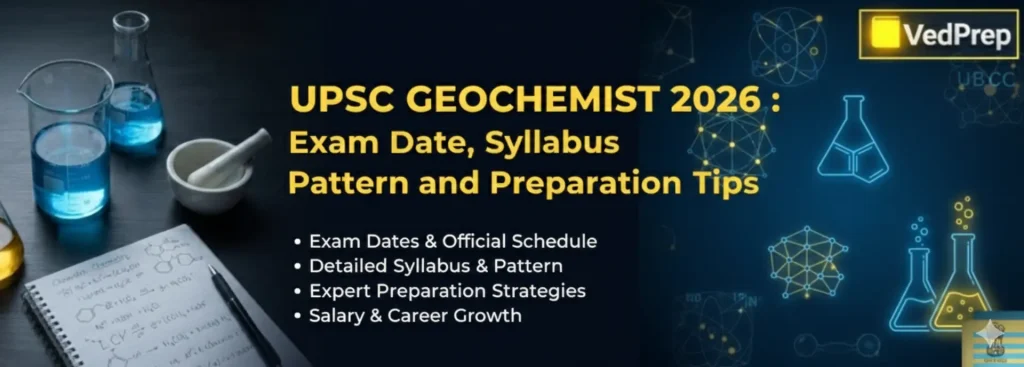
The roadmap for the UPSC Geochemist 2026 Exam under the Combined Geo-Scientist Examination 2026 has been formally released by the Union Public Service Commission (UPSC). Chemistry postgraduates can obtain Group “A” and Group “B” scientific positions with the Central Ground Water Board (CGWB) and the Geological Survey of India (GSI) through this nationwide recruiting campaign. This test offers prospective geochemists (chemists) a distinguished chance to support environmental evaluation, groundwater management, and mineral exploration projects in India.
The exam dates, eligibility requirements, syllabus, and helpful study advice for the UPSC Geochemist 2026 Exam for Chemist/Geochemist track are all covered in detail here.
UPSC Geo-Scientist 2026: Important Dates
For an application to be accepted, it is essential to stay ahead of the stated deadline. Applicants should be aware that the application period for the UPSC geochemist exam under the UPSC geo-scientist exam 2026 usually ends several months prior to the preliminary phase.
| Event | Date |
| Official Notification Release | September 3, 2025 |
| Last Date to Apply | September 23, 2025 (6:00 PM) |
| Admit Card Release | 3 weeks before the exam (Expected) |
| Preliminary Exam (Stage-I) | February 8, 2026 |
| Main Examination (Stage-II) | June 20 & 21, 2026 |
| Personality Test (Stage-III) | To be announced |
Eligibility Criteria for UPSC Geochemist 2026 Exam
To qualify for the UPSC Geochemist 2026 Exam for the Chemist or Scientist ‘B’ (Chemical) posts, candidates must meet specific age and educational requirements as of January 1, 2026.
1. Nationality
A candidate must be an Indian citizen, a citizen of Nepal or Bhutan, or a Tibetan refugee who arrived with the goal of settling permanently before January 1, 1962.
2. Educational Qualification
Aspiring Geochemists must hold a Master’s degree in one of the following disciplines from a recognized university in order to give the UPSC Geochemist 2026 Exam:
- M.Sc. in Chemistry
- Applied Chemistry
- Analytical Chemistry
- Physical Chemistry
- Inorganic Chemistry
- Organic Chemistry
- Hydro-Chemistry or Industrial Chemistry
3. Age Limit for the UPSC Geochemist 2026 Exam
- Minimum Age: 21 years
- Maximum Age: 32 years (Candidates must be born between Jan 2, 1994, and Jan 1, 2005).
- Relaxations: SC/ST (5 years), OBC (3 years), PwBD (10 years), and certain Government employees/Ex-servicemen (up to 7 years).
UPSC Geochemist Exam Pattern 2026
The selection process for the UPSC Geochemist 2026 Exam is rigorous and comprises three distinct stages. Marks obtained in all three stages are counted for the final merit list.
Stage I: Preliminary Examination (400 Marks)
This is an objective-type (Computer Based Test) screening stage where the test would be computerized. There is a negative marking of 1/3 for every wrong answer.
| Paper | Subject | Marks | Duration |
| Paper-I | General Studies (Common for all streams) | 100 | 2 Hours |
| Paper-II | Chemistry (Stream-specific) | 300 | 2 Hours |
Stage II: Main Examination (600 Marks)
Candidates who clear the Prelims are eligible to appear for the descriptive Mains exam. It consists of three compulsory papers focused entirely on Chemistry at the M.Sc. level.
| Paper | Subject | Marks | Duration |
| Paper-I | Inorganic Chemistry | 200 | 3 Hours |
| Paper-II | Physical Chemistry | 200 | 3 Hours |
| Paper-III | Analytical & Organic Chemistry | 200 | 3 Hours |
Stage III: Personality Test (200 Marks)
The interview for the UPSC Geochemist 2026 assesses a candidate’s technical knowledge, awareness of global scientific issues, and professional aptitude.
Detailed Syllabus for UPSC Geochemist 2026 Exam (Chemist Stream)
The UPSC Geochemist 2026 Exam syllabus is expansive, covering core principles of chemical sciences from fundamental to advanced levels.
Preliminary Syllabus (Paper-II: Chemistry)
This paper covers foundational M.Sc. level chemistry, including:
- Inorganic Chemistry: Chemical periodicity, bonding, acids and bases, and theoretical basis of quantitative analysis.
- Physical Chemistry: Kinetic theory, chemical thermodynamics, equilibrium, solutions, and electrochemistry.
- Basic Organic Chemistry: Stereochemistry and types of organic reactions.
Mains Syllabus: Descriptive Papers
Paper-I: Inorganic Chemistry
Key areas include inorganic solids, coordination compounds, redox titrations, complexometric titrations, organometallic compounds, and the chemistry of d- and f-block elements.
Paper-II: Physical Chemistry
This paper focuses on quantum chemistry, basic principles of spectroscopy, chemical kinetics, catalysis, and photochemistry.
Paper-III: Analytical and Organic Chemistry
- Analytical: Errors in analysis, separation methods (chromatography), spectroscopic analysis, and thermal methods.
- Organic: Reaction intermediates, addition reactions, Diels-Alder reactions, oxidation-reduction, and electrocyclic reactions.
Salary and Job Profile for Geochemists
A Geochemist in the GSI or CGWB starts as a Group ‘A’ Officer.
- Pay Scale: Rs. 56,100 to Rs. 1,77,500 (Level 10).
- Starting Gross Salary: Approximately Rs. 70,886 per month (inclusive of DA, HRA, and TA).
- Responsibilities: Analyzing minerals, water, and soil samples; conducting quality tests; providing technical inputs for mineral exploration and groundwater management.
- Growth: Career progression leads to roles such as Senior Chemist, Deputy Director, and eventually Chief Geochemist.
Preparation Tips for UPSC Geochemist 2026 Exam
To excel in this highly competitive exam, a structured and subject-centric approach is mandatory.
1. Master the Fundamentals
Don’t jump into advanced topics without a solid grasp of undergraduate concepts. Use standard textbooks for a strong foundation.
- Inorganic Chemistry: Principles of Inorganic Chemistry by B.R. Puri.
- Physical Chemistry: Physical Chemistry by Ira N. Levine or Essentials of Physical Chemistry by Arun Bahl.
- Analytical Chemistry: Analytical Chemistry by Gary D. Christian.
2. Integrate GS Preparation
General Studies (Paper-I of Prelims) is often the “make or break” factor. Focus on Environmental Ecology, Biodiversity, and Climate Change, as these overlap with geosciences. Read a standard daily newspaper like The Hindu to stay updated on current scientific issues.
3. Practice Descriptive Writing
For the Mains, knowledge alone isn’t enough; you must be able to present it.
- Use bullet points and well-labeled diagrams for chemical processes.
- Highlight key terms and formulas.
- Solve Previous Year Papers (PYQs) from UPSC, and supplement with GATE/CSIR-NET chemistry papers to build analytical depth.
4. Specialized Material for Geochemists
Focus on topics like “Analysis of Geological Materials” and “Hydro-Chemistry,” as these are specific to the GSI/CGWB roles. Prepare concise notes for complex topics like Pericyclic Reactions and Modern Organic Synthesis.
5. Mock Tests and Time Management
The Preliminary exam is a test of speed and accuracy. Regularly take mock tests to minimize negative marking and learn to manage the 2-hour window effectively.
Conclusion
The UPSC Combined Geo-Scientist 2026 is a golden opportunity for chemistry experts to serve in India’s top earth science organizations. With the UPSC Geochemist 2026 exam scheduled for February 2026, the time to begin your journey is now. Focus on the core syllabus, practice descriptive writing, and keep a close eye on the official UPSC website or visit upsc.gov.in regularly for official updates.
For further details and learning you can click here to learn more.
FAQS
Documents Required at UPSC Combined Geo-Scientist Exam 2026 ?
Documents Required at UPSC Combined Geo-Scientist Exam 2026 are :-
- Admit card
- Driving License
- Voter ID card
- Aadhar card
- Any other identity proof issued by state or central government
What is the UPSC Geo-Scientist Exam Application fee and Exam mode ?
The UPSC Geo-Scientist Exam Application fee 2026 is Rs 200 for general and OBC applicants and Exam mode is offline.
How many stages are there in the UPSC combined Geo-Scientist Exam 2026 ?
The UPSC combined Geo-Scientist Exam 2026 selection process include three stages:-
- Prelims
- Mains
- Interview
UPSC Geochemist Exam 2026 Exam Pattern ?
UPSC Geochemist Exam 2026 Exam Pattern is :-
Exam Pattern for Chemist
| S.no | Papers | Maximum Marks | Duration |
| 1 | General English | 100 | 3 hours |
| 2 | Chemistry Paper I | 200 | 3 hours |
| 3 | Chemistry Paper II | 200 | 3 hours |
| 4 | Chemistry Paper III | 200 | 3 hours |
What is the salary of Geo-Scientist 2026 ?
The Salary of Geo-Scientist 2026 starts from Rs 56,100 until Rs 1,77,500 based on experience.
Is there a minimum qualifying marks for the UPSC Geochemist Interview round?
No, there is no minimum qualifying marks for the final interview round , which is 200 marks.
When will the UPSC Combined Geo-Scientist (Prelim) Exam 2026 be held?
The preliminary exam is scheduled for February 2026.
How can I apply for the UPSC Combined Geo-Scientist Exam 2026?
Candidates can apply online through the official portal upsconline.nic.in by completing registration, uploading documents, and paying the fee.
What is the exam pattern for the UPSC Geo-Scientist Preliminary Exam?
The prelims consist of two papers: General Studies (100 marks) and Subject-Specific Paper (300 marks), conducted in objective-type format.
Is there negative marketing in UPSC Combined Geochemist Exam 2026 ?
There is no negative marketing in the first stage of exam