




How to fill out the BARC Scientist Recruitment 2026 Apply Online?
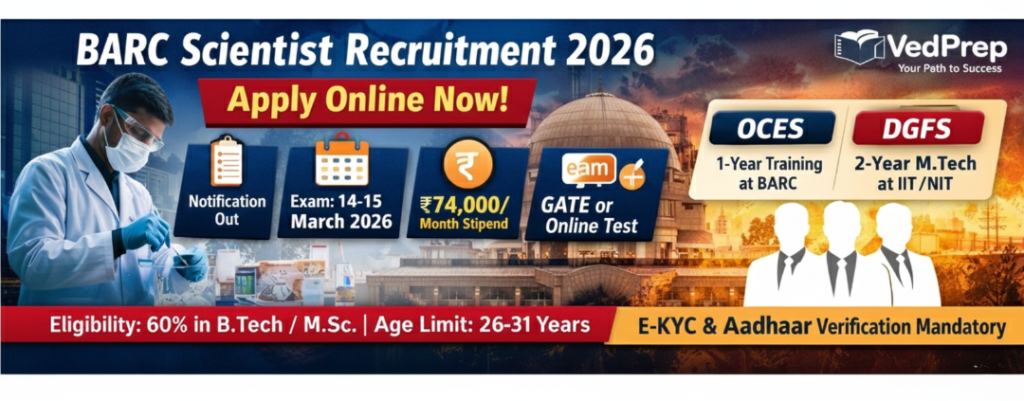
BARC Scientist Recruitment 2026 is announced for Scientific Officer posts. The online application portal opens tentatively on December 22, 2025.Candidates who all are applying for the BARC Scientist Recruitment 2026 will need to visit the official portal at barcocesexam. Do the pre-registration online and get a Portal Registration Number, do the E-KYC using Aadhar, and upload educational transcripts.
The final submission for BARC Scientist Recruitment 2026 must be done along with a non-refundable examination fee of ₹500 for General/OBC male candidates only. All female and SC/ST candidates are exempted from the payment.The online application window closes at 23:59 hours on January 21, 2026. One of the key technical requirements for admission to the 2026 batch is that E-KYC onboarding is mandatory to cross-verify candidate data with Aadhaar records at the time of registration to avoid duplicate profiles.
Candidates have to select one of the three available screening avenues: online exam only, GATE score only, or both.If the choice is “Both,” it automatically considers the higher percentile in short-listing to have maximum chances of receiving an interview call.It is essential that while uploading photos, care is taken that their size is 20KB to 50KB because, in case they are larger, the AI validation system rejects them instantly.
What are the BARC Scientist Recruitment 2026 Eligibility 2026 requirements?
For BARC Scientist Recruitment 2026 candidates must be Indian citizens with a minimum of 60% aggregate marks in a qualifying degree (B.E./B.Tech/B.Sc. Engg/M.Sc.).
As of August 1, 2026, the upper age limit is 26 years for General, 29 for OBC, and 31 for SC/ST. Final-year students graduating in 2025–26 are eligible provided they complete all requirements by July 2026.
| Category | Age Limit (as of Aug 1, 2026) | Educational Qualification |
| General | 26 Years | 60% in B.E./B.Tech or M.Sc. |
| OBC | 29 Years | 60% in B.E./B.Tech or M.Sc. |
| SC / ST | 31 Years | 60% in B.E./B.Tech or M.Sc. |
Specific discipline codes apply: Engineering (Codes 21–28) and Science (Codes 41–46). Note that distance learning or AMIE degrees without a valid M.Tech. are strictly disqualified under 2026 DAE guidelines. For geophysics and geology, mathematics at the B.Sc. level is a mandatory prerequisite regardless of postgraduate specialization.
When is the BARC Scientist Recruitment 2026 Exam Date?
The online screening examination for BARC Scientist Recruitment 2026 shall be conducted on March 14 and March 15, 2026, through CBT in 50+ cities spread all over India. The admit card for registered candidates will be generated between February 15 and February 20, 2026, after the window for application correction.
The exam consists of 100 MCQs to be solved in 120 minutes. For every correct answer, the candidate gets a +3 mark; for every incorrect response, -1 is penalized. The 3:1 negative marking ratio asks for super accuracy, as per the 2026 Competitive Index; the qualifying cutoff for core branches like Mechanical and Electronics ranges from 160 to 185 marks.
How does the BARC DGFS 2026 Apply Online differ from OCES?
The DGFS 2026 (DAE Graduate Fellowship Scheme) is a two-year M.Tech. program at IITs or NITs, whereas OCES is a one-year orientation course at BARC Training Schools. To apply for DGFS online, candidates must first clear the BARC interview and secure an independent M.Tech. admission in a DAE-approved specialization for the 2026–27 session.
While both programs offer a ₹74,000 monthly stipend, DGFS fellows receive additional benefits:
- Tuition Fee Reimbursement: Full coverage of IIT/NIT semester fees.
- Contingency Grant: ₹60,000 per annum for two years.
- M.Tech. Project Funding: Up to ₹400,000 for equipment and consumables.
DGFS is specifically designed for candidates who wish to pursue advanced academic research while maintaining their status as a Scientific Officer. Upon completion, DGFS fellows join DAE units with four additional increments, compared to the 2–3 increments typically awarded to OCES trainees.
Why the “GATE-Only” strategy may fail in 2026
Relying strictly on GATE scores for the recruitment process at BARC is also becoming uncertain due to the increased level of difficulty and cutoffs. Based on the 2025 recruitment cycle, it becomes clear that GATE cutoffs for mechanical were at 820+, while the BARC online exam gave a second chance for those who performed badly at the GATE exam but had sound basic technical foundations.
The BARC online examination requires speed skills and basic knowledge comprehensively (100 questions/120 minutes), which is vastly different from the GATE pattern. Anyone preparing for the BARC online examination feels that the questions are more relevant to the field of reactor engineering and sciences required at the Department of Atomic Energy.
Moreover, from the 2026 notice, it is certain that the selection interview alone warrants the final merit criteria. The screening test scores (online exam or GATE) are not applicable. Hence, inclusion of an online exam as a “mock test” or “backup” option would be a blunder; it must be utilized for a screening interview regardless of GATE performance.
Latest Developments and 2026 Updates
A new “Fast-Track” project funding scheme of ₹4 Lakhs has been introduced for DGFS fellows starting in 2026. Additionally, the stipend has been set to a flat ₹74,000 per month across all training schools. The 2026 cycle also marks the first time E-KYC is mandatory at the registration stage to streamline document verification.
Vedprep Online Courses for BARC 2026
For performing well in the concept-based selection interviews for BARC Scientist Recruitment 2026 and the fast-paced online test, it is necessary to have expert guidance.The Vedprep Online courses are designed with customized modules for physics, chemistry, and the biosciences stream, especially for the BARC OCES 2026 syllabi. The approach is based on the ‘why’ and ‘how’ aspects of technical concepts that form the major area of the legendary 60-minute technical interviews conducted by BARC.
Through the integration of the previous year’s question analysis and mock interview sessions, Vedprep ensures that the aspirants not only become examination ready but also interview ready. It can be any requirement that requires the March 2026 online test or the GATE 2026 score; the secret to a Group A Scientific Officer job lies in proper preparation.
Frequently Asked Questions (FAQs)
When is the last date to apply for BARC Scientist Recruitment 2026?
The last date for online application submission for BARC OCES/DGFS-2026 is January 21, 2026. Candidates must complete their registration and fee payment on the official portal, barcocesexam.in, before 23:59 hours on this date. Late submissions or offline applications are not entertained under any circumstances.
What is the BARC Scientist Exam Date 2026?
The BARC online screening examination (CBT) is tentatively scheduled for March 14 and March 15, 2026. The exam will be conducted in multiple shifts across more than 50 cities in India. Candidates will be able to download their confirm-cum-admit cards between February 15 and February 20, 2026, after selecting their preferred exam slot.
Is GATE 2026 score mandatory for BARC Scientist Recruitment?
No, a GATE score is not mandatory. Candidates can qualify for the selection interview through two parallel channels: the BARC Online Screening Exam or a valid GATE-2024, GATE-2025, or GATE-2026 score. Applicants are strongly encouraged to use both avenues to maximize their chances of being shortlisted.
What is the age limit for BARC Scientist Recruitment 2026?
As of August 1, 2026, the maximum age limit for the General category is 26 years. Age relaxations apply for reserved categories: OBC (Non-Creamy Layer) candidates up to 29 years, and SC/ST candidates up to 31 years. Additional relaxations are available for PwD candidates and dependents of those killed in the 1984 riots.
Can final-year students apply for BARC OCES 2026?
Yes, final-year engineering graduates and science postgraduates who are completing their degrees in the 2025–2026 academic year are eligible to apply. However, their selection is provisional, and they must produce proof of having acquired the qualifying degree with at least 60% aggregate marks by the time of joining in July 2026.
What is the training stipend for BARC OCES/DGFS 2026?
Trainee Scientific Officers (OCES) and DGFS Fellows receive a monthly stipend of ₹74,000 during their training period. OCES trainees also receive a one-time book allowance of ₹30,000. DGFS fellows are further eligible for tuition fee reimbursement and a contingency grant of ₹60,000 per annum to support their M.Tech. project work.
What are the qualifying marks for BARC Recruitment 2026?
A minimum of 60% aggregate marks (or equivalent CGPA as per university rules) in the qualifying degree is mandatory for all disciplines. For science postgraduates (Physics, Chemistry, etc.), this 60% requirement applies to both the B.Sc. and the M.Sc. degrees. There is no relaxation in the minimum percentage for any category.
What is the marking scheme for the BARC Online Exam 2026?
The BARC online exam consists of 100 objective questions to be completed in 120 minutes. The marking scheme follows a +3 for every correct answer and -1 for every incorrect answer format. Questions not attempted do not attract any penalty. The use of a virtual calculator is permitted during the computer-based test.
Is there an application fee for female candidates?
No, female candidates are exempted from paying the application fee for BARC Scientist Recruitment 2026. This exemption also applies to transgender candidates, SC/ST candidates, dependents of Defense Personnel Killed in Action (DODPKIA), and physically challenged (PwD) applicants. Male candidates in General and OBC categories must pay ₹500.
Where will the BARC selection interviews be held?
Selection interviews are typically conducted at the BARC Training School in Mumbai or the AMD Training School in Hyderabad (specifically for Geology). Outstation candidates shortlisted for the interview are eligible for to-and-fro AC-III tier train fare reimbursement via the shortest route.
What is the difference between OCES and DGFS?
OCES is a one-year orientation course conducted directly at BARC Training Schools, while DGFS is a two-year M.Tech. fellowship at prestigious institutes like IITs or NITs. While both lead to appointment as a Scientific Officer, DGFS fellows join the DAE with four increments, whereas OCES trainees typically receive two to three increments based on performance.
Is there a service bond for BARC Scientific Officers?
Yes, all selected candidates must execute a three-year service bond (Indemnity Bond) to serve the Department of Atomic Energy (DAE) after the successful completion of their training. Failure to fulfill this bond requires the candidate to refund the total stipend and allowances received during the training period.
What is the starting salary of a BARC Scientific Officer in 2026?
Upon appointment, Scientific Officers start at Level 10 of the 7th Pay Matrix with a basic pay of ₹56,100. Including three initial increments and allowances like HRA and DA, the total monthly emoluments in Mumbai are approximately ₹1,35,000. They also receive benefits like CHSS (medical), LTC, and performance-linked incentives.
Can I correct errors in my BARC 2026 application after submission?
Yes, a dedicated application correction window will be open from February 7 to February 14, 2026. During this period, candidates can log in to the portal to rectify specific details. However, it is always recommended to double-check all E-KYC and educational data before the final submission on January 21.