




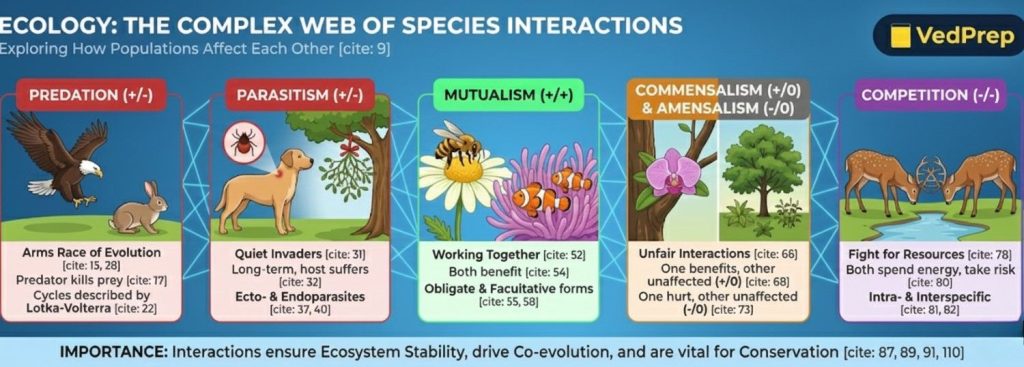

The Complex Web of Life: A Close Look at How Species Interaction in Ecology
In the huge stage of the natural world, no living thing is alone. Every living thing, from the tiny bacteria to the huge redwood tree, is part of a complicated web of relationships. These connections are what keep ecosystems stable, diverse, and changing over time. Today, we’ll look into the interesting ways that species interact in ecology and figure out how they all fit together.
It’s important to understand these interactions whether you’re a student getting ready for a test or someone who loves nature. We will go beyond the basics and look at the different kinds of parasitism, the evolutionary dance of predation, and the peaceful balance of a mutualistic relationship.
1. Learning about how species interaction in ecology
In ecology, species interaction in ecology is how populations of different species in a community affect each other. These interactions are not just random; they are evolutionary forces that change the physical traits, behaviors, and ways of staying alive of living things.
Ecologists usually put these interactions into groups based on how they affect the people involved:
Beneficial (+): The interaction helps the organism live longer or have more offspring.
Detrimental (-): The interaction hurts the organism.
Neutral (0): The interaction does not have a big impact on the organism.
Our competitors may only look at the definitions, but we will go deeper into how these interactions lead to co-evolution, which is when species change in response to each other.
2. Predation: The Arms Race of Evolution in species interaction in ecology
Predation is probably the most extreme way that species interact in ecology. In this biological interaction, one organism, the predator, kills and eats another organism, the prey.
After the Hunt: How Populations Change
It’s easy to think of predation as a simple “eat or be eaten” situation, but it is very important for keeping things in balance. Predators keep prey populations in check so that they don’t use up too many resources. On the other hand, the number of predators depends on how many prey there are.
This interdependence leads to cycles that go up and down, which are often described mathematically by the Lotka-Volterra equations. These equations show how the numbers of predators and prey go up and down in a synchronized, lagging way. For instance, when the number of prey goes up, the number of predators goes up too. When predators eat too much of their prey, the prey population crashes. This makes the predators fewer, which lets the prey recover.
Adaptations: How to Stay Alive
This constant pressure starts an arms race in evolution:
Changes in Predators: Eagle vision, cheetah speed, or praying mantis camouflage.
Prey defenses include chemical toxins (like poison dart frogs), mimicry (like viceroy butterflies that look like toxic monarchs), and mechanical defenses (like porcupine quills).
3. Parasitism: The Quiet Invaders (species interaction in ecology)
Parasitism is a long-term relationship in which one organism (the parasite) benefits at the expense of another (the host). This is different from predation, which is a short, deadly interaction. This is a key area where we can help you learn more than just the basic definitions.
To fully comprehend this interaction, it is essential to examine the various forms of parasitism present in nature.
Putting parasitism into groups
Ectoparasites vs. Endoparasites:
Ectoparasites reside on the exterior of the host. Some common examples are lice, ticks on animals, and mistletoe on trees. They often have special gripping structures that help them hold onto skin or bark.
Endoparasites reside within the host organism. These are often more complicated because they have to deal with the host’s immune system. For example, tapeworms can live in the human intestine, and Plasmodium (the malaria parasite) can live in blood.
Holoparasites vs. Hemiparasites: Holoparasites are plants that have lost all of their chlorophyll and depend on the host for water and nutrients (like Cuscuta or Dodder).
Hemiparasites, such as mistletoe, still have some chlorophyll and can photosynthesize, but they also take water and minerals from the host.
Brood parasitism is a very interesting way for birds to behave. A “parasite” bird lays its eggs in the nest of a “host” bird. The cowbird and the cuckoo are two classic examples. The host bird doesn’t know it is raising the intruder’s chick, and it often loses its own chicks in the process. This keeps the parasite from having to pay for parental care.
Hyperparasitism: Not even parasites are safe! When one parasite infects another parasite, it is called hyperparasitism. For instance, a parasitic wasp may put its eggs inside a parasitic fly that is growing inside a caterpillar.
Learning about these kinds of parasitism shows how adaptable life is. Parasites do more than just “steal” resources; they change how their hosts behave and work in very clever ways.
4. Mutualism: The Strength of Working Together in species interaction in ecology
Mutualism is the mutualistic relationship for opposite of predation and parasitism. It shows the cooperative side of nature. A mutualistic relationship is one in which both species benefit from the connection (++ interaction).
Obligate vs. Facultative Mutualism
Obligate Mutualism: The species need each other so much that they can’t live without each other. The relationship between termites and the protozoa in their guts is a good example. Termites can’t digest wood without them.
Facultative Mutualism: The species gain advantages from the interaction yet can exist autonomously. For instance, honeybees and a number of flowering plants.
Important Examples of Relationships That Help Each Other
Fixing Nitrogen: The mutualistic relationship between leguminous plants (like soybeans) and Rhizobium bacteria is one of the most important for the environment. The bacteria live in root nodules and turn nitrogen from the air into ammonia, which the plant can use as food. The bacteria get carbohydrates from the plant in return. This interaction is very important for the fertility of soil around the world.
Mycorrhizae: Fungi that live with plant roots and help them take in water and phosphorus by extending the roots. The plant’s photosynthesis gives the fungus sugars in return.
Coral Reefs: The bright colors of coral come from tiny algae called Zooxanthellae that live inside coral polyps. The algae use photosynthesis to make food, and the coral gives them a safe place to live and chemicals that help them photosynthesize.
5. Commensalism and Amensalism: The species Interactions in ecology That Aren’t Fair
In ecology, species interactions often have clear winners and losers. However, this is not always the case.
Commensalism (+/0): One species gains an advantage while the other remains unchanged.
For example, orchids and ferns that grow on tropical trees are epiphytes. They get more sunlight without hurting or helping the tree that is hosting them.
For example, cattle egrets look for food near grazing animals. The birds eat the insects that the cows stir up, but the cows don’t get anything out of it.
Amensalism (-/0): One species is hurt while the other stays the same.
For example, the Black Walnut tree releases a chemical called juglone from its roots that stops nearby plants from growing (allelopathy). The Black Walnut isn’t “attacking” them to eat them; it’s just making an exclusion zone as a result of how it breaks down food.
For example, penicillin mold makes antibiotics that kill bacteria that are close by. The mold isn’t necessarily eating the bacteria; it’s just killing them.
6. Competition: The Fight for Resources in species interaction in ecology
People compete for the same limited resources, like food, water, land, or partners. It is a (-/-) interaction because both sides have to spend energy and take on more risk when they compete, even the winner.
Intraspecific Competition: Competition between individuals of the same species. This is often what makes population control based on density work.
Interspecific competition happens when members of different species compete with each other. This can lead to Competitive Exclusion (Gause’s Law), where one species outcompetes and kills the other, or Resource Partitioning, where species evolve to use different parts of a resource to live together (for example, warblers feeding in different parts of a tree).
7. The Importance of species interaction in ecology Interaction for the Environment
Why do we look at how different species interact in ecology? It’s not just about making a list of strange behaviors.
Ecosystem Stability: A strong web is made up of many different interactions. If one predator is taken away, the number of prey animals may skyrocket and strip the plants, which can cause the ecosystem to break down (this is called a Trophic Cascade).
Co-evolution: The hummingbird’s beak and the flower it pollinates have specific shapes that are the result of a long-term relationship that benefits both species. The “arms race” between parasites and hosts is what keeps genetic diversity alive.
Conservation: Knowing that a certain orchid can’t live without a certain fungus or pollinator changes how we think about conservation. We can’t save a species by itself; we have to save how it interacts with other species.
Title: Decode the Graph: Learning Lotka-Volterra and Predator-Prey Dynamics for the CSIR NET
- Unit 10’s “Nightmare”
Intro: Why ecology students are afraid of the math.
Hook: “If you know the trick, it’s the easiest 4 marks you can get.”
- Breaking Down the Equation (Making the Math Easier)
Explain the Prey equation: $\frac{dN}{dt} = rN – aNP$ (Growth minus death by predator).
Please explain the Predator equation: The change in population over time is equal to the number of prey eaten minus the number of natural deaths.
Important Point: In simple terms, what do words like “capture efficiency” mean?
- The Phase-Plane Plot (The Graphs) * This is the most important part. Talk about the circle/cycle graph.
How to read the “Zero Isoclines,” which are the lines where populations stay the same.
VedPrep Tip: “If the arrow points to the right, the prey is getting bigger. If it points up, the predator is getting bigger.
- A solved example (a fake CSIR NET question)
Imagine this situation: “What happens to the predator population if the prey population suddenly doubles?”
Explain the logic to them.
- Call to Action (VedPrep Specific) “Are you having trouble with the biology calculus? At VedPrep, we break down the math behind the life sciences so you don’t just memorize it; you understand also all about species interaction in ecology.
In conclusion
Species interaction in Ecology is the engine of the natural world, from the immune system’s microscopic battles against different types of parasitism to the big migrations caused by predation. These connections are complicated, always changing, and very important for the health of our planet.
We find the fragile balance that keeps life going as we keep looking into these connections. Every interaction adds a stronger thread to the tapestry of life, whether it’s the cold efficiency of a predator or the cooperative bond of a mutualistic relationship.
Not only will you be ready for tests like the CSIR NET if you understand these ideas, but you will also learn to appreciate the invisible connections that are all around us every day.
Frequently Asked Questions (FAQs)
What is species interaction in ecology?
Ans: Species interaction refers to how populations of different species within a community affect one another, serving as evolutionary forces that shape physical traits and behaviors.
How do ecologists categorize these interactions?
Ans: Interactions are grouped based on their effects: Beneficial (+), Detrimental (-), or Neutral (0).
What is co-evolution?
Ans: Co-evolution occurs when species change and evolve in response to each other over time.
Why is it important to save interactions rather than just species?
Ans: Conservation must focus on interactions because many species cannot survive without their specific partners, such as a particular fungus or pollinator.
What role does predation play in an ecosystem?
Ans: Predation keeps prey populations in check, preventing them from exhausting resources and maintaining overall ecological balance.
What are the Lotka-Volterra equations?
Ans: These are mathematical descriptions of how predator and prey populations fluctuate in synchronized, lagging cycles. 7. What does "capture efficiency" mean in these equations? In simple terms, it refers to how effectively a predator can catch and kill its prey
How do prey species defend themselves against predators?
Ans: Prey evolve various defenses, including chemical toxins, mimicry (looking like a toxic species), and mechanical defenses like quills.
How is parasitism different from predation?
Ans: Parasitism is a long-term relationship where the parasite benefits at the host's expense, whereas predation is a short, typically deadly interaction.
What is the difference between ectoparasites and endoparasites?
Ans: Ectoparasites live on the exterior of the host (e.g., ticks), while endoparasites live inside the host (e.g., tapeworms).
What are holoparasites and hemiparasites?
Ans: Holoparasites (like Dodder) lack chlorophyll and depend entirely on the host, while hemiparasites (like mistletoe) can photosynthesize but still take water and minerals from the host.
What is brood parasitism?
Ans: This occurs when a bird (like a cuckoo) lays its eggs in another bird's nest, forcing the host to raise the intruder's chick.
What is hyperparasitism?
Ans: Hyperparasitism is when one parasite is infected by another parasite.
What is the difference between obligate and facultative mutualism?
Ans: In obligate mutualism, species cannot survive without each other; in facultative mutualism, they benefit from the interaction but can live independently.
How do Rhizobium bacteria help leguminous plants?
Ans: They live in root nodules and convert atmospheric nitrogen into ammonia for the plant to use as food, receiving carbohydrates in return.
What are mycorrhizae?
Ans: These are fungi that live with plant roots, helping the plant absorb water and phosphorus while receiving sugars from the plant.




