



Beyond Academia: Unlocking High-Paying PSU Opportunities After CSIR NET
For decades, the narrative surrounding the CSIR NET (Council of Scientific and Industrial Research National Eligibility Test) has been singular: pass the exam, secure a Junior Research Fellowship (JRF), complete a PhD, and enter academia as a professor. While this path is noble and prestigious, it is not the only road available. A silent revolution is happening in the Indian job market. Science graduates are increasingly looking beyond universities and laboratories, turning their gaze toward the industrial giants of the nation the Public Sector Undertakings (PSUs).
PSU opportunities after CSIR NET are becoming one of the most sought-after career trajectories for aspirants in Physical, Chemical, and Life Sciences. These roles offer the perfect blend of scientific rigor, bureaucratic stability, and corporate-level remuneration. However, information about these opportunities is often scattered or overshadowed by the hype around GATE.
In this extensive guide, we will decode the landscape of PSU opportunities after CSIR NET, exploring the roles, the recruitment nuances, and why working for a “Maharatna” might just be the best career move you ever make.
The Paradigm Shift: Why CSIR NET is No Longer Just for Professors
Traditionally, engineering graduates relied on GATE for PSU jobs, while science graduates relied on CSIR NET for PhDs. This line is blurring. Modern PSUs are not just construction or extraction companies; they are technology-driven conglomerates. They require deep research and development (R&D) capabilities to compete globally in renewable energy, material science, and biotechnology.
This shift has created a vacuum for pure science talent. Companies are realizing that while engineers build, scientists innovate. This realization has opened a floodgate of PSU opportunities after CSIR NET. Qualifying for this exam is no longer just a badge of academic excellence; it is a valid scorecard for employability in India’s most profitable government enterprises.
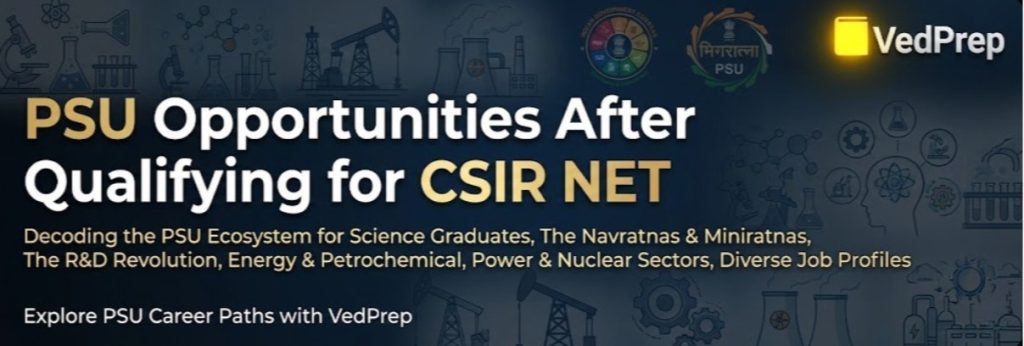
Decoding the PSU Ecosystem for Science Graduates
To understand the PSU opportunities after CSIR NET, one must first understand the hierarchy of these organizations. The government classifies PSUs based on their profit and investment autonomy into Maha ratnas, Nav ratnas, and Mini ratnas.
The Maharatnas (The Giants)
These are the titans of industry (e.g., ONGC, NTPC, IOCL). They have massive R&D budgets and frequently require chemists, geophysicists, and material scientists. Securing a role here is akin to a “government job with a corporate salary.”
The Navratnas and Miniratnas
Companies like OIL (Oil India Limited) or HAL (Hindustan Aeronautics Limited) fall here. While slightly smaller, their specialized focus (e.g., aerospace materials, petrochemical exploration) often aligns perfectly with the advanced syllabus covered in CSIR NET Physical and Chemical Sciences.
The R&D Revolution in the Public Sector for PSU Opportunities after CSIR NET
Unlike private companies that might prioritize immediate profit, PSUs prioritize sustainable growth and national security. This means they invest heavily in long-term research—areas where a CSIR NET qualified candidate shines. Whether it is developing new drilling chemicals for ONGC or analyzing nuclear materials for NPCIL, the PSU opportunities after CSIR NET are intellectually demanding and deeply rewarding.
Top Sectors Offering PSU Opportunities After CSIR NET
The opportunities are not uniform across all subjects. Here is a sector-wise breakdown of where your CSIR NET qualification holds the most weight.
The Energy and Petrochemical Sector
This is the largest employer. Companies like ONGC (Oil and Natural Gas Corporation) and IOCL (Indian Oil Corporation Limited) are prime destinations.
- Role: Chemists, Geologists, and Geophysicists.
- Relevance: For a Chemical Science student, ONGC offers roles that involve analyzing crude oil properties, ensuring quality control, and developing new petrochemical byproducts. For Earth Science candidates, the exploration wings are highly lucrative.
- The NET Edge: While GATE is popular here, specific R&D wings often look for the conceptual depth that comes with CSIR NET preparation, especially for positions that bridge the gap between lab research and field application.
The Power and Nuclear Sector
NTPC (National Thermal Power Corporation) and NPCIL (Nuclear Power Corporation of India Limited) are key players.
- Role: Scientific Officers and Executive Trainees (Science).
- Relevance: Physical Science graduates are vital here. From monitoring radiation levels to managing thermal efficiency in power plants, physics is at the core of these operations.
- Opportunity: NPCIL, in particular, recruits Scientific Officers (Grade C) where a strong grasp of nuclear physics (a core CSIR NET topic) is essential.
The Biotechnology and Pharmaceutical Sector
While fewer in number compared to energy PSUs, organizations like BIBCOL (Bharat Immunologicals and Biologicals Corporation Limited) offer PSU opportunities after CSIR NET for Life Science students.
- Role: Quality Control Managers, Microbiologists, and Research Scientists.
- Relevance: With India becoming the “pharmacy of the world,” public sector vaccine and drug manufacturing units are expanding, requiring top-tier talent from the Life Sciences pool.
Diverse Job Profiles: Beyond the Laboratory
A common misconception is that PSU opportunities after CSIR NET are limited to wearing a white coat and staring at a microscope. The reality is far more dynamic.
Executive Trainees (R&D)
This is the entry-level management role. You aren’t just doing research; you are managing it. You effectively bridge the gap between technical possibilities and business realities. You will oversee projects, manage budgets for lab equipment, and lead teams of technicians.
Technical Officers
In this role, you are the problem solver. If a chemical process in a refinery fails, or a material in a turbine cracks, the Technical Officer analyzes the root cause. This requires the deep theoretical knowledge tested in CSIR NET.
Corporate Communications and Policy
Surprisingly, some PSUs hire science postgraduates to help with technical documentation, patent filing, and science policy. They need people who understand the jargon to communicate technical achievements to the government and the public.
The Recruitment Roadmap: From Notification to Selection in PSU Opportunities after CSIR NET
Navigating the application process for PSU opportunities after CSIR NET can be tricky because it is not as centralized as the academic intake.
Tracking the Notifications
Unlike university admissions which happen cyclically, PSU recruitment is vacancy-based.
- The “Employment News” Hack: Most PSUs are legally mandated to publish vacancies in the “Employment News” weekly gazette. Subscribing to this is a non-negotiable step for serious aspirants.
- Direct Recruitment vs. Score Usage: Some PSUs will conduct their own separate written exam, while others may shortlist candidates directly based on their CSIR NET rank/score for an interview.
The Selection Matrix
The typical weightage for PSU opportunities after CSIR NET often looks like this:
- CSIR NET Score / Written Test: 60% – 85%
- Group Discussion / Group Task: 5% – 10%
- Personal Interview: 10% – 15% This matrix highlights that while your exam score gets you through the door, your personality and ability to apply knowledge determine if you stay.
Why Choose a PSU Over a PhD? (The Comparative Analysis)
This is the dilemma every qualifier faces. Should you spend 5 years on a PhD or join a PSU immediately?
Financial Independence
A JRF stipend is respectable, but a PSU salary is transformative. Entry-level executives in Maharatna PSUs often command a CTC (Cost to Company) ranging from ₹12 Lakh to ₹20 Lakh per annum. This immediate financial leap is a massive draw for PSU opportunities after CSIR NET.
Work-Life Balance and Perks
PhD life is notorious for burnout, with 12-hour days and weekend work. PSUs, being government organizations, adhere to strict labor laws. You generally get fixed working hours, paid leave, medical facilities for your entire family, and housing allowances.
Impact Scale
In a PhD, you solve a micro-problem that may end up in a thesis. In a PSU, your work impacts the nation’s energy security or industrial output. The tangible nature of the work is a significant motivator for those exploring PSU opportunities after CSIR NET.
Myths vs. Reality: Clearing the Air
Let’s address the elephant in the room regarding PSU opportunities after CSIR NET.
Myth: PSUs only hire engineers (GATE). Reality: While engineers are the majority, every engineering process relies on core science. There is a reserved quota and specific departments (Exploration, R&D, Quality Control) that only hire science postgraduates.
Myth: You need a PhD to enter a PSU R&D wing. Reality: While a PhD helps for higher lateral entry, most Executive Trainee positions are designed for MSc graduates who have cleared national level exams like CSIR NET.
Myth: The job is boring and clerical. Reality: Modern PSUs are at the cutting edge. IOCL is working on Hydrogen fuel; NTPC is working on carbon capture. These are frontier science problems requiring agile scientific minds.
How to get the PSU Opportunities after CSIR NET CSIR NET Qualifier
Getting the interview call is half the battle; converting it is the other half. The interview for PSU opportunities after CSIR NET is vastly different from a PhD interview.
Bridging the Theory-Industry Gap
In an academic interview, you are asked about the derivation of a formula. In a PSU interview, you are asked about the application of that formula.
- Example: Don’t just explain Thermodynamics laws; explain how they apply to a heat exchanger in a power plant.
- Strategy: Read the “Annual Report” of the PSU before the interview. Know their current technical challenges.
Soft Skills for Scientific Roles
PSUs look for “officer-like qualities.” They want to know if you can lead a team, handle unionized staff, and work in remote locations. Your technical brilliance must be matched by emotional intelligence.
VedPrep: Your Strategic Partner for PSU Selection
Unlocking PSU opportunities after CSIR NET requires a two-pronged approach: mastering the syllabus to get a high score, and mastering the application of that knowledge to crack the interview. This is where VedPrep steps in as your career catalyst.
Most coaching institutes stop holding your hand once the exam is over. VedPrep believes your journey ends only when you sign an offer letter.
How VedPrep Elevates Your PSU Chances:
- Applied Science Modules: Our study materials don’t just cover the theory; they include “Industrial Application” notes. When you study Organic Chemistry with us, you also learn its relevance in the petrochemical industry, giving you a massive edge in PSU interviews.
- Interview Bootcamp: We offer specialized sessions focused on the PSU interview format. From mock interviews with industry veterans to personality development workshops, we groom you to look and sound like a Scientific Officer.
- Notification Alerts: Never miss a vacancy. The VedPrep ecosystem keeps you updated on niche PSU notifications that often fly under the radar of major job portals.
- Concept Clarity for R&D: The deep conceptual clarity we foster is exactly what R&D wings of organizations like BARC, DRDO, and ONGC look for. We teach you to think like a scientist, not just a student.
With VedPrep, you aren’t just preparing for an exam; you are preparing for a career. Whether you aim for a JRF or a high-flying PSU job, we provide the foundation you need to build your future.
Conclusion
The landscape of employment for science postgraduates in India is evolving. The monopoly of academia is ending, and the era of the “Industrial Scientist” is beginning. PSU opportunities after CSIR NET represent a golden mean—a career path that offers the stability of the government, the salary of the corporate world, and the intellectual satisfaction of science.
Qualifying for CSIR NET is a tremendous achievement, but it is a key, not a destination. You can use that key to open the door to a lab, or you can use it to open the door to a Maharatna boardroom. The choice is yours.
As you prepare for the upcoming exam cycle, broaden your horizon. Don’t just study for the fellowship; study for the industry. Keep an eye on the notifications, tailor your preparation to include practical applications, and believe that your science degree is a powerful ticket to national building.
With the right guidance from platforms like VedPrep and a strategic mindset, one of these coveted PSU opportunities after CSIR NET could be yours. The nation needs its scientists—not just in classrooms, but in the field, driving the innovation engine of India.
Frequently Asked Questions (FAQs)
Are PSU jobs available for CSIR NET qualifiers, or are they only for GATE aspirants?
Ans: While engineering graduates traditionally rely on GATE, there is a "floodgate" of opportunities for science graduates with CSIR NET qualifications, especially in R&D wings of companies like ONGC and NTPC
What types of PSUs hire science graduates?
Ans; Recruiters range from "Maharatnas" (industry titans like IOCL, NTPC) to "Navratnas" and "Miniratnas" (specialized companies like OIL and HAL)
Why are PSUs shifting towards hiring science graduates?
Ans: Modern PSUs are becoming technology-driven conglomerates that require deep Research and Development (R&D) capabilities to compete globally, creating a high demand for pure science talent to innovate.
What are the key sectors offering these opportunities?
Ans: The primary sectors include Energy and Petrochemicals, Power and Nuclear, and the Biotechnology and Pharmaceutical sectors.
What roles are available in the Energy and Petrochemical sector?
Ans: Companies like ONGC and IOCL recruit for roles such as Chemists, Geologists, and Geophysicists for tasks like analyzing crude oil properties and developing petrochemical byproducts.
Which PSUs recruit Physical Science graduates?
Ans: Organizations like NTPC and NPCIL (Nuclear Power Corporation of India Limited) are key recruiters for roles like Scientific Officers, where knowledge of nuclear physics and thermal efficiency is vital.
Are there opportunities for Life Science students in PSUs?
Ans: Yes, organizations like BIBCOL recruit Life Science graduates for roles such as Quality Control Managers, Microbiologists, and Research Scientists, especially in vaccine and drug manufacturing.
What does an Executive Trainee (R&D) do?
Ans: This is an entry-level management role where you oversee projects, manage lab budgets, and bridge the gap between technical possibilities and business realities.
What is the role of a Technical Officer in a PSU?
Ans: A Technical Officer acts as a problem solver who analyzes the root cause of failures, such as chemical process issues or material cracks, using deep theoretical knowledge.
Do PSUs hire for non-lab roles?
Ans: Yes, some PSUs hire science postgraduates for Corporate Communications and Policy roles to handle technical documentation, patent filing, and communicating achievements to the government
ow can I find out about PSU vacancies for CSIR NET qualifiers?
Ans: Since recruitment is vacancy-based, you must track the "Employment News" weekly gazette, where PSUs are legally mandated to publish vacancies.
What is the typical selection process for these roles?
Ans: The selection matrix generally assigns 60-85% weightage to your CSIR NET score or written test, 5-10% to Group Discussion, and 10-15% to the Personal Interview.
What is the salary range for PSU positions?
Ans: Entry-level executives in Maharatna PSUs often command a CTC (Cost to Company) ranging from ₹12 Lakh to ₹20 Lakh per annum.
Is a PhD required to join a PSU?
Ans: This is a myth. While a PhD helps for lateral entry, most Executive Trainee positions are designed specifically for MSc graduates who have cleared national-level exams like CSIR NET.
How does the work-life balance in a PSU compare to a PhD?
Ans: Unlike the potential burnout associated with PhDs, PSUs offer fixed working hours, paid leave, and benefits like medical facilities and housing allowances, adhering to strict labor laws.