




Is CSIR NET Tough? Decoding the Reality of Life Sciences and How to Beat the Odds
If you are a Master’s student or a budding researcher in India, you have likely stood at the edge of a daunting cliff known as the CSIR NET exam. It is the gateway to prestigious Junior Research Fellowships (JRF) and Assistant Professor roles, yet it carries a reputation that scares many away before they even start. You find yourself asking the inevitable question: is CSIR NET tough?
The short answer is yes—but perhaps not for the reasons you think. It is not just about raw intelligence; it is about strategy, endurance, and the ability to navigate an ocean of information without drowning. While recent exam analyses from 2025 suggest a “moderate” difficulty level with cut-offs hovering around 110-115 marks for the General category, the numbers don’t tell the whole story.
In this guide, we will move beyond the basic syllabus lists and exam updates to dissect the nature of this exam’s difficulty. We will explore why the Life Sciences paper specifically feels so overwhelming and how you can shift your mindset from “surviving” to “conquering.”
The Myth of “Impossible”: Is CSIR NET Tough or Just Massive?
When students ask, “is CSIR NET tough?“, they are often conflating difficulty with volume. The CSIR NET Life Sciences syllabus is vast. It covers everything from the microscopic details of Molecular Biology to the macroscopic patterns of Ecology and Evolution.
The “Volume” Trap
The primary reason candidates struggle is the sheer breadth of the curriculum. Unlike the Chemical Sciences, which focuses heavily on application-based questions, or Physical Sciences which is mathematically rigorous, Life Sciences is a unique blend of memory retention and deep analytical reasoning. You are expected to know the enzymes in a replication fork while simultaneously understanding the geological time scale.
However, the “toughness” here is an illusion caused by the belief that you must study everything. You don’t. The exam pattern allows for significant choice. You only need to answer 75 questions out of a total of 145. This internal choice is your biggest weapon. The exam isn’t testing if you know all of biology; it’s testing if you can master specific parts of it deeply.
Deconstructing the Beast: A Section-Wise Difficulty Analysis
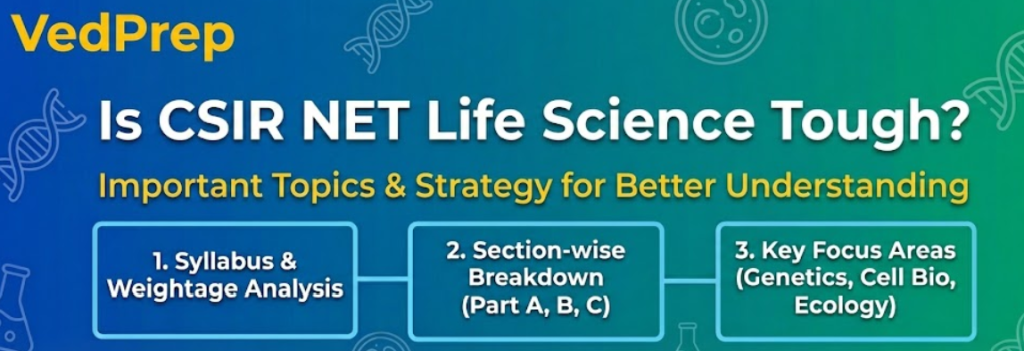
To truly understand if the exam is difficult, we must break it down by its components. The perceived difficulty often stems from mismanaging these three distinct sections, each requiring a different part of your brain.
Part A: The General Aptitude Barrier
Part A is often the most neglected section, yet it is where many “Life Science” purists lose the battle. It tests General Aptitude—puzzles, series, data interpretation, and basic algebra.
- Why it feels tough: Biology students often lose touch with mathematics after high school. Facing questions on probability or compound interest can induce panic.
- The Reality: The difficulty here is usually “Easy to Moderate”. You only need to attempt 15 out of 20 questions. Scoring here is about selecting the low-hanging fruit—graph interpretation or simple series questions—rather than solving complex geometry.
Part B: The Memory Game
Part B contains 50 questions, of which you must attempt 35. This section tests your factual knowledge. Questions here are direct: “Which enzyme does X?” or “What is the secondary metabolite Y?”.
- Why it feels tough: The penalty for guessing is high. Negative marking is 0.5 marks per wrong answer. This section punishes partial knowledge. If you don’t recall the specific factual detail—like the chromosome number in wheat or specific signaling pathways —you cannot deduce the answer.
- The Reality: This section requires precision, not deep analysis. The difficulty lies in retention. If your revision game is weak, Part B will destroy your score.
Part C: The Real “Tough” Factor
This is the heart of the CSIR NET Life Science exam. Part C consists of 75 questions, and you must answer only 25. Each question carries 4 marks.
- Why it feels tough: These are analytical, experimental, and research-based questions. They don’t ask “What is X?”; they ask “If we mutate gene X in condition Y, what happens to Z?”. Recent trends show that Part C is becoming the deciding factor for selection. It requires you to think like a scientist, interpreting graphs and experimental data rather than regurgitating facts.
- The Reality: Ironically, this section can be the easiest for a well-prepared candidate because the choice ratio is so high (25 out of 75). You can skip entire units you are weak in (e.g., Plant Physiology) and still score full marks by focusing on units you love (e.g., Genetics or Cell Biology).
The Psychological Hurdles: Why Aspirants Fail
If the syllabus is manageable via choice and the questions are logical, why is the success rate only around 6-7% for JRF?. The answer to “is CSIR NET tough?” often lies in the psychological and strategic failures of the aspirant.
The “Jack of All Trades” Syndrome
Many students try to cover all 13 units of the Life Science syllabus superficially. In doing so, they fail to develop the depth required for Part C. In the exam hall, they find they can understand the questions but cannot be sure of the options. The exam demands mastery of 6-7 units, not a vague familiarity with 13.
Time Management Paralysis
The exam duration is 3 hours. A common complaint is running out of time, especially given the lengthy, paragraph-style questions in Part C. Candidates often waste the “golden hour” (the first hour) on low-yield questions. Experts suggest tackling Part C first because it carries the highest weightage. Failing to prioritize this section is a strategic error that makes the exam feel impossible.
Fear of Negative Marking
With a negative marking scheme of 25% (0.5 marks in Parts A/B and 1 mark in Part C), anxiety leads to hesitation. Fear forces students to under-attempt or, worse, panic-guess. Understanding the math of risk-taking is crucial.
Comparative Difficulty: CSIR NET vs. The Rest
To gain perspective, it helps to compare this exam with others.
- Vs. GATE: GATE often focuses more on numericals and engineering aspects of biotechnology. CSIR NET is more theoretical and experimental.
- Vs. UGC NET: UGC NET (for non-science subjects) is often considered slightly less grueling in terms of analytical depth compared to the scientific rigor of CSIR NET Part C.
- Vs. University Exams: This is where the shock happens. University exams reward memorization. CSIR NET rewards application. The transition from “learning” to “applying” is the steepest learning curve for most Indian students.
Transforming “Tough” into “Achievable”
So, is CSIR NET tough? It is challenging, yes. It is designed to filter out the top 6-7% of minds for research. But it is not insurmountable. Here is how you change the narrative from “tough” to “qualified.”
Master the “Art of Skipping”
You must learn what not to study. Look at the data from the June 2025 exam: topics like Ecology (Graph interpretation, Logistic growth), Evolution (Geological time scales), and Molecular Biology (Replication, Transcription) were high-yield. Focus your energy there. If you hate Math, skip the complex mathematical units in Life Sciences but ensure you are unbeatable in Cell Biology and Genetics.
2. Practice “Scientific Reading”
Part C questions are essentially mini-research abstracts. You need to train your brain to read scientific text quickly and extract the variable, the control, and the result. Regular practice with previous years’ papers is the only way to build this muscle.
3. Analyze the Cut-Off Trends
Don’t aim for 200/200. You only need about 110-120 marks to be safe for JRF. This means you can afford to lose 80-90 marks! Realizing that you can leave nearly 40% of the paper blank and still top the exam is a massive confidence booster.
Conclusion: Your Mindset Defines the Difficulty
Ultimately, is CSIR NET tough? The exam is a rigorous test of your scientific aptitude, your ability to handle pressure, and your decision-making skills under a time limit. It is not just about what you know; it is about how you use what you know.
The syllabus is vast, the competition is high, and the questions are tricky. But thousands of students—average students who simply planned better—clear this exam every year. They succeed not because they are geniuses, but because they respected the exam’s pattern, focused on their strengths, and didn’t let the “tough” label paralyze them.
Start your preparation by downloading the syllabus , analyzing the previous papers, and building a strategy that works for you. The exam is only as tough as your lack of strategy makes it.
The Mentor’s Perspective (Best for the “About Us” feel)
## The VedPrep Perspective: Is CSIR NET Tough? Not With the Right Map
At VedPrep, we have mentored thousands of students who started with the same fear: “Is CSIR NET tough?” Our philosophy is simple this exam doesn’t test your ability to memorize textbooks; it tests your ability to filter noise.
The syllabus might look like an ocean, but success lies in finding the islands. We believe that CSIR NET is not tough; it is just tricky. With the right mentorship, you stop trying to “finish” the syllabus and start learning how to “exploit” the exam pattern. Whether it is decoding the analytical puzzles of Part C or mastering the quick-math of Part A, VedPrep transforms the daunting “toughness” into a manageable, step-by-step strategy. We don’t just teach you Life Science; we teach you the art of cracking the exam.
For getting more information visit the official site of Vedprep https://www.vedprep.com/
Key Takeaways for Aspirants:
- Focus on Depth over Width: Master 6-7 units completely rather than skimming all 13.
- Respect Part C: It is the kingmaker. Dedicate the majority of your practice time to analytical questions.
- Mock Tests are Non-Negotiable: You must practice time management to ensure you can read and select the right questions.
- Stay Updated: Keep an eye on the official NTA website for the latest pattern changes and exam dates.
Frequently Asked Questions (FAQs)
Is the CSIR NET Life Science exam actually tough?
Ans: Yes, the exam is challenging, but the blog explains that this is not just about raw intelligence. The difficulty stems more from the need for strategy, endurance, and navigating a vast amount of information
What is the recent difficulty trend for the CSIR NET exam?
Ans: Recent analyses from 2025 suggest a "moderate" difficulty level, with cut-offs for the General category hovering around 110-115 marks
Why does the CSIR NET exam have a reputation that scares students?
Ans: The reputation comes from the daunting size of the syllabus ("volume") and the high competition for prestigious JRF and Assistant Professor roles, rather than the impossibility of the questions themselves.
What is the "Volume Trap" mentioned in the blog?
Ans: The "Volume Trap" refers to the misconception that the exam is tough because the syllabus is massive, covering everything from Molecular Biology to Ecology. Students struggle because they try to master the sheer breadth of the curriculum instead of focusing on depth.
Do I need to study the entire syllabus to pass?
Ans: No. The "toughness" is an illusion caused by the belief that you must study everything. The exam pattern offers significant internal choice (answering only 75 out of 145 questions), allowing you to master specific parts deeply rather than covering all 13 units.
Why do Life Science students find Part A (General Aptitude) difficult?
Ans: Many Biology students lose touch with mathematics after high school. Facing questions on probability, compound interest, or algebra can induce panic, even though the actual difficulty level is usually "Easy to Moderate".
What is the best strategy for Part A?
Ans: You only need to attempt 15 out of 20 questions. The strategy is to select the "low-hanging fruit"—like graph interpretation or simple series questions—rather than trying to solve complex geometry problems
Why is Part B called the "Memory Game"?
Ans: Part B tests factual knowledge with direct questions (e.g., "Which enzyme does X?"). It is difficult because it requires precise retention; if you don't recall specific details like chromosome numbers or signaling pathways, you cannot deduce the answer.
What is the risk factor in Part B?
Ans: The penalty for guessing is high with 0.5 marks deducted per wrong answer. This section punishes partial knowledge severely
Why is Part C considered the heart of the exam?
Ans: Part C carries the highest weightage (4 marks per question) and determines selection. It asks analytical, experimental, and research-based questions ("If we mutate gene X..."), requiring you to think like a scientist rather than just recall facts
How can Part C be the "easiest" section for a prepared candidate?
Ans: Part C has a very high choice ratio—you only need to answer 25 out of 75 questions. This allows you to completely skip units you are weak in (like Plant Physiology) and score full marks by focusing entirely on your strong units (like Genetics).
Why is the success rate for JRF only around 6-7%?
Ans: The low success rate is often due to psychological and strategic failures, such as poor time management and the "Jack of All Trades" syndrome, rather than a lack of knowledge.
What is the "Jack of All Trades" syndrome?
Ans: This refers to the mistake of trying to cover all 13 syllabus units superficially. Candidates often fail because they lack the depth required for Part C, meaning they understand the questions but are unsure of the options
What is the common "Time Management Paralysis" students face?
Ans: Candidates often waste the "golden hour" (the first hour) on low-yield questions. Experts recommend tackling Part C first because of its high weightage; failing to prioritize it can make the exam feel impossible to finish
ow does the fear of negative marking affect performance?
Ans: With a negative marking scheme of 25% (0.5 marks in Parts A/B and 1 mark in Part C), anxiety causes students to hesitate, leading to under-attempting or panic-guessing.