




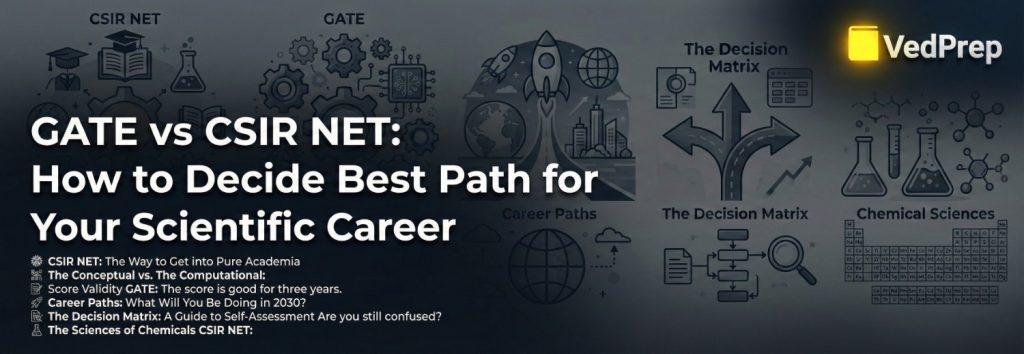

GATE vs CSIR NET: Which is the Best Way to Start Your Scientific Career in 2026?
In 2026, India’s scientific landscape has become a dynamic ecosystem of interdisciplinary research, high-tech industrial use, and strict academic standards. The choice between GATE and CSIR NET is still a tough one for science graduates and postgraduates who are at a crossroads in their careers.
Ten years ago, it was easy to choose: engineering students took GATE and science students took CSIR NET. But now, the lines are less clear. It’s no longer about your degree; it’s about where you’re going. IITs are opening up interdisciplinary departments, and PSUs are hiring MSc graduates.
Choosing the right entrance exam is the first step in your career, whether you want to design the next quantum processor, find a cure for a rare disease, or teach the next generation of scientists. In this long guide, we will go beyond the basic definitions that you can find in regular brochures.
We will look at the GATE vs CSIR NET debate from the point of view of 2026, looking at how the exams are changing, the “Hybrid Ph.D.” culture, and the reality of stipends and salaries. This blog is your guide if you’re not sure which path is right for your DNA.
The Basic DNA: What Are These Tests?
Really You need to know the main idea behind these tests in order to make an informed choice. They are more than just tests; they are ways to separate two very different types of scientific minds.
CSIR NET: The Way to Get into Pure Academia
The Council of Scientific and Industrial Research National Eligibility Test (CSIR NET) is the best test for pure science in India. The Ethos: It checks for “scientific temper.” It’s not enough to just solve a problem; you also need to understand why the problem is happening.
The main goal is to find people who are qualified for the Junior Research Fellowship (JRF) and to make sure they are qualified for Assistant Professorships (Lectureship) at Indian universities.
The National Education Policy (NEP) is now fully in place, and the CSIR NET is the only way for anyone who wants to work in education or pure research labs like CCMB, NCL, or IICB to get in.
GATE: The Pathway to Technical Progress Science students often don’t understand
The Graduate Aptitude Test in Engineering (GATE). The Ethos: It checks for “Application and Precision.” It asks, “You know the science, but can you use it to make a system? “The goal is to get people into Ph.D. programs, but the main selling point is that it lets people go straight into M.Tech degrees and Public Sector Undertakings (PSUs).
In 2026, corporate R&D departments are looking for candidates with an engineering mindset toward science. This is because there are a lot of new Deep Tech and Biotech startups.H2: The 2026 Showdown: A Detailed Comparison Matrix Let’s compare the structure, eligibility, and difficulty of the GATE and CSIR NET tests.
Who can take the CSIR NET?
It’s mostly for M.Sc. students. It includes five main areas: Earth Sciences, Life Sciences, Chemical Sciences, Physical Sciences, and Mathematical Sciences. GATE: Anyone with a B.Tech, M.Sc., or even a third-year undergraduate degree can take it. It has specific papers for Physics (PH), Chemistry (CY), Mathematics (MA), and Life Sciences (XL), as well as niche papers like Biotechnology (BT) and Ecology (EY).
The 2026 Twist: When you compare GATE and CSIR NET, GATE lets you take two papers. A student in an M.Sc. Biotech programs can write both the Life Sciences (XL) and Biotechnology (BT) papers, which gives them twice the chance of passing. This kind of flexibility is not available with CSIR NET.
The Conceptual vs. The Computational:
Exam Pattern This is where the difference really shows. CSIR NET is known for its “Part C,” which has analytical and experimental questions. You can choose what to do, like try to answer 25 out of 75 questions. This lets you use your strengths. You can still do well on the test even if you are not good at Plant Physiology but are good at Molecular Biology.
GATE: There are fewer options. The questions are exact and have numbers. The “Numerical Answer Type” (NAT) questions don’t have any points taken off for wrong answers, but you have to do the maths exactly.
Conclusion: If you are a “Concept Thinker” who likes to look at experiments, CSIR NET is for you. If you are a “Precision Thinker” who knows a lot about numbers and formulas, GATE is for you.
Score Validity GATE: The score is good for three years.
This gives you some extra time. You can pass it in 2026 and start an M.Tech or Ph.D. in 2028. CSIR NET: The JRF award letter is good for two years. The fellowship ends if you don’t sign up for a Ph.D. within that time frame. The Lectureship (LS) certificate, on the other hand, lasts forever.
Career Paths: What Will You Be Doing in 2030?
The choice between GATE vs CSIR NET is really a choice about what kind of job you want to have in the future.H3: The Academic Leader: The CSIR NET Route If you choose CSIR NET, your path will be straight but honourable. As a Ph.D. Scholar, you work in a lab with a JRF (Junior Research Fellowship).Post-Doctoral Fellow: You do advanced research in India or another country.
You can apply to universities (DU, JNU, BHU) or state colleges as an assistant professor. As a scientist, you work in government labs like CSIR, DST, and DBT. Pros: Lots of respect, freedom to think, and chances to teach. Cons: It takes a long time to get a Ph.D. (4 to 6 years), and the job market for permanent faculty positions is very competitive.
The GATE Route: The Technocrat
The GATE vs CSIR NET debate leans heavily toward GATE if you want to work in the field. You can get a Master’s in Technology at IITs or NITs for an M.Tech or M.E. With this degree, you can get high-paying corporate jobs in research and development, data science, and pharmaceuticals.
Companies like ONGC, IOCL, BARC, and DRDO hire scientists and officers based on their GATE scores. These government jobs pay well and have a lot of security. You can skip M.Tech and go straight to a Ph.D. at IITs. Pros: M.Tech/PSU lets you get into the workforce faster, and corporate salaries start off higher. Cons: Not as much emphasis on “pure” biology and chemistry as at CSIR institutes.
The “Ph.D. Dilemma”: Should You Take the GATE or the CSIR NET for Your Doctorate?
This is the most common mistake: Which test is better for getting a Ph.D.? The answer for 2026 depends on where you want to do your Ph.D. CSIR Labs (CDRI, NCL, IGIB): They like CSIR NET JRF better. The fellowship comes straight from CSIR/UGC, which makes you a “free” candidate for the guide (the government pays you, not the lab).
This makes you very attractive. Both IITs and IISc accept them. But GATE is often better for labs that work with more than one field, like Biomedical Engineering or Material Science. Some IITs have “Institute Fellowships” just for people who pass the GATE. The Interview Advantage: In an IIT interview for GATE vs CSIR NET, a high GATE rank (Top 100) is often just as respected as a JRF.
But at a university, JRF is the clear winner.H2: The Real Financial Situation: Stipends, Salaries, and Stability Let’s talk about money. The GATE vs. CSIR NET analysis puts a lot of weight on financial stability.
During the Ph.D. CSIR NET JRF, the stipend was changed to about ₹37,000–₹42,000 per month plus HRA in 2026.
It is a steady source of income. If you join an M.Tech program, you will get a stipend of ₹12,400 per month. If you get into a Ph.D. program through GATE, the institute (MHRD/MoE) will pay you the same amount as the JRF (₹37,000+).Main Difference: You can take your money with you when you use the JRF. The GATE fellowship is linked to the school.
Pay for Jobs PSU (through GATE):
Starting salaries in 2026 will be between ₹12 LPA and ₹18 LPA.
Assistant Professor (via CSIR NET): The starting salary for this job is between ₹85,000 and ₹1,10,000 per month (7th/8th CPC).
Corporate R&D (through GATE M.Tech): Very different, but the best IIT graduates in Biotech/Chem Engineers can make between ₹15 LPA and ₹25 LPA.
The Decision Matrix: A Guide to Self-Assessment Are you still confused?
This personality test will help you decide for yourself which is better: GATE vs CSIR NET. Pick CSIR NET as your trait If…Pick GATE if your main goal is to teach or do basic research. Research and development in the industry, public sector units, or engineering. Strength of the Subject You enjoy theory, reading a lot, and testing out ideas. You like formulas, numbers, and solving problems quickly.
Level of Patience: High. You are willing to spend 5 or more years on a Ph.D. You might want a job after two years of M.Tech. Geography You want to work at colleges and universities all over India. You want to go to the best tech schools, like IITs or IISc. Math You are “okay” with basic maths (Part A). You are good at calculus and math for engineering.H2: Differences in 2026 for Each Subject The GATE and CSIR NET numbers are different for each subject.
Life Sciences / Biotechnology CSIR NET:
There are a lot of units in the syllabus (13). It needs a lot of knowledge. Best for students majoring in botany, zoology, or biochemistry. GATE (BT/XL): The syllabus is short. Ideal for students of Biotechnology and Microbiology. The GATE BT score will be very important for biopharma jobs in 2026.
The Sciences of Chemicals CSIR NET:
Concentrates on organic mechanisms and inorganic trends. GATE: A lot of its questions are about Physical Chemistry and Thermodynamics. GATE is a nightmare if your Physical Chemistry is weak, but CSIR is doable.
Physical Sciences CSIR NET:
Tests deep theoretical physics. GATE: Tests physics in real-world situations (Electronics, Solid State devices). A lot of people get jobs at BARC and DRDO through GATE Physics.
Is it possible to target both?
The “Hybrid Strategy” for 2026Putting all your eggs in one basket is dangerous in today’s competitive market. The smartest students use a “Hybrid Strategy.” There is about a 60–70% overlap in the syllabi, so it is possible to pass both.
The Plan: Core Foundation: Get ready for CSIR NET first. It has a wider range of topics and goes into more detail on the basics. This covers 80% of the GATE material.
The Math Bridge: Spend two months just on “Engineering Mathematics” and “General Aptitude” for GATE. These are harder than CSIR’s Part A.
Practice with numbers: Change modes. When you study for CSIR, pay attention to the big ideas. When studying for the GATE, pay attention to the calculator. Practice NAT questions with the virtual calculator. It’s not about choosing between GATE vs CSIR NET; it’s about putting one first and keeping the other as a strong backup.
Common Myths Busted Myth:
“GATE is only for engineers. “Fact: No. M.Sc. students do very well on the GATE Science papers. IITs like M.Sc. Students who want to get a Ph.D. “CSIR NET is harder than GATE” is a myth. They are tough in different ways, that’s a fact. CSIR is hard because there is a lot of it and it’s not clear. GATE is hard because you have to be exact and work quickly.
“I can’t get a job with CSIR NET” is a myth. It’s true that CSIR doesn’t directly lead to PSUs, but the Ph.D. you get through it does lead to high-level scientist jobs in both the government and the private sector.
VedPrep: Your Guide to Competitive Excellence It’s tiring to find your way through the GATE vs CSIR NET maze.
The syllabus is long, the competition is tough, and your career is on the line. If you want to become a Professor through CSIR NET or a Technocrat through GATE, you need a partner who knows the ins and outs of 2026. VedPrep is here to help. We don’t just offer courses at VedPrep; we also offer career paths. We know that a student getting ready for the GATE and GATE vs CSIR NET the CSIR NET needs different tools for each test.
How VedPrep Helps You Solve the Problem Dual-Focus Modules:
Our one-of-a-kind curriculum design divides subjects into “Conceptual” (for CSIR) and “Computational” (for GATE). You can switch between modes to make sure you’re ready for the descriptive nature of NET and the numerical nature of GATE.
The “Part C” Mastery: Our special modules on Research Aptitude and Experimental Analysis make it easy for CSIR NET candidates to pass the hardest part of the test.
The Virtual Calculator Training: For people who want to take the GATE exam, we give them a lot of practice with the interface and virtual calculator to help them make fewer mistakes that can cost them points.
Advice from Double-Rankers: Get advice from people who have passed both tests. They give you the real-world “Hybrid Strategy” that books can’t teach you. You don’t have to choose between quality and coverage with VedPrep. We give you the power to go for both JRF and AIR-1 at the same time. You should have the best launchpad for your scientific goals.
Final Thoughts
The discussion about GATE vs CSIR NET isn’t about which test is better; it’s about which test is better for you. The scientific community values specialization in 2026.If you love solving problems, spending long hours in the lab, and teaching the next generation in the classroom, choose CSIR NET. It is the way of the student. If you want to find answers, be more productive, and work in an industrial setting, choose GATE.
It is the way of the person who comes up with new ideas. In the end, both paths lead to the top of scientific excellence. The syllabus is only the beginning; your hard work is what keeps it going. Think about your strengths, picture your goal for the next ten years, and choose your battlefield. The only way to fail is to not try, whether it’s GATE vs CSIR NET.
Get ready, make smart choices, and let your science make the world a better place.
Frequently Asked Questions (FAQs)
What is the fundamental difference between the career paths for GATE and CSIR NET?
Ans: CSIR NET is the pathway to pure academia, qualifying you for Junior Research Fellowships (JRF) and Assistant Professorships. GATE is the route to technical progress, leading to M.Tech degrees, jobs in Public Sector Undertakings (PSUs), and corporate R&D.
Who is eligible to take the CSIR NET and GATE exams?
Ans: CSIR NET is primarily designed for M.Sc. students. GATE is open to a wider range of candidates, including those with B.Tech, M.Sc., or even third-year undergraduate degrees.
Can I appear for more than one paper in GATE 2026?
Ans: Yes, GATE allows candidates to take two papers. For example, an M.Sc. Biotech student can write both the Life Sciences (XL) and Biotechnology (BT) papers to double their chances of success.
How does the exam pattern differ between the two?
Ans: CSIR NET focuses on "scientific temper" with analytical questions in "Part C" where you have choices (e.g., answer 25 of 75). GATE focuses on precision with "Numerical Answer Type" (NAT) questions that require exact calculations.
How long are the scores valid for?
Ans: A GATE score is valid for three years. For CSIR NET, the JRF award letter is valid for two years, while the Lectureship (LS) certificate is valid for a lifetime
Which exam is better if I want a high-paying job immediately?
Ans: GATE is better for immediate high-paying jobs in PSUs (starting 12–18 LPA) or corporate R&D (15–25 LPA for top graduates).
Is there a difference in the PhD stipend received through GATE vs. CSIR NET?
Ans: The amount is generally the same (approx. ₹37,000+ per month). However, CSIR NET JRF is a "free" fellowship paid by the government, making you attractive to labs, whereas GATE fellowships are often linked to the institute's funding.
Is it true that GATE is only for engineers?
Ans: No, this is a myth. M.Sc. students perform very well in GATE Science papers, and IITs welcome M.Sc. students for PhD programs.
Can I prepare for both exams at the same time?
Ans: Yes, a "Hybrid Strategy" is recommended because there is a 60–70% overlap in the syllabi. You should prepare for CSIR NET to build a core foundation and focus on Engineering Mathematics and Aptitude specifically for GATE.
Which exam is easier for someone who is strong in Physical Chemistry?
Ans: CSIR NET is generally more doable. GATE can be a "nightmare" if your Physical Chemistry is weak because it asks many questions on Thermodynamics and Physical Chemistry