



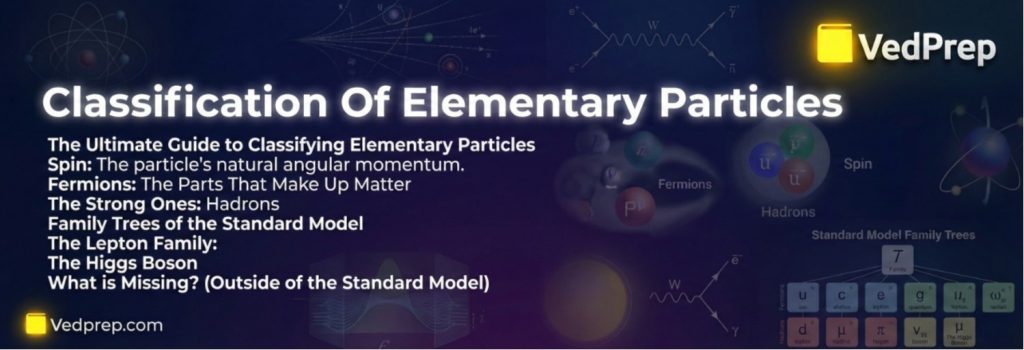

The Ultimate Guide to Classifying Elementary Particles
The answer to the question “What is the universe made of?” depends on how closely you look. We find elementary particles when we look at things that are $10^{-15}$ meters or smaller. We don’t know of any smaller parts that can be broken down into these things. They are point-like and don’t have any internal structure, but they have the properties that all matter and energy have.
High Energy Physics or Particle Physics is the name of the field that studies these things. Physicists have created a strong classification system to help them understand the many particles that have been found in accelerators over the last hundred years.
The Philosophy of Classification: How We Sort Things We Can’t See in Elementary particles
We need to know how physicists group these basic particles before we can talk about names like “quark” or “lepton.” At first, people tried to group them by mass into three groups: light particles (leptons), medium particles (mesons), and heavy particles (baryons). This is interesting from a historical point of view, but modern physics sorts them based on two more basic properties:
Spin: The particle’s natural angular momentum.
Interactions: The particle “feels” one of the four basic forces.
This modern method shows the basic symmetries of nature by separating “matter” particles from “force” particles.
Fermions and bosons are two types of particles that can be classified by their spin.
“Spin” is a quantum mechanical property that divides elementary particles into two main groups. Picture a ball spinning on its axis. Now forget that picture, because quantum spin is not something that happens; the particle doesn’t actually spin, but it acts like it has angular momentum.
Fermions: The Parts That Make Up Matter
Fermions are what make up the universe. They have half-integer spin, which means their spin is 1/2, 3/2, 5/2, etc.
The Loner Personality: Fermions follow a rule known as the Pauli Exclusion Principle. This principle says that two fermions can’t be in the same quantum state at the same time. This “antisocial” behavior is very important because it stops all the electrons in an atom from falling to the lowest energy level. It makes the structure of electron shells, which is what makes chemistry, biology, and us possible.
Fermions include electrons, protons, neutrons, and quarks.
Bosons: The People Who Carry the Force
Bosons are what keeps the universe together. They have integer spin, like 0, 1, 2, etc.
The Party Personality: Bosons do not follow the Pauli Exclusion Principle. You can put an unlimited number of bosons in the same quantum state. This lets them carry forces and move energy between particles of matter. It also makes things like lasers (coherent photons) and superfluidity possible.
Photons (light), gluons (strong force), and the Higgs boson are all examples.
The Four Fundamental Forces: A Way to Sort by Interaction
A more descriptive way to sort elementary particles is to ask, “Who do they talk to?” In physics, “talking” means interacting through one of the four basic forces: the strong nuclear force, the weak nuclear force, the electromagnetic force, and gravity.
The Strong Ones: Hadrons
Quarks make up hadrons, which are composite particles. They are defined by how well they can feel the Strong Nuclear Force. People often talk about them in this way because they were once thought to be “elementary particles,” even though they are not technically “elementary particles” because they are made of quarks.
Hadrons are split up even more into:
- Baryons: Three quarks make it up. They are fermions. Protons ($uud$) and neutrons ($udd$) are two of the most well-known examples.
- Mesons: They are made up of one quark and one antiquark. They are bosons. Pions ($\pi$) and Kaons ($K$) are two examples.
- Leptons: The Light Travelers
Leptons are very basic particles. They don’t feel the strong nuclear force10. They can only interact with each other through the Weak force, Electromagnetism (if charged), and Gravity.
The Greek word “lepton” means “light” or “small,” but the Tau lepton is actually very heavy.
Important Feature: They are alone. Quarks are always found in groups, but leptons can move around freely in space.
A Deep Dive into the Family Trees of the Standard Model
In particle physics, the Standard Model is like the periodic table. It puts all known elementary particles into groups, or “generations.”
The Fermions, which are the matter particles
There are two types of matter particles: quarks and leptons. There are three generations in each group, and each one is heavier and less stable than the one before it.
1. The Family of Quarks
Quarks are strange. “Color confinement” is a phenomenon that keeps them from being alone.
There are six “flavors” of them:
- Generation I: Up ($u$) and Down ($d$). These are the most stable and lightest. They are what make up protons and neutrons, which make up all normal matter.
- Generation II: Charm ($c$) and Strange ($s$). Heavier and not stable.
- Generation III: Top ($t$) and Bottom ($b$). The Top quark is the heavyweight champion because it has a mass similar to that of a tungsten atom.
Quarks are the only particles that have fractional electric charges, either $+2/3$ or $-1/3$.
2. The Lepton Family:
There are three types of leptons, and each one has a charged particle and a neutral “ghost” particle called a neutrino.
- Generation I: Electron (e−) and Electron Neutrino (νe). The electron is what makes electricity and chemistry work.
- Generation II: Muon ($\mu^-$) and Muon Neutrino ($\nu_\mu$). The muon is like an electron that is heavy but breaks down quickly.
- Generation III: Tau ($\tau^-$) and Tau Neutrino ($\nu_\tau$). The lepton with the most weight.
Neutrinos are very interesting basic particles. They have very little mass, move close to the speed of light, and go through Earth by the trillions every second without hitting anything.
The Gauge Bosons, also known as the Force Carriers
How does an electron “know” to push away another electron? They trade gauge bosons, which are very small particles.
Photons ($\gamma$) are what carry the electromagnetic force. It has no mass and can go on forever. It is in charge of light, radio waves, and holding atoms together.
Gluon ($g$): The particle that carries the Strong force. It “glues” quarks together in protons and neutrons.
The Weak force is carried by W and Z Bosons. These are heavy, unlike photons. They are what makes the sun burn and what causes radioactive decay (like beta decay).
The Higgs Boson
The Higgs Boson ($H$) is a scalar boson (spin 0) that is often called the “God Particle” in the news. Finding it in 2012 confirmed how other elementary particles get their mass. Electrons would move at the speed of light, and atoms would never be able to form without the Higgs field.
The Mirror World: Particles and Their Opposites
Nature has made an antiparticle for each of the particles listed above.
Antiparticles have the same mass and spin as their counterparts, but their electric charge and other quantum numbers are the opposite.23232323.
- Electron → Positron ($e^+$) with a positive charge.
- Proton → Antiproton (Negative charge)
Quark to antiquark.
When a particle and its antiparticle meet, they destroy each other right away, releasing pure energy in the form of photons. Physics says that this is the most efficient way to release energy ($E=mc^2$).
It’s important to remember that some neutral particles, like the photon and the $\pi^0$ meson, are their own antiparticles.
Conservation Laws: More Than Just the Basics
When elementary particles interact or break down, they don’t just do what they want. They follow strict rules known as laws of conservation.
Energy and momentum are always kept the same.
- Charge: The total amount of electric charge must stay the same before and after an interaction.
- Baryon Number: The number of baryons must not change. This is why protons (the lightest baryons) are stable: they can’t decay into anything lighter while keeping the baryon number the same.
- Lepton Number: The amount of leptons in a reaction stays the same. When an electron is made, an anti-electron neutrino usually comes along to balance out the “electron-ness.”
Strangeness is a special property that is kept in strong interactions but broken in weak interactions. This is why “strange” particles, which have strange quarks in them, live much longer than you might think before they break down.
What is Missing? (Outside of the Standard Model)
Our classification of elementary particles is strong, but it is not full.
We think there is a boson for gravity called the Graviton (spin 2), but we haven’t found it yet.
Dark Matter: The universe is mostly made up of matter that we can’t see. Is there a “Dark Fermion” or “Dark Boson”?
Some theories say that every fermion has a boson partner and vice versa (Selectrons, Photinos), which would double the number of elementary particles.
Learn everything there is to know about Elementary particles physics with VedPrep.
The world of elementary particles is interesting, but let’s be honest: it can be too much. If you’re getting ready for competitive tests like GATE Physics, CSIR NET Physical Sciences, or JEST, just knowing the names of quarks isn’t enough. You need to know the selection rules, be able to figure out threshold energies, and understand deep symmetries like Isospin and Parity.
This is where VedPrep helps you succeed.
We don’t just tell you to memorize the particle zoo at VedPrep; we also show you how and why it works.
Learning in a structured way: Our modules make High Energy Physics easier to understand by breaking it down into smaller parts, from the simple quark model to the more complex Gell-Mann–Nishijima formulas.
Exam-Focused Approach: We talk about the specific topics that come up often on the CSIR NET, like breaking the law of conservation and the validity of decay reactions.
Visual and Conceptual Clarity: Elementary Particles physics is hard to understand. Our knowledgeable teachers use simple diagrams and comparisons to help students understand ideas like “spin” and “helicity.”
VedPrep is the way to go if you can’t tell the difference between a Meson and a Baryon or if you need help with hard reaction probability problems. Don’t be scared by how complicated elementary particles are. With VedPrep, you can make this hard subject your best unit.
In conclusion
One of the smartest things people have ever done is to put elementary particles into groups. We have taken off the layers of reality to show that Quarks, Leptons, and Bosons are the basic building blocks.
These basic particles move in time with the four basic forces. For example, the electrons that flow through your phone and the neutrinos that pass through your body. The Standard Model is the best map we have right now, but the journey is far from over. There are still questions about dark matter and gravitons that need to be answered, so the next big discovery in physics could be just around the corner, and you might be the one who makes it.
You are not only learning physics by understanding these basic categories; you are also learning the language of the universe itself.
Frequently Asked Questions (FAQs)
What defines an "elementary" particle?
Ans: Elementary particles are point-like objects found at scales of $10^{-15}$ meters or smaller1111. Unlike atoms or protons, they do not have any internal structure and cannot be broken down into smaller parts2.
What are the two main properties used to classify particles in modern physics?
Ans: While historical methods grouped them by mass, modern physics sorts particles based on Spin (natural angular momentum) and Interactions (which of the four forces they "feel").
What is the fundamental difference between Fermions and Bosons?
Ans: The primary difference is Spin:
-
Fermions have half-integer spin ($1/2$, $3/2$, etc.) and make up matter4.
-
Bosons have integer spin ($0$, $1$, $2$, etc.) and act as force carriers5.
What is the Pauli Exclusion Principle?
Ans: This is a rule followed by Fermions which states that two fermions cannot occupy the same quantum state at the same time. Bosons do not follow this rule, allowing them to crowd together (essential for lasers).
What are Hadrons?
Ans: Hadrons are composite particles made of quarks that are defined by their ability to feel the Strong Nuclear Force. They are further divided into Baryons and Mesons.
How do Baryons differ from Mesons?
Ans:
- Baryons are Fermions made of three quarks (e.g., Protons $uud$, Neutrons $udd$)10.
-
Mesons are Bosons made of one quark and one antiquark (e.g., Pions, Kaons)11.
How many "flavors" of quarks are there?
Ans: There are six flavors of quarks arranged in three generations: Up ($u$), Down ($d$), Charm ($c$), Strange ($s$), Top ($t$), and Bottom ($b$)12121212.
What is "Color Confinement"?
Ans: Color confinement is a phenomenon that prevents quarks from ever being found alone; they are always grouped together.
What are Leptons and how are they different from Quarks?
Ans: Leptons are "loner" particles that do not feel the strong nuclear force and can move freely in space. Unlike quarks, they do not have fractional electric charges.
What are Neutrinos?
Ans: Neutrinos are neutral "ghost" particles found in the Lepton family. They have very little mass, travel near the speed of light, and can pass through the Earth by the trillions without hitting anything.
What is the Standard Model?
Ans: The Standard Model is like the periodic table for particle physics; it groups all known elementary particles into "generations".
What are Gauge Bosons?
Ans: Gauge bosons are small particles that act as "force carriers". They allow matter particles to interact, such as electrons repelling each other.
Which boson carries the Electromagnetic force?
Ans: The Photon ($\gamma$) carries the electromagnetic force21. It has no mass and is responsible for holding atoms together22.
What do the W and Z bosons do?
Ans: These heavy bosons carry the Weak force. They are responsible for radioactive decay (like beta decay) and the sun's burning.
What is the Higgs Boson?
Ans: Often called the "God Particle," the Higgs Boson ($H$) is a scalar boson (spin 0) confirmed in 201225. It is crucial because the Higgs field gives other elementary particles their mass26.