





The CSIR NET Life Sciences exam is one of the hardest and most respected competitive tests in India. If you want to be a Junior Research Fellow (JRF) or an Assistant Professor at one of India’s best universities, you need to pass the CSIR NET Life Sciences 2026 exam.
But is hard work enough on its own? No, the answer is a resounding no. It is almost impossible and not very useful to try to cover all 13 units in 100% depth because the syllabus is so big. “Strategic Depth over Superficial Width” is the real key to success. In this final guide, we’ll look at the top 10 high-weightage units that will help you do well on the 2026 exam.
1. Learning about the CSIR NET Life Sciences 2026 Pattern
We need to know how the examiner thinks before we start working on the units. There are three clear parts to the paper:
Part A: General Aptitude (math, logical reasoning, and graphical analysis).
Part B: Questions about factual memory (basic biology ideas).
Part C: High-level analytical questions that require scientific thinking and research-based logic.
Part C is the most important part of the JRF, so you need to focus on it the most. This is where your “Top 10 Units” strategy will be most useful.
2. Why choosing the right unit is so important for 2026
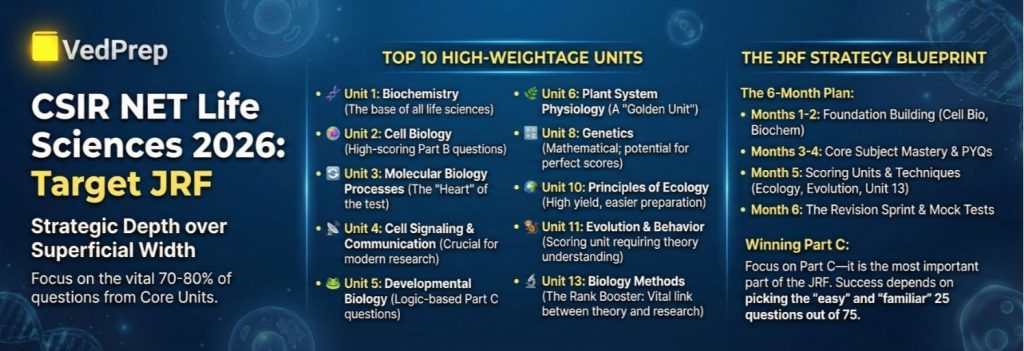
There are 13 units in the syllabus. Examining the papers from the last ten years shows that about 70–80% of the questions always come from certain “Core Units.” When you plan for the CSIR NET Life Sciences 2026, you need to know the difference between “High-Yield” and “Low-Yield” topics so you can make the most of your study time.
3. Take a closer look at the top 10 units with the most weight
Unit 1: Molecules and How They Work Together Biochemistry is important for biology.
Biochemistry is the base of all life sciences. If you don’t take this unit, you won’t be able to understand the complexities of Molecular Biology or Cell Biology.
Main topics: Protein structure (the Ramachandran Plot), enzyme kinetics (V_{max} and K_m), thermodynamics, and metabolic pathways (glycolysis, the TCA cycle, and oxidative phosphorylation).
Prep Tip for 2026: Pay a lot of attention to math problems about pH, buffers, and amino acid titration.
Unit 2: Cell Biology and the Organization of Cells
This unit talks about how the cell works on the inside.
Plasma membrane dynamics, protein trafficking (the secretory pathway), cell cycle regulation (cyclins and CDKs), and microbial fermentation are all important areas of study.
Importance for strategy: Part B questions are often straightforward, which makes this a high-scoring unit.
Unit 3: Basic Processes in Molecular Biology
The “Heart” of the CSIR NET test. You can’t pass the JRF without knowing this unit inside and out.
The main things to focus on are DNA replication, transcription, translation, and DNA repair mechanisms in both prokaryotes and eukaryotes. People have always liked the Lac and Trp operon models.
2026 Trend: Expect more questions about gene silencing and RNA interference (RNAi).
Unit 4: Cell Signaling and Communication
This unit is not only important for getting a good grade, but it is also important for understanding modern research.
Main topics of study: GPCR pathways, RTK signaling, cancer biology (oncogenes vs. tumor suppressor genes), and immunology (innate and adaptive immunity, MHC molecules).
Keep in mind that cell junctions and the extracellular matrix (ECM) are small but common topics.
Unit 5: Biology of Development
This unit’s hard, logic-based questions are often in Part C.
Key Focus Areas: The ABC model of plant floral development, embryonic development in Drosophila, C. elegans (vulva formation), and amphibian development.
Visual Strategy: To remember things, practice drawing lineage maps and signaling gradients.
Unit 6: Plant System Physiology
This is a “Golden Unit” for students who have studied Botany or Agriculture.
Main areas of interest: photosynthesis (C3, C4, CAM), nitrogen metabolism, and plant hormones (auxin, gibberellin, ABA, and ethylene).
Getting ready for 2026 Tip: Pay extra attention to the “Stress Physiology” section because it has been getting more questions lately.
Unit 8: Genetics and Inheritance Biology
Genetics is a field of math. You can get a perfect score in this section if you understand the ideas.
Important topics include Mendelian genetics, pedigree analysis, gene mapping (three-point cross), and chromosomal aberrations.
Vedprep Insight: Quickly solve complicated genetic crosses by using probability rules.
Unit 10: Principles of Ecology
Ecology has a higher yield and is easier to get ready for than Molecular Biology.
Population growth curves (exponential and logistic), r/K selection theory, community ecology, and island biogeography are some of the main topics of study.
Importance: Usually gets 20–30 points in Part C with logic that isn’t too hard.
Unit 11: Behavior and Evolution
This is a scoring unit like Ecology that needs a good understanding of theories.
Natural selection, phylogenetic trees (cladograms), altruism (Hamilton’s Rule), and Hardy-Weinberg Equilibrium are some of the most important things to learn about.
Tip: If you know how to use cladograms, you’ll definitely get at least one 4-mark question in Part C.
Unit 13: Biology Methods (Techniques)
This is often thought to be the hardest unit, but it is the most important part of Part C.
Some of the most important areas of study are recombinant DNA technology, PCR, NMR, mass spectrometry, chromatography, and microscopy.
Vedprep says that instead of memorizing, you should learn the Principle and Application of each technique.Expanded Section: Unit 13: The Rank Booster: Methods in Biology
Unit 13 is more than just a chapter in the CSIR NET Life Sciences 2026; it is the link between what you learn in theory and what you do in research. Part C of the paper usually has 8 to 10 questions from this unit, and they are often mixed with ideas from Molecular Biology and Biochemistry.
DNA technology that is recombinant
This is the most important part of biotechnology. To do well on the 2026 exam, students need to focus on:
Restriction Endonucleases: Learn about Type II enzymes and how to figure out how often restriction sites occur.
Vector Systems: A comparison of plasmids, phagemids, BACs, and YACs based on how much they can hold.
Selection Markers: How antibiotic resistance markers and blue-white screening work in a lab.
Biophysical Techniques (Spectroscopy & Microscopy)
Physics-based biology is hard for a lot of people who want to study it, but these are good topics to study:
Molecular Analysis: Concentrate on the uses of Circular Dichroism (CD) for identifying protein secondary structure and NMR for 3D protein folding.
Microscopy: Learn the differences between SEM and TEM. Pay close attention to Confocal Microscopy and Fluorescence Resonance Energy Transfer (FRET) in 2026, as they are becoming more popular in recent papers.
Using Statistics in Biology
You don’t have to be good at math, but you do need to know:
Binomial, Poisson, and Normal distributions are all types of probability distributions.
Tests of Importance: When to use a t-test instead of a Chi-square test. In research-based questions, CSIR often wants to know the “Null Hypothesis.”
4. The 6-Month Master Plan for CSIR NET Life Sciences 2026
Phase 1: Months 1-2 (Foundation Building)
Begin with Cell Biology and Biochemistry. Use Vedprep’s video lectures or standard textbooks. Create “Flashcards” for amino acids and metabolic enzymes.
Phase 2: Months 3-4 (Core Subject Mastery)
Tackle Molecular Biology, Genetics, and Cell Signaling. This is the time to start solving Previous Year Questions (PYQs). Analyze why an option is wrong, not just why one is right.
Phase 3: Month 5 (Scoring Units & Specialized Techniques)
Cover Ecology, Evolution, and Unit 13. These units are best studied closer to the exam so the facts remain fresh in your memory.
Phase 4: Month 6 (The Revision Sprint)
Do not pick up any new topics. Focus entirely on revision and full-length Mock Tests. In CSIR NET Life Sciences 2026, time management will be the difference between a LS (Lectureship) and a JRF.
5. Recommended Reference Books for CSIR NET 2026
Biochemistry: Lehninger Principles of Biochemistry
Molecular Biology: Watson / Lodish
Cell Biology: Bruce Alberts (The “Bible” of Cell Bio)
Plant Physiology: Taiz and Zeiger
Genetics: Snustad & Simmons
Quick Revision: Pathfinder Publication Life Sciences parts 1 & 2.
6. Pro-Tips for Success in CSIR NET 2026
Print Your Syllabus: Keep it on your desk. Strike off topics as you finish them—it provides a psychological boost.
The Art of Selection (Part C): You only need to answer 25 out of 75 questions. Success depends on picking the “easy” and “familiar” questions.
Minimize Negative Marking: Accuracy is more important than the number of attempts.
Stay Updated with Vedprep: Regular mentorship and structured test series can increase your preparation speed by 2x.
7. Conclusion: Your JRF Dream is Within Reach
Cracking CSIR NET Life Sciences 2026 is not an impossible feat; it is a game of strategy. By mastering these Top 10 High-Weightage units, you are not just aiming to pass—you are aiming for a top rank. Remember, the journey of a thousand miles begins with a single, well-planned step tools.
Frequently Asked Questions (FAQs)
Do I need to cover all 13 units to crack the CSIR NET Life Sciences 2026 exam?
Ans: No, it is almost impossible and not very useful to try to cover all 13 units in 100% depth. Focusing on high-weightage "Core Units" that make up 70-80% of the questions is a better strategy.
What is the "Strategic Depth over Superficial Width" philosophy?
Ans: This philosophy suggests that instead of studying everything superficially, you should focus on the "Core Units" and study them in depth to ensure success.
What is the structure of the CSIR NET Life Sciences exam?
Ans: The exam has three parts: Part A (General Aptitude), Part B (Factual memory/basic biology), and Part C (High-level analytical questions).
Which section of the exam is the most important for JRF?
Ans: Part C is the most important part because it contains high-level analytical questions that require scientific thinking.
How many questions do I need to answer in Part C?
Ans: You need to select and answer only 25 out of 75 questions in Part C. Success depends on choosing the "easy" and "familiar" ones.
Why is Unit 1 (Biochemistry) considered the base of life sciences?
Ans: Biochemistry is essential because without it, you cannot understand the complexities of other units like Molecular Biology or Cell Biology.
What are the high-scoring topics in Unit 2 (Cell Biology)?
Ans: Key topics include plasma membrane dynamics, protein trafficking, cell cycle regulation (cyclins and CDKs), and microbial fermentation. Part B questions from this unit are often straightforward
What new trend is expected for Unit 3 (Molecular Biology) in 2026?
Ans: For the 2026 exam, expect more questions about gene silencing and RNA interference (RNAi)
Why is Unit 4 (Cell Signaling) important for modern research?
Ans: Beyond getting a good grade, Unit 4 covers topics like GPCR pathways and cancer biology, which are crucial for understanding modern research.
How can I handle the hard, logic-based questions in Unit 5 (Developmental Biology)?
Ans: Focus on key areas like the ABC model of floral development and Drosophila embryogenesis. A good visual strategy is to practice drawing lineage maps and signaling gradients.
Is Unit 6 (Plant System Physiology) a good choice for everyone?
Ans: It is considered a "Golden Unit" specifically for students who have studied Botany or Agriculture.
How can I score full marks in Unit 8 (Genetics)?
Ans: Genetics is mathematical, so you can score perfectly if you understand the ideas. VedPrep suggests using probability rules to quickly solve complicated genetic crosses.
Why is Unit 10 (Ecology) recommended over Molecular Biology for some students?
Ans: Ecology has a higher yield and is easier to prepare for than Molecular Biology, often fetching 20-30 points in Part C.
What is a specific tip to score marks in Unit 11 (Evolution)?
Ans: If you learn how to use cladograms (phylogenetic trees), you will definitely get at least one 4-mark question in Part C.
Why is Unit 13 (Methods in Biology) called a "Rank Booster"?
Ans: It is the link between theory and research, usually providing 8 to 10 questions in Part C. It is vital for a top rank.