




Important Topics for Master CSIR NET Life Science and a Guide to Weightage Percentages for 2026
Getting ready for the CSIR NET life science exam is like running a marathon, not a sprint. As people get ready for the 2026 cycle, the exam continues to change, with more emphasis on understanding concepts than on memorizing facts. If you want to get a Junior Research Fellowship (JRF) or a Lectureship (LS), the first thing you need to do is learn how the exam is set up.
There are 13 different units in the syllabus, but not all of them are the same. Finding out which areas give you the best return on investment is key to smart planning. This guide gives a detailed look at the most important life science topics for the CSIR NET life science in 2026, along with the expected weightage percentages based on recent trends and expert analysis.
Getting to know the CSIR NET Life Science Exam Pattern
Before getting into specific topics, it’s important to know the battlefield. The CSIR NET life science exam is designed to test more than just your knowledge; it also tests your scientific ability and your ability to handle stress.
Part A (General Aptitude): There are 20 questions in this section that test your general science, math, and analysis skills. You have to answer 15. This part is very important for passing, even though it is often ignored.
Part B (Core Subject): There are 50 questions in this section that test standard syllabus-based ideas. You have to try 35. These questions are usually about memory, direct memory, or basic concepts.
Part C (Skills for Analyzing): The “rank-decider.” There are 75 questions, but you only have to answer 25 of them. These questions are worth 4 points each and test your ability to understand and apply deep experimental concepts.
Experts always say to focus on the units that are most important in Part C, since this section is worth 100 points, which is half of the total paper.
Projected Unit-Wise Weightage for CSIR NET Life Science 2026
We can guess the weightage for the 2026 cycle by looking at the papers from the previous year and the trends we saw in 2025. The CSIR NET life science syllabus doesn’t change, but the number of questions from some units changes a little bit each year.
The following chart sorts units into High, Medium, and Low priority groups based on how important they were in the past in Parts B and C.
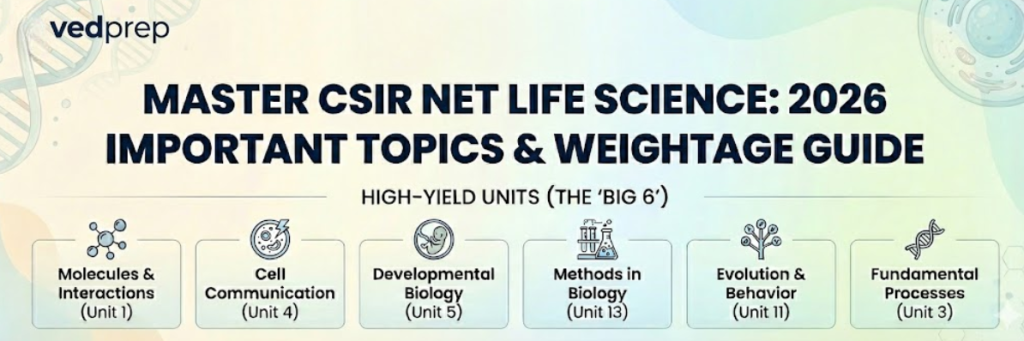
The “Big 6” High-Yield Units
These units usually have the most questions, especially in Part C, which is the analytical part. If you master these, you can get 60–70% of the marks you need.
Name of Unit
Focus Area Est.
Part C Weightage:
Unit 1: Molecules and Interactions
Biochemistry: ~17% ~8%
Unit 4: Cell Communication
Signaling and Immunology 14% 14%
Unit 5: Developmental Biology
Embryology and Morphogenesis: 17% and 11%
Biology Methods (Unit 13)
Techniques and Instruments: ~14% ~12%
Unit 11: Evolution and Behavior
Natural Selection and Ethology: ~14% ~7%
Basic Processes (Unit 3)
Molecular Biology: ~11% ~8%
Where the data comes from: Moderate-Yield Units
These units are important for keeping your score in check, and they usually have simple questions that are easy to answer if you know the basics.
Name of Unit Focus Area Est
. Part B Weightage Est. Part C Weightage
Unit 2: Cellular Organization
Cell Biology and Membranes: ~11% ~7%
Getting things from your parents Biology (Unit 8)
Genetics: 9% and 6%
Unit 6: System Physiology—Plants
Botany and Metabolism: ~14% and ~7%
Unit 12: Applied Biology
Biotech Applications: 9% and 7%
Low-Yield Units: Data Trends Source
“Low yield” means fewer questions, but these units usually have patterns that can be predicted. You shouldn’t skip them completely, but you can put them lower on your to-do list.
Name of Unit Focus Area Part B Est. Weightage Est. Part C System of Weightage Animal Physiology (Unit 7)
Human Physiology ~5% ~5%
Unit 10: Ecological Principles
Ecosystems ~6% ~5%
Unit 9: Different Types of Life
Taxonomy ~3% ~3%
Source of Data Trends:
A Detailed List of Important Topics for 2026
You can’t just skim these units to pass the CSIR NET life science exam in 2026. You need to look into certain sub-topics that the NTA (National Testing Agency) likes. This is a detailed list of what to study in the high-weightage units.
1. Unit 1: Molecules and Their Interactions Pertinent to Biology
This unit is the most important part of your preparation. It makes up about 10–12% of all the questions and gives you the chemical background you need to understand Cell Biology and Molecular Biology.
Structure and Function of Proteins: There is no way to change this. Pay attention to the Ramachandran plot, the secondary structures (like the alpha-helix and beta-sheet), and the way the protein folds into its tertiary structure. Many questions are about how certain mutations change stability.
You need to know how to use Michaelis-Menten kinetics and Lineweaver-Burk plots for enzyme kinetics. You should expect questions that ask you to do math on $K_m$ and $V_{max}$, as well as questions about types of inhibition (competitive and non-competitive).
Thermodynamics is a common theme in bioenergetics. Get your mind straight on Delta G, entropy, and coupled reactions (how ATP makes reactions that aren’t good for the body happen).
Nucleic Acids: Learn about the different shapes of DNA (A, B, and Z forms) and RNA. There has been a rise in questions about pH buffers and the pKa values of amino acids in the last few years.
2. Unit 2: How Cells Are Organized by CSIR NET life science
This unit is very important because it is directly related to Signaling (Unit 4), even though it may be a little less important than Biochemistry.
Transport across membranes: The fluid mosaic model is standard, but the test is mostly about how things move, like active vs. passive transport, sodium-potassium pumps, and ABC transporters.
Sorting Proteins: A common question is how proteins get to the nucleus, mitochondria, or ER. Look at the signal sequences (KDEL, NLS).
Cell Cycle: Regulation is very important here. Examine the function of Cyclins, CDKs, and checkpoints (G1/S transition). In Part C, tumor suppressors like p53 and Rb are often talked about in relation to cancer biology.
3. Unit 3: Basic Processes in Molecular Biology
This unit is probably the most important for the analytical questions in Part C. You can answer questions that combine genetics and applied biology if you know what the “Central Dogma” is.
Copying: Concentrate on the enzymes (Polymerase, Helicase, Ligase) and the distinctions between Prokaryotic and Eukaryotic replication. Replication of telomeres is another hot topic
Transcription and RNA Processing: Learn about the promoter regions (TATA box), transcription factors, and, most importantly, RNA processing (Capping, Splicing, and Polyadenylation). Questions about diseases often test for splicing errors.
People often ask about ribosome assembly, tRNA charging, and how antibiotics like Puromycin and Tetracycline affect translation machinery.
Gene Regulation: The Lac and Trp operons are important. In eukaryotes, concentrate on chromatin remodeling, methylation, and epigenetics, which are becoming more important in recent tests.
Unit 4: How Cells Talk to Each Other and Send Signals
This unit is a powerhouse for the CSIR NET life science exam, often making up 14% or more of the most important parts.
Pathways for signaling: You need to remember the cascades for the GPCR, RTK, JAK-STAT, and Wnt pathways. Questions frequently depict a “disrupted” pathway and require you to anticipate the cellular result.
Cancer Biology: This is similar to how the cell cycle is controlled. The intrinsic and extrinsic apoptosis pathways and the function of caspases are essential.
Immunology: Immune signaling is very important, even though it is sometimes thought of as separate. Concentrate on antigen-antibody interactions, MHC molecules, T-cell receptors, and hypersensitivity reactions.
5. Unit 5: Biology of Development
This unit is different from others because it is very abstract. You can answer these questions without having to memorize a lot of facts if you understand the logic of “cell fate.”
Basic Ideas: competence, potency, commitment, specification, and induction
Model organisms: Drosophila and amphibians are the main ones. Learn how to make the anterior-posterior axis (Hox genes, Bicoid, Nanos).
Organogenesis: The development of limbs and the induction of the eye lens are particular topics that recur in Part C.
6. Unit 13: Biology Methods in CSIR NET life science
In the last few years, the test has changed to focus more on testing experimental skills. This unit will help you figure out the “research-based” questions in Part C.
PCR, RT-PCR, and DNA sequencing (Sanger vs. Next-Gen) are all important molecular techniques.
Immuno techniques: ELISA, RIA, and Western Blotting. You need to know why you would choose one over the other.
Biophysical Techniques: Microscopy (TEM, SEM, Confocal) and Spectroscopy (UV-Vis, NMR, X-ray crystallography)
Statistical Methods: People often ask about the basics of t-tests, ANOVA, and Chi-square when they are looking at biological data.
Strategic Focus: Topics that are getting more attention and those that are new
The “Big 6” are your top priority, but to get ready for the CSIR NET life science test, you need to study other units as well so that you can get the most out of the “choice” options in Parts B and C.
Unit 6: The Study of Plants of CSIR NET life science
This is a high-scoring area for students of botany. For some, pay attention to the “big picture” mechanisms.
Photosynthesis: Z-scheme, C3, C4, and CAM pathways.
Auxin, Gibberellin, Cytokinin, Ethylene, and ABA are all types of phytohormones.
Nitrógeno Metabolism: The nitrogenase complex and the formation of nodules
Unit 10 and 11: Evolution and Ecology
People often study these two units together because the math is usually easy and they get high scores.
Ecology: Population growth curves (Logistic vs. Exponential), Lotka-Volterra models (Predator-Prey), and Survivorship curves.
Hardy-Weinberg: Evolution The most important math idea here is balance. Also, pay attention to the different types of speciation (allopatric and sympatric) and cladograms.
2026 Preparation Strategy: Adding Weightage to Your Study Plan
It’s only half the battle to know the important life science topics for the CSIR NET. A JRF comes from following a study plan that makes use of this information.
1. The “Reverse Pyramid” Method in CSIR NET life science
Begin your study with the units that are most important in Part C.
Months 1–3: Spend this time really getting to know Units 1, 3, 4, and 5. You can’t cram for these units; you need to have a clear understanding of the concepts.
Months 4–5: Switch to moderate units, such as Unit 2, 8, 10, and 11. These have a lot of facts in them, which makes them easier to remember before the test.
In month 6, only work on Unit 13 (Methods) and Part A (Aptitude). You should study methods last so that the technical details are still fresh.
2. Give Section C Logic the most importance for CSIR NET life science
You can technically skip whole units and still get the highest score because Section C lets you choose 25 questions out of 75.
Instead of skimming all 13 units, focus on mastering 7–8 of them. If you know the “Big 6” and Ecology/Evolution well, you can answer 25 questions with a high degree of accuracy.
3. Don’t forget about Part A in CSIR NET life science
One mistake people often make is not paying attention to General Aptitude. To be safe, you need to get 15 to 20 percent of your total marks here.
What to do: Spend 30 minutes every day working on puzzles, graph analysis, and simple series questions. This little bit of work could help you pass the JRF cutoff.
4. Smart Revision with PYQs
Solving Previous Year Questions (PYQs) is not only good practice; it’s also good for finding patterns for CSIR NET life science.
PYQs by topic: As soon as you finish a chapter (like DNA Replication), answer questions from 2015 to 2024 that are related to that topic.
Find Repeats: The Ramachandran plot, Michaelis-Menten, and Hardy-Weinberg are examples of ideas that come up in almost every cycle.
Mistakes You Shouldn’t Make in 2026
Students often mess up even with the best list of important life science topics for the CSIR NET life science.
Hoarding Resources: Don’t try to read every book (like Lehninger, Alberts, Gilbert, etc.) from cover to cover. Stick to one standard source for each unit and your coaching notes.
Not doing revision: In biology, the “Forgetting Curve” is real. Use spaced repetition: go over a topic one day, three days, and seven days after you study it.
Part C: Guesswork Part C has negative marking, which means you lose one mark for each wrong answer. It’s better to answer 20 questions with 100% certainty than 25 with 50% certainty.
Final Thoughts for CSIR NET life science
There are many choices you need to make along the way to the 2026 CSIR NET life science exam. You can get the most out of your study time and get the best grades by focusing on high-weightage subjects like Molecular Biology, Cell Signaling, and Developmental Biology.
Don’t try to “know everything” in the syllabus; instead, focus on learning the most important things well enough to use them analytically. Use this weightage guide as a map, keep going over the material, and keep testing yourself with papers from previous years.
Are you ready to start your trip? Start today by downloading the syllabus and checking off the “High Yield” topics listed above. Your JRF is ready
Master CSIR NET Life Science 2026: High-Yield Topics, Weightage Analysis & JRF Strategy by VedPrep
Alternative Options:
-
Option 1 (Focus on Strategy): Unlock JRF 2026: The “Big 6” High-Weightage Units & Preparation Blueprint
-
Option 2 (Focus on Analysis): CSIR NET Life Science 2026 Roadmap: Important Topics & Unit-Wise Weightage Breakdown
-
Option 3 (Short & Punchy): Smart Prep for 2026: CSIR NET Life Science Important Topics & Trends
Why these work:
-
They clearly mention the exam year (2026), which is crucial for search relevance in CSIR NET life science.
-
They highlight the core value proposition: Weightage and Important Topics.
-
They use authority words like “Master,” “Unlock,” and “Blueprint” to establish VedPrep as a trusted guide.
Frequently Asked Questions (FAQs)
What is the most effective study strategy for CSIR NET Life Science 2026?
Ans: The recommended strategy is the "Reverse Pyramid" approach. This involves prioritizing high-weightage, concept-heavy units (like Biochemistry and Cell Signaling) in the first few months, followed by moderate units, and leaving techniques and aptitude for the final phaseThe recommended strategy is the "Reverse Pyramid" approach. This involves prioritizing high-weightage, concept-heavy units (like Biochemistry and Cell Signaling) in the first few months, followed by moderate units, and leaving techniques and aptitude for the final phase
Which units are considered the "Big 6" or high-yield units for 2026?
Ans: The six most critical units are Molecules & Interactions (Unit 1), Cell Communication (Unit 4), Developmental Biology (Unit 5), Methods in Biology (Unit 13), Evolution & Behavior (Unit 11), and Fundamental Processes
Why is Part C considered the "rank-decider" for the exam?
Ans: Part C accounts for 100 marks (50% of the total paper) and tests deep experimental understanding and analytical skills. Success here separates top rankers (JRF) from those who just qualify or fail.
How many questions do I need to attempt in Part C?
Ans: You are required to attempt only 25 questions out of 75 options. Each question carries 4 marks
Can I skip certain units and still clear the exam?
Ans: Yes. Since you have a wide choice in Part C (25 out of 75), experts recommend completely mastering 7-8 high-yield units rather than skimming through all 13.
What is the weightage of Unit 1 (Molecules & Interactions)?
Ans: Unit 1 is projected to carry approximately 17% weightage in Part B and about 8% in Part C
Is Part A (General Aptitude) important?
Ans: Absolutely. Neglecting Part A is a common mistake. You should aim to score 15-20% of your total marks here to safely clear the JRF cutoff
What are the key topics to study in Developmental Biology (Unit 5)?
Ans: Focus on "cell fate" logic, model organisms (Drosophila, Amphibians), anterior-posterior axis formation (Hox genes), and organogenesis (limb and eye development)
How should I prepare for Unit 13 (Methods in Biology)?
Ans: Focus on molecular techniques (PCR, sequencing), immunotechniques (ELISA, Western Blotting), biophysical methods (Microscopy, Spectroscopy), and statistical tools (ANOVA, t-test).
What is the "Forgetting Curve" and how do I combat it?
Ans: The "Forgetting Curve" refers to how quickly we lose new information. To combat it, use spaced repetition: revise a topic 1 day, 3 days, and 7 days after initially studying it
Which topics are essential in Unit 4 (Cell Communication)?
Ans: You must master signaling pathways (GPCR, RTK, JAK-STAT), cancer biology (apoptosis, p53), and immunology fundamentals (Antigen-Antibody interactions, MHC)
. Is it better to guess in Part C if I am unsure?
Ans: No. Part C has a negative marking of -1 for every wrong answer. It is statistically better to answer 20 questions with 100% certainty than to guess on 25.
What should be my focus for Plant Physiology (Unit 6)?
Ans: Focus on "big picture" mechanisms like Photosynthesis (C3, C4, CAM), Phytohormones (Auxin, Gibberellin), and Nitrogen Metabolism
Why are Ecology and Evolution considered "high scoring" units?
Ans: These units (10 & 11) often feature straightforward math and logic. Key topics include Population growth curves, Hardy-Weinberg Equilibrium, and Cladograms
How important is solving Previous Year Questions (PYQs)?
Ans: PYQs are crucial for pattern recognition. Concepts like the Ramachandran plot and Michaelis-Menten kinetics appear in almost every exam cycle.