
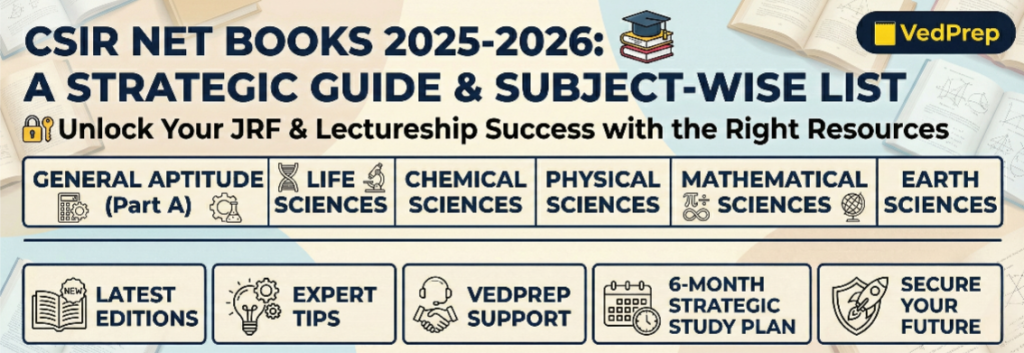

The Complete Subject-Wise List of CSIR NET Books for 2025–2026
Getting ready for the Council of Scientific and Industrial Research National Eligibility Test (CSIR NET) is a long and hard process that needs more than just hard work; it needs the right tools. The key to your success, whether you want a Junior Research Fellowship (JRF) or a Lectureship, is to choose the best CSIR NET books.
We break down CSIR NET subject-wise books in this guide to help you get through the huge syllabus of Chemical, Earth, Life, Mathematical, and Physical Sciences, as well as the important General Aptitude section.
1. General Aptitude (Part A): The Base Everyone Shares
Part A is the same for all five subjects and tests your ability to think and analyze numbers. You can get a big edge over other people by using CSIR NET books that are specific to this section.
- Gupta’s CSIR-UGC NET Paper I: A common suggestion for candidates who want a full picture of Part I.
CSIR-UGC-NET Ram Mohan Pandey’s General Aptitude Theory and Practice: This book is all about getting a clear understanding of theory and then putting it into practice.
Christy Varghese’s “CSIR NET General Aptitude: A New Outlook” Famous for its quick ways of doing things and its focus on the newest test patterns.
2. CSIR NET Life Sciences: Mastery of Each Subject
Life Sciences is one of the most popular subjects, but it requires a lot of knowledge about 13 difficult units. To learn these different subjects well, you need to find the right CSIR NET subject wise books.
Fundamentals and Practice (Parts 1 and 2) by Pranav Kumar: These CSIR NET books are very important because they cover almost all of the main topics and have practice questions at the end of each chapter.
Dr. Poonam Sharma’s Life Sciences (Vol 1): Notable for its extensive incorporation of diagrams, tables, and illustrations to expedite rapid review.
Taiz and Zeiger’s Plant Physiology is the best book for learning about complicated plant processes.
Prescott’s Microbiology: Necessary for units that talk about the different types of microbes and how they can be used.
3. CSIR NET Chemical Sciences: A Look at Each Subject
Candidates for chemistry must be able to balance organic, inorganic, and physical chemistry. Experts highly recommend the following CSIR NET subject-wise books.
Organic Chemistry by Jonathan Clayden is widely thought to be one of the best CSIR NET books for learning about how reactions work in a simple way.
Inorganic Chemistry by Shriver and Atkins: This book gives clear answers to basic questions about inorganic chemistry.
Peter Atkins’ Principles of Physical Chemistry: Known for its clear and simple writing, which is backed up by solved examples for practice.
Ernest L. Eliel’s “Stereochemistry of Organic Compounds” is a complete guide for people who want to learn everything there is to know about stereochemistry.
4. Core Resources for CSIR NET Physical Sciences
To do well in physics, you need to be good at math and have a deep understanding of concepts. Both of these things should be reflected in your choice of CSIR NET books.
David J. Griffiths’ Introduction to Quantum Mechanics is a “master class” book that goes into great detail about quantum theory.
A well-researched guide that covers everything from simple to complex math concepts is “Mathematical Methods for Physicists” by Arfken and Weber.
Kenneth S. Krane’s Introductory Nuclear Physics: This book is great for learning about the real exam pattern because it has short theory and multiple-choice questions.
- Reif’s “Fundamentals of Statistical and Thermal Physics” covers important ideas in modern physics without making things too complicated.
5. CSIR NET Mathematical Sciences: Important Books for Each Subject
For math, the focus is on strict theory and how fast you can solve problems. These CSIR NET subject-wise books are must-haves for the best students.
Real Analysis by HL Royden and PM Fitzpatrick: A key book for one of the most important subjects on the test.
Brown and Churchill’s book “Complex Variables and Applications” Provides a well-thought-out mix of simple learning methods and practice problems.
Foundations of Functional Analysis by S. Ponnusamy is a long, problem-filled book that connects math and modern physics.
I.N. Herstein’s Topics in Algebra: Known for making hard ideas simple and giving practice tests based on real tests.
6. CSIR NET Earth Sciences:
A Specialized Guide Earth Sciences includes geology, oceanography, and atmospheric sciences. These CSIR NET books make sure that everything is covered.
D.S. Lal’s Climatology and Oceanography: Uses a lot of examples to make hard theories and ideas easy to understand.
Principles of Geomorphology by W.D. Thornbury: A basic book for studying landforms.
- Gupta’s Joint CSIR-UGC (NET) Earth Sciences Exam Guide is a complete study and practice guide that is based on the most recent exam pattern.
Graham Borradaile’s Statistics of Earth Science Dating is a niche but important resource for geoscientists.
How to Pick the Best CSIR NET Books: A Strategic Guide
When you are putting together your library of CSIR NET subject-wise books, keep these expert tips in mind:
Check for the Most Recent Editions: Make sure that your CSIR NET books are up to date with the NTA’s current syllabus and exam format.
Check the Clarity of the Content: Choose authors who explain difficult ideas in a clear and organized way.
Include PYQs: Always pick CSIR NET books that have question papers from previous years with full answers so you can see how hard they are.
Get Help: Ask teachers or people who have already passed the exam for suggestions on the best study materials.
7. Get a better prep with Vedprep
The right CSIR NET books are important, but getting help from an expert can help you learn much faster. Vedprep offers a number of services that can help you with your reading:
Specialized Wings: They offer subject-specific mentoring for Chemical and Life Sciences through Chem Academy and Vedprep Biology Academy.
Curated Study Materials: Vedprep has notes and question banks made by experts that take the huge amount of information in standard CSIR NET subject-wise books and turn it into content that is useful for exams.
Mock Test Series: Their tests are like real ones, which helps you manage your time and avoid getting points taken away.
Doubt Clearing: Having direct access to experienced teachers can help you understand difficult ideas that textbooks might not fully explain.
Plan for a 6-Month Strategic Study
Months 1 and 2: Use basic CSIR NET books to build your understanding of concepts. Make notes that summarize what you read.
Months 3–4: Switch to CSIR NET subject-specific books for specialized units. Begin answering questions by topic.
In Month 5, only work on Previous Year Questions (PYQs). Look at your mistakes and go over the theory again.
Month 6: Use your own notes and visual aids to do full-length practice tests and make final changes.
End
To do well on the CSIR NET, you need to be disciplined, have a plan, and have the right tools. If you use this list of CSIR NET books and focus on CSIR NET subject-specific books for your field, you can be sure that your preparation is both deep and broad. Use platforms like Vedprep to get professional help with your self-study and fill in any gaps. Aim for a top JRF rank.
Get the right CSIR NET books and start getting ready for the test today. This will help you secure your future in Indian research
Frequently Asked Questions (FAQs)
What is the most critical factor for success in the CSIR NET JRF or Lectureship exams?
Ans: The key to success is choosing the best CSIR NET books, which act as the right tools for the long and hard preparation process.
Is the General Aptitude (Part A) syllabus different for each science stream?
Ans: No, Part A is the same for all five subjects (Chemical, Earth, Life, Mathematical, and Physical Sciences).
Which book is recommended for understanding General Aptitude theory and practice?
Ans: "CSIR-UGC-NET Ram Mohan Pandey's General Aptitude Theory and Practice" is recommended for getting a clear understanding of theory and putting it into practice.
Is there a book known for quick methods and new patterns in General Aptitude?
Ans: Yes, Christy Varghese's "CSIR NET General Aptitude: A New Outlook" is famous for its quick ways of doing things and focus on the newest test patterns
How extensive is the CSIR NET Life Sciences syllabus?
Ans: It is one of the most popular subjects and requires knowledge about 13 difficult units.
Which Life Sciences books are best for covering main topics and practice questions?
Ans: "Fundamentals and Practice (Parts 1 and 2)" by Pranav Kumar are very important because they cover almost all main topics and include practice questions
What resource is best for reviewing diagrams and illustrations in Life Sciences?
Ans: Dr. Poonam Sharma's "Life Sciences (Vol 1)" is notable for its extensive incorporation of diagrams, tables, and illustrations to expedite rapid review.
Which book is recommended specifically for Plant Physiology?
Ans: Taiz and Zeiger's "Plant Physiology" is the best book for learning about complicated plant processes.
Who is the recommended author for learning Organic Chemistry reaction mechanisms?
Ans: Jonathan Clayden’s "Organic Chemistry" is widely thought to be one of the best books for learning how reactions work in a simple way
Which Physical Chemistry book is known for clear writing and solved examples?
Ans: Peter Atkins' "Principles of Physical Chemistry" is known for its clear, simple writing and is backed up by solved examples.
What is considered the "master class" book for Quantum Mechanics?
Ans: David J. Griffiths' "Introduction to Quantum Mechanics" is considered a master class book that goes into great detail about quantum theory
Which book helps Physical Science candidates learn the real exam pattern?
Ans: Kenneth S. Krane's "Introductory Nuclear Physics" is great because it has short theory and multiple-choice questions.
What is the primary focus of the CSIR NET Mathematical Sciences exam?
Ans: The focus is on strict theory and how fast you can solve problems
Which book connects mathematics with modern physics?
Ans: "Foundations of Functional Analysis" by S. Ponnusamy is a long, problem-filled book that connects math and modern physics.
What subjects are covered under Earth Sciences?
Ans: Earth Sciences includes geology, oceanography, and atmospheric sciences.