




A Full Guide to CSIR Awards and Fellowships for Unlocking Research Potential
The field of Indian science and technology is huge, but the Council of Scientific and Industrial Research (CSIR) has had a huge impact on it. For decades, CSIR has been the leader in scientific excellence, encouraging new ideas that range from basic lab discoveries to industrial uses that help the economy grow. For people who want to be scientists, researchers, or academics, being a part of CSIR is more than just a job; it’s proof of their commitment to learning.
The CSIR Awards and CSIR Fellowships are the main way that this ecosystem recognizes and supports people. The goal of these programs is to find, support, and honor the smartest people in the country. There is a CSIR Awards or fellowship that is right for you, whether you are a master’s student working toward a Ph.D., a young scientist making new discoveries, or an established researcher changing the way your field works.
We at Vedprep know that the road to these prestigious awards often starts with a single step: passing tests like the CSIR NET. As a top coaching partner for Life Sciences and related fields, we have seen how these awards change people’s lives. In this in-depth guide, we will look closely at the different types of CSIR honors, including who is eligible for them, what benefits they offer, and how much they help the scientific community.
Why the CSIR Award System is Important
The Council of Scientific and Industrial Research (CSIR) is not just a place to get money; it is also a force for national growth. CSIR’s awards are not just money; they are also symbols of national recognition. A CSIR Award puts a researcher in a small group of scientists who have made a big difference in India’s scientific progress.
There are two main goals for every CSIR Award: to recognize and to help.
Recognition: By honoring outstanding contributions, CSIR shows how important scientific research is for finding solutions to problems in the real world.
Enablement: CSIR makes sure that money doesn’t stop a brilliant mind from doing high-impact research by giving out large grants and fellowships.
It’s important for both students and professionals to understand the details of each CSIR Award. It helps you make long-term career plans. For example, a student who is studying for the CSIR NET with Vedprep today might want to win the Young Scientist Award in five years. This long-term goal is what keeps up the high level of academic performance.
Major CSIR Awards: Honoring Great Work in Science
CSIR has set up a number of awards to honor scientists at various points in their careers. The range is wide and includes everything from school kids with new ideas to seasoned scientists with a lifetime of success. Below, we look at the most important awards that every researcher should know about.
-
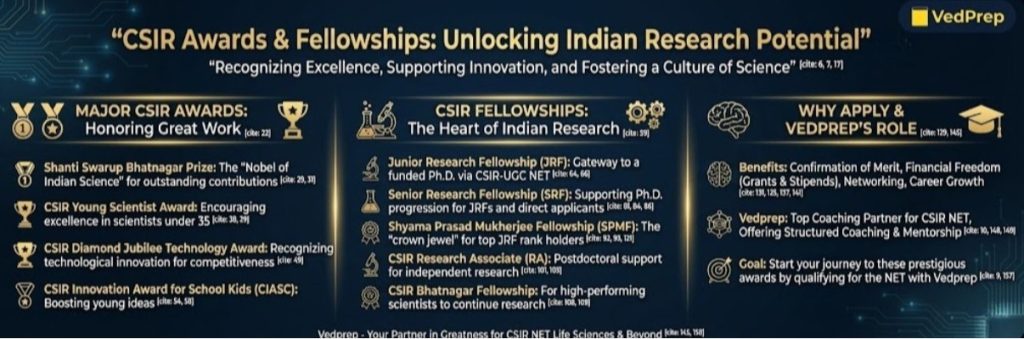
The Shanti Swarup Bhatnagar Prize for Science and Technology
This award is named after Dr. Shanti Swarup Bhatnagar, who was the founder and director of CSIR. It is probably the most sought-after CSIR Award in the country. Because of its strict selection process and high status, it is often called the “Nobel Prize of Indian Science.”
Goal: To honor great Indian work in science and technology.
Importance: Scientists under 45 who have made “conspicuously important and outstanding contributions” to human knowledge and progress receive this CSIR Award every year.
The prize is open to people in seven fields: Biological Sciences, Chemical Sciences, Earth, Atmosphere, Ocean, and Planetary Sciences, Engineering Sciences, Mathematical Sciences, Medical Sciences, and Physical Sciences.
The Prize: The winner gets ₹5,00,000 (Five Lakhs) in cash, a citation, and a plaque. More importantly, it gives you the chance to lead in national labs and policy-making groups.
For a Life Science researcher, winning this CSIR Award is often the best thing they’ve done in their career so far, showing that their work is of the highest quality around the world.
-
Awards for Young Scientists from CSIR
The Bhatnagar Prize is for established mid-career scientists, while the CSIR Young Scientist Award is for up-and-coming scientists. This CSIR Award, which started in 1987, is only for scientists who work for the CSIR and are under 35 years old.
Goal: To encourage excellence and honor the great work done by young CSIR scientists.
Reasons to do it:
Cash Prize: ₹50,000 in cash.
Research Grant: A huge research grant of ₹25 Lakhs (₹5 Lakh per year for five years). This gives the young researcher a lot of freedom to work on their own ideas without having to worry about money.
Honorarium: An extra special honorarium of ₹7,500 per month until the awardee turns 45.
Why it Matters: This CSIR Award gives a young researcher the money and freedom they need to build a unique research identity early in their career.
-
The CSIR Diamond Jubilee Technology Award (CDJTA)
Innovation drives economic growth, and the CSIR Diamond Jubilee Technology Award helps this engine run. This CSIR Awards is different because it often goes to groups and organizations instead of just people. It focuses on technological innovation that makes India more competitive.
Focus: technological innovation that opens up new markets, boosts the country’s reputation, or solves important social problems.
The Prize: A large cash prize of ₹10 Lakhs, which makes it one of the most lucrative awards in the Indian tech industry.
Criteria: The new idea must have come from India or have a big Indian part. It must be a “finished” technology, which means it should either be commercially successful or used for the greater good.
-
CSIR Innovation Award for Kids in School (CIASC)
Young people need to learn how to be scientific. The CIASC is a CSIR Awards that aims to catch them when they are young. It asks school kids to come up with new tech ideas, which helps them think of the world as a place where they can solve problems.
Who can apply: Indian students who are under 18 years old.
Effect: This award gives young students’ ideas a boost, which will help them become the next generation of Bhatnagar laureates.
The CSIR Fellowships: The Heart of Indian Research
Awards honor things that have already been done, while fellowships help with things that are happening now and in the future. Thousands of Ph.D. students and postdoctoral researchers in India depend on CSIR fellowships to stay alive. We at Vedprep always tell students how to use these fellowships to build a strong career in Life Sciences and other fields.
-
Junior Research Fellowship (JRF) from CSIR
Almost every M.Sc. student in India wants to get the CSIR JRF. India’s students. It is the way to get into a funded Ph.D. program, and you get it by passing the CSIR-UGC NET exam.
The Way to Research
Getting the JRF is often the first big “win” in a researcher’s life. It means that you have the skills and knowledge to do research.
Who can apply:
M.Sc. or a degree in science that is the same level.
Passing the CSIR-UGC NET exam.
The upper age limit is usually 28 years old, but there are some exceptions for reserved categories.
Help with money:
Stipend: The JRF gives a monthly stipend for the first two years. It is now ₹37,000, but candidates should always check the latest notifications to see if this has changed.
Contingency Grant: The host institute gets a grant every year to cover the cost of consumables, making sure the fellow has everything they need.
Career Path: A JRF scholar should sign up for a Ph.D. program within two years. The tough training during this time sets the stage for a career in research and development or academia.
-
Senior Research CSIR Fellowship (SRF) from CSIR Awards
The SRF is meant to help scholars move from the learning phase to the contribution phase of their Ph.D. It’s a long journey of research.
Progression: A committee looks at a fellow after they have been a JRF for two years. They are promoted to SRF if they are making good progress.
Direct Applicants: If you have research experience (like publications) and an M.Sc./M.Tech. degree, you can apply directly for SRF, even if you don’t have a JRF.
Pros:
Increased Stipend: The monthly stipend goes up a lot (usually to ₹42,000) to reflect the scholar’s higher level of knowledge and responsibility.
Length: The fellowship usually lasts for the 3rd, 4th, and 5th years of the Ph.D. This lets the student focus completely on their thesis without worrying about money.
-
3. The Shyama Prasad Mukherjee Fellowship (SPMF)
This is the best CSIR fellowship, known as the “crown jewel.” It is a special fellowship program for the best students in the CSIR-UGC NET JRF.
Selection: You don’t need to fill out a separate application. CSIR finds the top candidates (for example, the top JRFs in Life Sciences, Chemical Sciences, and so on) and invites them to a special interview.
Prestige: Being an SPM Fellow shows that you are very smart. It makes you stand out even among JRF qualifiers.
Financial Benefit:
Stipend: The stipend is higher than the standard JRF. It starts at ₹43,000 per month for the first two years and goes up to ₹50,000 per month from the third year on (based on performance).
Contingency: A generous annual contingency grant of ₹70,000 lets you go to conferences, buy books, and get specialized equipment.
Goal: The goal is to encourage “budding scientific talent” who could become future leaders in science.
-
CSIR Research Associate (RA)
The future can be unclear for people who have finished their Ph.D. The CSIR Research Associateship gives new doctors a break so they can work in active research settings while they look for permanent jobs or continue their own research.
People who have a Ph.D. or have sent in their thesis are eligible.
Mentorship: RAs work with top scientists in CSIR labs or universities to learn.
Stipend: The stipend is competitive, ranging from ₹58,000 to ₹67,000 depending on experience. This is similar to the starting salaries for academics and gives the postdoctoral researcher financial independence and respect.
-
The CSIR Bhatnagar Fellowship
This fellowship is not the same as the prize. It is for high-performing scientists, whether they are currently working or have retired, to keep doing their research.
Target Audience: Highly respected scientists who have a history of doing great work.
Benefit: For retired winners, it pays them the same amount as a Secretary to the Government of India. It gives scientists who are already working an extra ₹50,000 a month on top of their current salary.
Time frame: 3 to 5 years.
A Strategic Approach to the Application Process
To win a CSIR Awards or CSIR fellowship, you need more than just brains; you also need a plan. At Vedprep, we stress how important it is to know the criteria for selection.
For Fellowships (JRF/SPMF):
The CSIR-UGC NET exam is the biggest problem. This test checks not only what you know by heart but also how well you can think.
Preparation: Make sure you really understand the concepts. In Life Sciences, it’s not enough to just memorize pathways; you also need to know how those pathways are controlled.
The SPMF Edge: To get the Shyama Prasad Mukherjee Fellowship, you can’t just “pass” the NET; you have to aim for the top 10 ranks. You need to be able to answer all of the questions in Sections B and C of the test paper perfectly.
For the Young Scientist/Bhatnagar Awards:
You can only win these awards by being nominated or applying for them. Your publication record will speak for itself.
Innovation is key: CSIR values work that is “conspicuously important.” It’s good to publish in journals with a lot of readers, but it’s even better to show how your work solves a specific problem, whether it’s basic or applied.
Documentation: Your presentation to the committee is very important when you apply for the Young Scientist Award. You need to be able to explain how your work will affect the future, not just what you’ve done so far.
Why should you apply for a CSIR awards?
Is it worth the work? Yes, for sure. This is why getting a CSIR Awards or CSIR fellowship can change your career:
-
Confirmation of Merit
In the competitive world of academia, getting outside approval is important. A CSIR Awards is a sign that your CV is of high quality. It lets universities and potential employers around the world know that the top research organization in India has checked you out.
-
Being financially free
Research takes a lot of resources. The CSIR Young Scientist Award (₹25 Lakhs) and other similar awards come with grants that let you set up your own lab, hire helpers, or buy special chemicals right away, without having to wait for your institute to approve them.
-
Opportunities to network
People who win CSIR awards often form a close-knit group. Winners are invited to special events, seminars, and conclaves where they can meet policy makers, industry leaders, and other winners. You can work with people in this network to shape the rest of your career.
-
Career Growth
In Indian universities, CSIR Awards and fellowships are very important for academic promotions (from Assistant Professor to Associate Professor, etc.). They are worth a lot in the API (Academic Performance Indicators) score. An award from the CSIR can help you get promoted faster.
The Vedprep Point of View: Your Partner in Greatness
Our mission at Vedprep is the same as CSIR’s vision: to encourage excellence in science. We know that every CSIR Awards winner has a story of sleepless nights, failed experiments, and finally winning.
We help students get over the first and often hardest obstacle: the CSIR NET exam. We make sure you’re ready for a research career, not just an exam, by giving you structured coaching, high-quality study materials, and Life Sciences mentorship.
If you want to win the Junior Research CSIR Fellowship or the Shanti Swarup Bhatnagar Prize, keep in mind that the key is to have a strong understanding of concepts and a love of learning.
The End
The CSIR Awards and Fellowships are more than just programs; they are what keeps Indian science alive. They make sure that talent is noticed, developed, and rewarded. CSIR is with you every step of the way, from the CSIR Awards for school kids that makes them curious to the Bhatnagar Fellowship that honors a lifetime of service.
If you study Life Sciences, Chemical Sciences, or something similar, you should learn about these chances. Look at them. The goal of getting a CSIR Awards should be what keeps you going with your studies and research every day. And don’t forget that Vedprep is here to help you with the first step of qualifying for the NET.
Would you like me to make a detailed 6-month study plan for the CSIR NET Life Sciences exam to help you get ready for the JRF and maybe even the SPM Fellowship?
Frequently Asked Questions (FAQs)
What is the primary goal of the CSIR Awards and Fellowships?
ans: The goal of these programs is to find, support, and honor the smartest people in the country. They aim to recognize outstanding contributions and enable brilliant minds to conduct high-impact research through grants and fellowships.
Who is eligible for the Shanti Swarup Bhatnagar Prize?
Ans: This prize is open to scientists under the age of 45 who have made "conspicuously important and outstanding contributions" to human knowledge and progress. It covers seven fields, including Biological, Chemical, and Physical Sciences.
What does the winner of the Shanti Swarup Bhatnagar Prize receive?
Ans: The winner receives ₹5,00,000 (Five Lakhs) in cash, a citation, and a plaque.
What is the CSIR Young Scientist Award?
Ans: This award is for up-and-coming scientists under 35 years old who work for the CSIR. It aims to encourage excellence and honor great work done by young scientists within the organization
What are the financial benefits of the CSIR Young Scientist Award?
Ans: Winners receive a cash prize of ₹50,000 and a special honorarium of ₹7,500 per month until they turn 45. Additionally, they receive a research grant of ₹25 Lakhs distributed as ₹5 Lakh per year for five years
Who is the CSIR Diamond Jubilee Technology Award (CDJTA) meant for?
Ans: This award often goes to groups and organizations rather than just individuals, focusing on technological innovation that makes India more competitive.
What is the prize amount for the CSIR Diamond Jubilee Technology Award?
Ans: The award includes a large cash prize of ₹10 Lakhs, making it one of the most lucrative awards in the Indian tech industry.
Who can apply for the CSIR Innovation Award for School Children (CIASC)?
Ans: Indian students who are under 18 years old can apply for this award. It encourages them to come up with new tech ideas and solve problems.
What is the CSIR Junior Research Fellowship (JRF)?
Ans: The JRF is a fellowship that M.Sc. students can obtain by passing the CSIR-UGC NET exam. It serves as a gateway to a funded Ph.D. program.
What is the age limit for the CSIR JRF?
Ans: The upper age limit is usually 28 years old, though there are exceptions for reserved categories.
What is the current stipend for a CSIR JRF scholar?
Ans: The JRF provides a monthly stipend that is currently ₹37,000 for the first two years.
How does a scholar progress from JRF to Senior Research Fellowship (SRF)?
Ans: After two years as a JRF, a committee reviews the fellow's progress; if progress is good, they are promoted to SRF.
Can I apply directly for the CSIR SRF without a JRF?
Ans: Yes, if you have research experience (such as publications) and an M.Sc. or M.Tech. degree, you can apply directly for the SRF.
What is the stipend for a Senior Research Fellowship (SRF)?
Ans: The monthly stipend for an SRF usually increases to ₹42,000 to reflect the scholar's higher level of knowledge.
What is the Shyama Prasad Mukherjee Fellowship (SPMF)?
Ans: Known as the "crown jewel," the SPMF is a special fellowship for the top-ranking students in the CSIR-UGC NET JRF.