




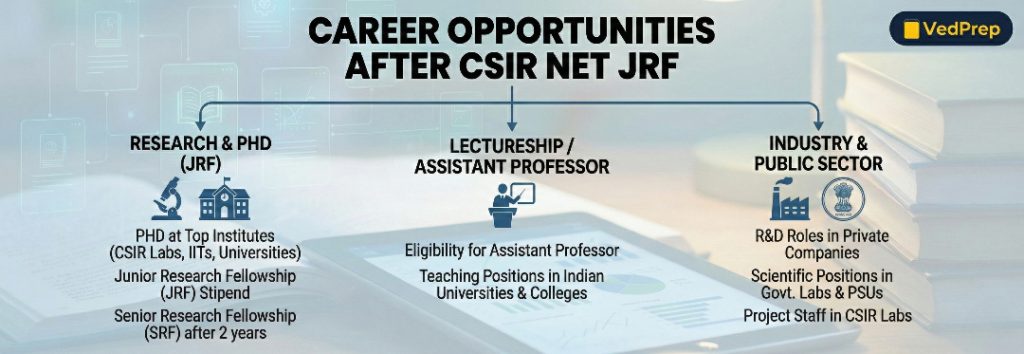

Opportunities after qualifying CSIR NET JRF
A Complete Guide to Job Opportunities After qualifying CSIR NET JRF People from all over India have always been very proud to qualify for the CSIR NET exam. It is a prestigious milestone that sets you apart as one of the best thinkers in your field. But after the parties are over, a lot of students are left with a lot of questions about what will happen next. You might be wondering, “What should I do now that I’ve passed the test?” or “What are my career options now?”
The truth is that the chances that come after qualifying CSIR NET JRF (used here as a way to think about life after the qualification) are huge. They include jobs in research, academics, the government, and private companies. This certificate is more than just a piece of paper; it can lead to stable finances, more knowledge, and high-paying jobs. After qualifying CSIR NET JRF, you have a lot of options. You could wear a lab coat at a top school or teach the next generation of scientists. This in-depth guide will help you find the best career options for you so that you can make an informed choice that will help you succeed in your career.
1. The Academic Route after qualifying CSIR NET JRF:
Getting a PhD and Research Fellowships After qualifying CSIR NET JRF, many people think that the best and most logical thing to do is to do a lot of research. The main purpose of the test is to see if you are qualified for the Junior Research Fellowship (JRF). Getting this opens doors to some of the best schools in the world. PhD Opportunities in the US Candidates with a high rank can get into PhD programs at top Indian universities and institutes, such as the Indian Institute of Science (IISc), the Tata Institute of Fundamental Research (TIFR), and a number of CSIR labs.
If you get a PhD, you will be an expert in a specific area, such as Physics, Chemistry, Mathematics, or Life Sciences. Getting CSIR NET JRF is great because you get to choose who you want to work with first. Most research universities like students who have passed this test because it shows that the student has the right mindset and knowledge base for hard doctoral work. Because of this, you will probably have to work less hard to get a PhD position than someone who is not qualified.
You can also get a monthly stipend (Fellowship) that lets you focus completely on your research without having to worry about money. International PhD and Postdoctoral Research You can qualify for more than just jobs in India after qualifying CSIR NET JRF. The qualification is well-known around the world, and many foreign universities offer scholarships and fellowships to Indian students who pass this exam. Getting a PhD abroad gives you a chance to learn about research practices around the world and greatly improves your academic record. Also, for people who have already finished their doctoral studies, the certification can be a strong credential for Postdoctoral Researcher jobs in India and other countries.
2. Teaching and Assistant Professor Roles after qualifying CSIR NET JRF:
Shaping Future Minds
If you love teaching and helping others, the future looks very bright for you after qualifying CSIR NET JRF. With this certification, you can work as an Assistant Professor or Lecturer at colleges and universities all over India.
Public and Private Colleges and Universities
For CSIR NET qualified candidates, the job of Assistant Professor is one of the most prestigious. You can apply for these jobs at a number of government universities. The pay and benefits are great.
Private universities also look for candidates who have passed the CSIR NET exam when they hire people. Schools and colleges see this qualification as a standard for quality, making sure that their teachers have a lot of knowledge about the subject.
Advancement in your career
You can start as a lecturer or assistant professor, but that’s just the start. Candidates can eventually move up to higher and more powerful jobs, like Head of Department, Principal, Vice-Chancellor, or Director. Not only does this career path pay well, but it also feels good to help future generations have stable academic lives and get good advice.
3. Serving the Nation after qualifying CSIR NET JRF:
Government websites and Public Sector Undertakings (PSUs)
Working with Public Sector Undertakings (PSUs) is a very popular but often overlooked option after qualifying CSIR NET JRF. Many PSUs have recently become very interested in hiring people who have passed the CSIR NET exam directly.
Why Pick PSUs?
These companies give talented people a lot of benefits, job security, and great pay. When choosing scientists for R&D departments, PSUs look at CSIR scorecards first and hire people based on their proven skills.
You can use your degree at some of the best organisations and institutes, such as: Indian Space Research Organisation (ISRO) Indian Veterinary Research Institute (IVRI) Indian Agricultural Research Institute (IARI) Bhabha Atomic Research Centre (BARC) Department of Atomic Energy (DAE) Oil and Natural Gas Corporation (ONGC) Bharat Heavy Electricals Limited (BHEL)
It is likely that even more state-level companies will use CSIR NET scores in their hiring processes in the coming years, which will give candidates more opportunities.
4. The Scientific Frontier after qualifying CSIR NET JRF:
Working in DRDO and CSIR Labs
For people who are really into science and technology, working as a Scientific Officer or Researcher in a government lab is a dream job. You can apply for jobs at some of India’s most advanced research facilities after passing the CSIR NET JRF.
Labs run by the Council of Scientific and Industrial Research (CSIR)
Candidates can work as researchers by applying for Research Fellow jobs at any of the well-known CSIR labs. These jobs involve doing important research in biotechnology, environmental science, and life sciences, and they offer steady career growth.
The Defence Research and Development Organisation (DRDO)
The DRDO is a top agency in the Ministry of Defence and one of the most well-known groups that picks CSIR NET qualified candidates for its best labs. DRDO often holds its own recruitment drives for JRF positions, and it often uses NET scores as a way to narrow down the candidates.
Some of the well-known DRDO labs where you might be able to work after qualifying CSIR NET JRF are: ● Advanced Numerical Research & Analysis Group (ANURAG), Hyderabad
• Centre For Air Borne System (CABS) in Bangalore
● The Defence Bio-Engineering and Electro Medical Laboratory (DEBEL) in Bangalore
● Hyderabad’s Defence Research and Development Laboratory (DRDL)
● Laser Science & Technology Centre (LASTEC)
● Naval Physical & Oceanographic Laboratory (NPOL) in Kochi
You can help your country by working on important defence technologies and scientific progress in these roles.
5. Beyond the Lab after qualifying CSIR NET JRF:
Starting a Business, Writing Science, and Corporate R&D
You can do more than just work in a traditional academic or government job if you have the CSIR NET qualification. There are many other career paths that are just as rewarding. Jobs in R&D and the corporate world People who are qualified can find difficult research jobs in the pharmaceutical, biotechnology, and information technology industries. Companies hire NET JRF candidates to test products, analyse data, and make new biotech tools like spectrophotometers and PCR instruments. You could be a Research Scientist at a private pharmaceutical company, where salaries range from ₹50,000 to ₹90,000 per month.
Writing for Science and Journalism
If you like to write, getting a degree after qualifying CSIR NET JRF can help you start a career in science communication. You can help connect complicated scientific ideas with the general public by working as a scientific writer, editor, or journalist. This job is great for people who love talking about science instead of just doing experiments.
Being an entrepreneur For those who want to start their own business, the advanced research skills you get after qualifying CSIR NET JRF exam can be the foundation. You can start your own research lab (with permission from the government) or a biotechnology or healthcare startup. A lot of successful business owners use their strong research skills to make products and services that make a difference.
6. Help and Planning with VedPrep after qualifying CSIR NET JRF
Getting to the point where you qualify after the CSIR NET JRF takes a lot of hard work and the right strategic advice. This is where specialised platforms like VedPrep come in.
VedPrep offers a full range of services to people who want to get this qualification through its specialised branches, such as Chem Academy and Biology Academy. Their job goes beyond just giving the written test; they also provide the guidance needed to get through the complicated world after passing.
● Interview Help: VedPrep has mentorship programs that can help you get ready for the next step: going to interview boards for PhD admissions at top schools like IITs and IISERs. Structured Preparation: For those who are still on the journey, they offer “Genesis” and “Sankalp” batches that cover the whole syllabus with live interactive classes and sessions for solving problems. Subject Expertise: They focus on Chemistry, Life Sciences, Physics, and Maths, and offer specialised resources like past year question papers and mock tests. These are important for building the deep subject knowledge needed for both the exam and later research interviews.
Using these kinds of resources makes sure that you not only qualify, but also do so with a high enough rank to get the best research fellowships. 7. Financial Rewards: Salary Expectations and Fellowship Benefits One of the best things about the career paths open to you after qualifying CSIR NET JRF is that they offer financial stability. Salaries are competitive and depend on whether you work in academia, the government, or the private sector.
Also visit the official website of Vedprep for getting more information about this.
Here is a list of the possible salary ranges you might get:
According to Position range of monthly salary
Junior Research Fellow (JRF) gets ₹31,000 to ₹35,000, plus HRA and a backup fund.
Senior Research Fellow (SRF) ₹35,000–40,000 Assistant Professor (Govt. Universities) ₹70,000 to ₹1,20,000 for Assistant Professor at Private Colleges ₹35,000–₹60,000 for a PSU R&D Scientist (ONGC, IOCL, etc.) 40,000 to 80,000 rupees
Research Scientist in the Private Pharma Sector ₹50,000 to ₹90,000
Postdoctoral Fellow in India ₹50,000 to ₹70,000
Scientific Content Developer: ₹30,000 to ₹70,000
Also, the best test takers may be able to get special awards like the CSIR SPM Fellowship, which honours people for their hard work and dedication.
The end There are many answers to the question “What to do after qualifying CSIR NET JRF?”
Each one can lead to a successful and satisfying career. There are endless possibilities for you, whether you want to get a PhD, teach students as a professor, come up with new ideas in a DRDO lab, or lead a corporate R&D team.
This test is more than just a test; it’s a way to get a good job in science and research. Candidates should think about their long-term goals and interests when choosing the course that will help them reach those goals. If you get the right advice and work hard, the life you build after qualifying CSIR NET JRF will be one of success, discovery, and prestige.
Frequently Asked Questions (FAQs)
What is the main benefit of qualifying CSIR NET JRF?
Ans: After qualifying CSIR NET JRF, It makes you a eligible for a research stipend to pursue a PhD and for assistant Professorship role in universities nationwide.
Can I join DRDO after clearing CSIR NET?
Ans: Yes, DRDO Frequently recruits JRFs through separates drives, often using NET scores as a primary selection criterion.
Is the CSIR NET Score useful in the private sector?
Ans: Absolutely, Industries such as pharmaceuticals, biotechnology, and Environmental science after challenging R&D positions to qualified individuals.
What is the duration of the JRF fellowship?
Ans: The fellowship is typically for five years - two years as a JRF and the remaining three years as a Senior research fellow (SRF) upon successful evaluation.
What are the main career paths available after qualifying CSIR NET JRF?
Ans: Qualifying CSIR NET JRF opens diverse career paths including pursuing a PhD with a fellowship, becoming an Assistant Professor or Lecturer, joining Public Sector Undertakings (PSUs) like ONGC or IOCL, working in government research labs (DRDO, CSIR), and taking up R&D roles in the private sector.
What is the difference between CSIR NET JRF and Lectureship (LS) regarding career scope?
Ans: JRF (Junior Research Fellowship) is primarily for those wishing to pursue research and a PhD with financial support, while Lectureship (LS) is for candidates aiming to become Assistant Professors in universities. JRF qualified candidates are eligible for both research fellowships and lectureship, whereas LS qualified candidates are eligible only for teaching roles and do not receive the JRF stipend
Can I work in the private sector after qualifying CSIR NET?
Ans: Yes, private sector opportunities are vast. You can work as an Industrial R&D Scientist in pharma or biotech companies, a Quality Control Specialist, or a Scientific Content Developer. Companies frequently hire NET qualified candidates for their rigorous research foundations
What is the stipend amount for a Junior Research Fellow (JRF)?
Ans: As of the latest guidelines, the stipend for a JRF is ₹37,000 per month for the first two years, plus an annual contingency grant of ₹20,000. After two years, if upgraded to a Senior Research Fellow (SRF), the stipend increases to ₹42,000 per month.
Is the CSIR NET JRF certificate valid for a lifetime?
Ans: No, the CSIR NET JRF certificate is valid for two years from the effective date for the purpose of availing the fellowship. However, the certificate for Assistant Professor (Lectureship) has lifetime validity
Does qualifying CSIR NET JRF guarantee a PhD seat?
Ans: No, qualifying JRF makes you eligible and provides funding, but you must still clear the PhD interview and admission process of the respective institute (like IITs, IISc, or CSIR labs). Institutes often conduct their own interviews to assess your research aptitude
Can I become an Assistant Professor immediately after qualifying CSIR NET?
Ans: Yes, qualifying CSIR NET makes you eligible to apply for the post of Assistant Professor in colleges and universities across India. However, for higher promotions (like Associate Professor), a PhD is eventually required
Is a PhD mandatory to apply for an Assistant Professor job if I have cleared CSIR NET?
Ans: Currently, for entry-level Assistant Professor posts in many colleges, NET qualification is the minimum requirement, and a PhD is not strictly mandatory for appointment, though it is highly preferred and essential for long-term career growth.
Which Public Sector Undertakings (PSUs) recruit through CSIR NET?
Ans: Major PSUs that recruit using CSIR NET scores include ONGC (Oil and Natural Gas Corporation), IOCL (Indian Oil Corporation Limited), NTPC, BHEL, and sometimes DRDO. These organizations often shortlist candidates directly based on their JRF ranks
What is the salary range for a Scientist in a PSU after CSIR NET?
Ans: Entry-level scientists in PSUs can expect a salary ranging from ₹50,000 to ₹80,000 per month, often accompanied by excellent government benefits like housing, medical, and allowances. Senior positions can command salaries above ₹1.2 Lakh per month.
How can VedPrep help me after I qualify for the written exam?
Ans: VedPrep offers specialized interview guidance programs designed to help candidates crack the rigorous interview rounds for PhD admissions at premier institutes like IITs and IISERs, ensuring you convert your score into a seat