



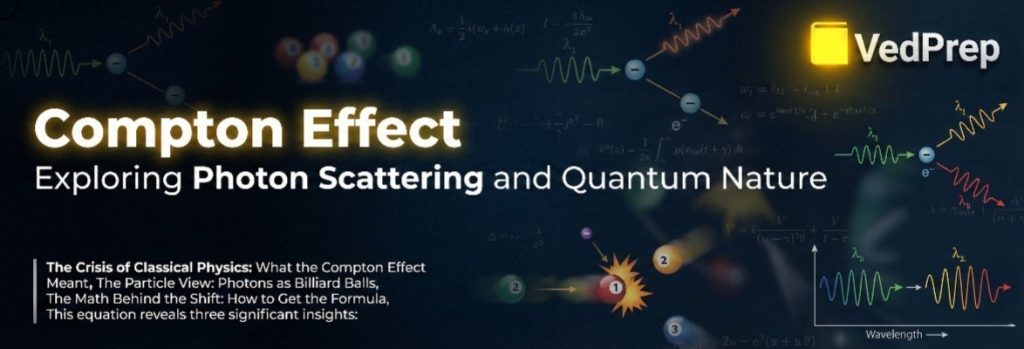

The Compton Effect in 2026: Looking into Photon Scattering and the Unbreakable Quantum Nature of Light
We live in a world powered by quantum technologies in the year 2026. The word “Quantum Nature” is no longer just a buzzword; it is the foundation of our daily lives. For example, quantum sensors keep an eye on our climate, and Q-bits process our data. But the path to this reality began more than a hundred years ago with a few important experiments that changed the way people thought about the universe. The Compton Effect is one of the biggest of these.
The Photoelectric effect suggested that light might act like a particle, but Arthur Holly Compton’s 1923 experiment was the final blow to classical wave theory. He demonstrated that light possesses momentum, a characteristic formerly attributed solely to mass.
Students who are getting ready for competitive exams like CSIR NET, GATE, or JEST in 2026 need to do more than just memorize the shift formula; they need to understand the basic Quantum nature of radiation. In this long guide, we will go beyond the derivation. We will look at how collision dynamics works, why classical electrodynamics doesn’t work, and how this effect is used in the advanced medical imaging and material analysis technologies of 2026.
The Crisis of Classical Physics: What the Compton Effect Meant
In order to understand the answer, we need to know what the problem is. Maxwell’s classical wave theory of light was the most popular idea in the early 1900s. This theory says that X-rays were waves of electricity.
Classical physics said that if you shot an X-ray wave at an electron, this would happen:
The electron would move back and forth at the same speed as the wave that was coming in.
Then the electron would scatter the wave at the same frequency and wavelength as before.
The scattering shouldn’t change with the angle of the wavelength shift.
But when A.H. Compton shot monochromatic X-rays at a graphite target, he saw something that shouldn’t be there. He saw that the scattered X-rays had a longer wavelength (lower energy) than the X-rays that hit them. Also, this change in wavelength only depended on the angle of scattering.
The classical theory fell apart. It was unable to elucidate the reason for the alteration in the “color” (wavelength) of the X-ray. This oddity called for a new way of looking at things, one that accepted the Quantum nature of light.
The Particle View: Photons as Billiard Balls
Compton was a genius because he thought of the interaction as two billiard balls hitting each other instead of a wave washing over a stone. He used Planck and Einstein’s idea of the quantum nature of light, which says that light is made up of small packets of energy called photons.
The Anatomy of the Crash
Think of playing pool. The cue ball (the X-ray photon) hits a target ball (the electron) that is not moving.
The Hit: The photon hits the electron.
The Transfer: The photon gives the electron some of its kinetic energy and momentum.
The Recoil: The electron is pushed away (recoil electron), which gives it more kinetic energy.
The Scatter: The photon bounces off at an angle. It must have less energy now that it lost energy to the electron.
When it comes to waves, lower energy doesn’t mean lower amplitude; it means lower frequency and longer wavelength. This straightforward mechanical analogy elucidated the wavelength shift, offering irrefutable evidence of the quantum characteristics of electromagnetic radiation.
The Math Behind the Shift: How to Get the Formula
The Compton Effect is beautiful to a physics student because of how mathematically simple it is. It is based on two important laws of physics: the Law of Conservation of Energy and the Law of Conservation of Momentum.
Setting the Variables $λ: The wavelength of the photon that hit the surface first.λ’: The last wavelength of the scattered photon.h: Planck’s constant. $m_0$: The electron’s rest mass.c: The speed of light.θ: The angle at which the photon spreads out.
The Logic of Derivation
Compton came up with the famous “Compton Shift” formula using Relativistic Mechanics (because the recoil electron moves very fast). This equation tells us how quantum the interaction is: $The difference between two wavelengths, $\Delta \lambda = \lambda’ – \lambda = \frac{h}{m_0 c} (1 – \cos \theta)$, is equal to the difference between the two wavelengths.
This equation reveals three significant insights:
Independence from Material: The change ($\Delta \lambda$) does not depend on the target’s material (gold, carbon, etc.). It only depends on the angle of scattering ($\theta$).
The Compton Wavelength: The number $\frac{h}{m_0 c}$ is a constant that is called the Compton Wavelength of the electron ($\lambda_c$). It is about $0.0243 Å$ (Angstroms) or $2.43 \times 10^{-12}$ meters in size.
Angle Dependency: When $\theta = 0^\circ$ (Grazing collision), $\cos 0 = 1$, and $\Delta \lambda = 0$. There is no shift.
If $\theta = 90^\circ$, then $\cos 90 = 0$ and $\Delta \lambda = \lambda_c$.
If θ = 180° (head-on collision), then cos 180 = -1 and Δλ = 2λc. This is the biggest shift that can happen.
This formula matches experimental data with amazing accuracy, proving that the interaction between photons and electrons is quantum in nature.
What are X-Rays? The Significance of High Energy
“Why don’t we see the Compton Effect with visible light?” is a common question in job interviews.
The answer is in the relative scale. The Compton shift ($\Delta \lambda$) is very small, about 0.024 Å.
The wavelength of visible light is about 5000 Å. A change of 0.024 Å is too small (0.0005%) to be noticed.
X-Rays: The wavelength is about 1 Å. A change of 0.024 Å is important (about 2.4%) and can be easily measured.
This shows that the quantum nature of particle-like scattering only becomes important at high energies (high frequency/short wavelength). When the energy is lower, the wave nature takes over, and we see things like Rayleigh scattering instead.
The Compton Effect and the Photoelectric Effect
In the study of the quantum nature of light, these two effects are related but not identical. It is very important to be able to tell them apart for the 2026 exams.
Feature
The Photoelectric Effect
Effect of Compton
Level of Energy
Low to Medium Energy (UV/Visible)
High energy (X-rays and gamma rays)
What Happens to Photons
The photon is completely taken in. It goes away.
The photon is spread out. It lives, but with less energy.
Status of the Electron
Ejected electrons are usually bound.
The goal is to find loosely bound or free electrons.
Proof of the particle nature (quantization of energy).
The quantization of momentum shows that particles have a certain nature.
Both phenomena are fundamental pillars underpinning the Quantum nature of radiation, yet they signify distinct interaction regimes.
The Recoil Electron’s Kinetic Energy
Not only does the Compton Effect have to do with the photon, but it also has to do with the electron. The electron gets the energy that the photon loses.$KE_{electron} = h\nu – h\nu’$ and $KE_{electron} = hc \left( \frac{1}{\lambda} – \frac{1}{\lambda’} \right)$
You can find this recoil electron. In fact, we can see the path of this recoil electron in modern cloud chambers and particle detectors from 2026. This gives us a second layer of proof that the collision was quantum in nature.
The direction of the recoil electron ($\phi$) is also related to the angle at which the photon scatters ($\theta$):$\cot \phi = (1 + \alpha) \tan (\theta/2)$, where $\alpha = \frac{h\nu}{m_0 c^2}$.
The Astrophysical Giant: Inverse Compton Scattering
The “Inverse” Compton Effect is a big part of what we know about the universe in 2026.
The Process: What happens when a low-energy photon hits a high-energy electron? The flow of energy changes direction. The electron gives the photon energy.
The outcome: A low-energy photon (like a microwave) is turned into a high-energy Gamma ray.
This is because of the same Quantum nature that makes black holes and supernovae emit high-energy Gamma rays. It is the way that the universe speeds up light.
Modern Uses in 2026
The Compton Effect isn’t just something that happened a long time ago. It is a useful tool in both industry and medicine in 2026.
Compton Cameras in Health Care
X-rays that are more common give us shadows (absorption). But “Compton Cameras” look at the photons that have bounced off of things. This makes it possible to make 3D models of tissues without the high radiation dose of a CT scan. Doctors can find the exact density of a tumor by looking at the angles at which it scatters. This is possible because of the Quantum nature of scattering, which saves lives.
Scanning Cargo and Airport Security
The full-body scanners at airports use a technology called Compton Backscatter imaging. It can find low-density materials that regular X-rays might miss, like plastics or organic explosives. Backscattered X-rays (that bounce off the object) tell you the atomic number of the material, which lets security AI find threats right away.
Defects and Material Science
In 2026, engineers will use Compton scattering to find tiny cracks in turbine blades and aerospace composites. Because the scattering depends on the density of the electrons, any hole or crack changes the pattern of the scattering, showing flaws inside the part without breaking it.
VedPrep: Seeing the Quantum World
To understand the Compton Effect, you have to use your imagination to go from the world of waves that you can see to the world of particle collisions that you can’t see. If you want to pass the CSIR NET or GATE exam in 2026, relying on rote memorization of the shift formula is a sure way to fail. You need to picture the Quantum nature of the event.
This is where VedPrep changes how you learn.
We at VedPrep think that advanced physics should be easy to understand.
Interactive Collision Models: Our modules don’t just show you the formula; they let you change the variables and see what happens. Change the angle $\theta$ and watch the wavelength change in real time.
We break down the steps of the relativistic momentum conservation that confuse most students, turning complicated math into a clear story.
Solving Problems with an Exam in Mind: We look at the trend of questions over the past ten years, focusing on the hard “Recoil Energy” and “Maximum Shift” problems that set the best students apart from the rest.
VedPrep can help you turn the Compton Effect into your highest-scoring topic, whether you’re having trouble with the idea of relativistic mass or the geometry of scattering angles. Don’t just learn about the quantum nature of light; learn it well with VedPrep.
Final Thoughts
The Compton Effect is not just a change in wavelength; it is a change in the way we think about things. The experiment made scientists accept that light, which is the most ethereal of substances, has the punch of a particle. It made the Quantum nature of reality stronger.
Arthur Compton’s discoveries about how energy flows in the universe apply to everything from the tiny billiard game between photons and electrons to the huge gamma-ray bursts that happen all over the galaxy.
The Compton Effect is still a shining example of quantum mechanics in 2026, when we use these ideas to improve healthcare, make travel safer, and explore space more deeply.
It is very important for a physics student to understand this topic. It links the old laws of conservation with the new laws of quanta. It connects the past and the present.
So, when you figure out the shift $\Delta \lambda$, keep in mind that you are figuring out the quantum world’s heartbeat.
Frequently Asked Questions (FAQs)
What fundamentally did the Compton Effect prove that classical physics could not?
Ans: The Compton Effect proved that light possesses momentum, a property previously thought to belong only to mass. While the Photoelectric effect suggested particle-like behavior, Compton's experiment dealt the final blow to classical wave theory by showing light acting like billiard balls rather than waves.
Why did classical wave theory fail to explain Compton's observations?
Ans:
Classical physics predicted that an electron hit by an X-ray would oscillate at the same speed as the incoming wave and scatter it at the exact same frequency and wavelength. It could not explain why Compton observed scattered X-rays with longer wavelengths (lower energy).
What is the "Billiard Ball" analogy used to describe the Compton Effect?
Ans: Arthur Compton visualized the interaction as a collision between two billiard balls: the photon (cue ball) hits a stationary electron (target ball). During the "hit," the photon transfers kinetic energy and momentum to the electron, causing the photon to scatter with less energy (longer wavelength) and the electron to recoil.
Does the material of the target affect the wavelength shift?
Ans: No. One of the significant insights from the Compton equation is that the wavelength shift ($\Delta \lambda$) is independent of the target material (e.g., gold vs. carbon). It depends solely on the angle of scattering
Why don't we observe the Compton Effect with visible light?
Ans: The Compton shift ($\Delta \lambda$) is approximately 0.024 Å, which is significant for X-rays (wavelength ~1 Å) but negligible for visible light (wavelength ~5000 Å). For visible light, the change is only about 0.0005%, which is too small to notice, whereas for X-rays, it is a measurable 2.4%
What is the formula for the Compton Shift?
Ans: The formula is $\Delta \lambda = \lambda' - \lambda = \frac{h}{m_0 c} (1-\cos \theta)$. Here, $h$ is Planck's constant, $m_0$ is the electron's rest mass, $c$ is the speed of light, and $\theta$ is the scattering angle.
Under what condition is the Compton shift zero?
Ans: The shift is zero during a "Grazing collision" when the scattering angle $\theta$ is $0^\circ$. In this case, $\cos 0 = 1$, making the term $(1 - \cos \theta)$ equal to zero.
When does the maximum wavelength shift occur?
Ans: The maximum shift occurs during a head-on collision where the scattering angle $\theta$ is $180^\circ$. At this angle, the shift is equal to $2\lambda_c$ (twice the Compton wavelength).
How does the Compton Effect differ from the Photoelectric Effect regarding the photon's fate?
Ans: In the Photoelectric Effect, the photon is completely absorbed and disappears. In the Compton Effect, the photon is scattered; it survives the interaction but continues with reduced energy.
What is the "Inverse Compton Effect"?
Ans: This process occurs when a low-energy photon interacts with a high-energy electron, causing the energy flow to reverse. The electron transfers energy to the photon, turning low-energy photons (like microwaves) into high-energy Gamma rays.