




Ultimate guide on the categorization of elementary particles subject (2026 edition)
The great aspect is you received a texture of grit, keeping things straight forward and simple. You were squelching him. And learn this, He’s crushing the dust. Stay until you reach. The real advantage is what you have is small things, but the Abs of the universe, keeping things straight forward and uncomplicated. Basically, these are elementary particles, invisible components refute the reality of everything, from fusion in our sunlight to mentions are riving in your brain.
Here’s what you should know: in 2026, our of these particles deepened. The standard model remains. Having worries? It’s a physics educator, a SIR EARNINGS aspirant or a curious thinker, the categorization of elementary particles is your gateway to New physics.
Hoping to produce things easygoing? In other words, in this guide, we go beyond the elementary particles definitions of the manual. We will study exacting categorization free-based on thorn, mass, and interaction, the Ghost Particles,” astounding scientists in 2026 and see what is beyond the standard framework, enabling taking the stress out.
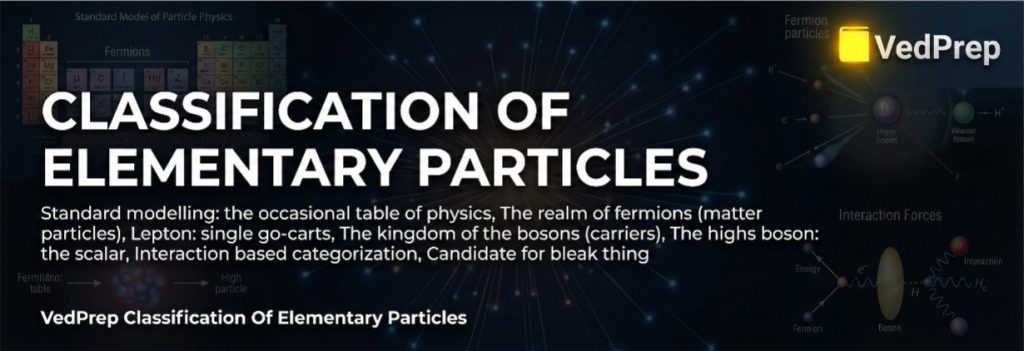
Standard modelling: the occasional table of physics
The standard model is. What it comes down to is to consider this as the periodic table for subatomic physics, but rather of chemical elements, we have quantum battlefields.
This is astonishingly simple: in the standard modeling, uncomplicated particles are tiny balls, but excitations of quantum areas penetrate the universe. You’all find that this model divides particles into Two realms, based on a quantum place telephoned tailspin.
The realm of fermions (matter particles)
What makes this dissimilar is if the universe were a home, fermion would be the stones. So basically, it is the Elementary particles that form the affairs of things. This is effortlessly bare: they follow a hard-and-fast rule called the paul exclusion principle, which entails they are territorial; no Two fermions can take the same quantum state at the same time. This underground effort.
Here’s what happens: the closures are labeled with half-integers ($ 1/2, 3/2, \dots $). They are parted into.
Quarks: social introverts (Elementary particles)
You never find Quark alone. This is preposterously easy: they are the social introverts of particles, which are always piled in radicals to organize composite particles called hadrons (such as protons and neutrons). Wish you could make things easygoing? Just put, this phenomenon is called color limitation.
So basically, there are Six quarks ‘flavors’, which are split into Three generations:
Up & Down: Twinkle and stable. Put simply, they shape protons and neutrons in your body.
So fundamentally, Charm & Strange: heavier and unstable, found in cosmic rays and mellow energy throttles.
So essentially, top & bottom: the Quark class’s intemperate goods vehicles only produce under extreme shapes such as the marvelous hadron collider (Lac).
Lepton: single go-carts
This is attractively crafted: unlike quark, the leptons are independent. You’all find that you can travel in the population alone. Would you wish to make things easier? Basically, the most celebrated Lepton is the electron that enlivens our New world.
Thing is, leptons are present in Three geneses:
So basically, neutrino electrons & electrons: stable genesis.
Components is, muon & muon Neutrino: heavier versions of the electron, often grown in the upper atmosphere.
Real talk: Tau & Tau Neutrino: the hardest and most precarious leptons.
What makes this dissimilar is the line on aperient 2026: in Recent Years, the classification of elementary particles has been powerfully concentrated on Lepton’s universality. So fundamentally, constituents of experiments such as luck have suggested negations, Mu-Mesons and rosebushes could not act precisely like this during decomposition, which could crack the standard model. This is an excellent option: recent data, have rewarded confinements, which has left the standard modeling to remain resilient and enthralling.
The kingdom of the bosons (carriers)
You’all find that if the settlements are the stones, the bosons are the cementum. They are the violence. Interestingly, this is cleverly planned: unlike fermions, bosons are sociable; they can jam in the same quantum state (which allows fresh phenomena like lasers and super fluids).
The move: bosons are marked with an integer pine ($ 0, 1, 2, \dots $).
The quantifying bosons: messengers
Element is, these primary particles carry the forces of nature:
Veridical talk: gluons (strong force): the layer sustains quark protons and neutrons.
Essay this: photons (electro magnetic force): particles of light predominate electricity, magnetism, and alchemy.
So basically, W, and z bosons (weakness): heavy strange substitution banks responsible for radioactive rotting and nuclear coalition.
The highs boson: the scalar in Elementary particles
Unlike other alternatives, the high Boson, found in 2012, is often visited by God’s particle (physicists do not like the term). Fun fact: Require a hand? It’s a Boson Scaler (Spin 0). The cool thing is, its character is not to carry a violence in the traditional sense, but to interact with the high battlefield. Component is, other elementary particles swim through this sphere, they learn Mass. What’s particular here is without the highs, electrons would slip at the speed of light, atoms would not shape and live, we would not exist.
Alternative classifications: mass and interaction in Elementary particles
The solvent? The standard framework is the banner, physicists often employ other methods to relegate unproblematic particles to complex problems.
Classification by mass
The thing is, historically, before you knew about quark, particles were sorted by weight category, like packers.
Lepton (light): Originally thought the unaccentedest. (E.G. Electrons).
Messene (average): intermediate plenty of particles (pions, hugs, Et. ), giving you the power to produce a breeze. Here’s what you should bang: we now these are particles composed of a quark and an antiquary.
Would you like to make things easygoing? In plain , English, baryons (heavy weight): heavy goods vehicles (e.G. Protons, neutrons). This is refreshingly straightforward: they’re made of Three quarks.
Here’s what occurs: why this scheme failed: the discovery of the Lepton De Tau violated this system. Dew is a Lepton.
Interaction based categorization in Elementary particles
Entity is, this is an extremely practical proficiency of classifying elemental particles in the analysis of nuclear responses.
Care you could fabricate things leisurelier? In other intelligence, hadrons: particles the knock-down atomic forcefulness. (E.G. Protons, neutrons, pawns). Just so you love, note: hadrons are not elementary, they are colonial.
Leptons: unreasoning particles for powerful force. You can employ only the watery force and (if charged) the electromagnetic violence.
So fundamentally, photons: particles are only involved in electromagnetic interactions (and gravity).
The bounds of 2026: beyond the standard modeling in Elementary particles
This is refreshingly square: the standard model explains almost everything, but it has shortcomings. You can use it not for gravity, inglorious matter, nor for the intellect why the population is composed of subject rather than antimatter. What’s nice about this is here, the New classification of elementary particles becomes.
Neutrinos: the chama eleons of the population elementary particles
Would you care to produce things easier? In plain English, neutrinos are the Johnnies of elementary particles. You’all see that in the initial standard model, they were assumed to be massless. We know they have a flyspeck mass and oscillate (the taste of change) they trip, serving you making it a breeze.
The move: late experimentation (such as dune and hyper-Camiocand) try to decide the mass order of Neutrinos. Are Two of them light and One impenetrable, or vice versa? This is preposterously effortless: the resolution could reveal the arcanums of the primitive universe.
Candidate for bleak thing
Dream of establishing matters easier? Simply put, we can see the gravitational effects of dark matter, but we haven’t caught any particles yet. Plus, new possibilities propose simple particles Secret Sector will interact little with our visible world, aiding you keeping things simple.
Plus, wimp (low interacting massive particles): heavy candidate, like a fermion.
What solves: axioms: hypothetical ultralight bosons could solve the warm Pa problem in quantum chromodynamics.
Supersymmetry (busy) in Elementary particles
the LAC has not. What it occurs down to is this possibility suggests every known primary particle has a heavier super partner.
So fundamentally, quarks $ \rightarrow $ squares
Element is, electrons $ \rightarrow $ electrons
Element is, photons $ \rightarrow $ photos
Here’s the aspect: if we find out, it would repeat the classification of elemental particles and could solve the whodunit of dark topics (the lightest supersymmetric particles being a main candidate).
Why categorization materials for your physical career
Confronting challenges? It is necessary to memorize memories by heart to understand the categorization of elementary particles. Here’s what’s outstanding: You’ll find that it is about the symmetries of nature.
Here’s how: nature security laws: a particle is a Lepton or Baryon evidences you what nature security laws (Lepton number, baryon number) hold in response.
Ever asked yourself to ameliorate your situation? What actually materializes is quantum mechanism: if a particle is a fermion, screwing, or boson determines the statistical math you utilize (ferm dirac vs. The Bose Einstein data).
Aspect is, for students who are prosecuted in competitive exams such as Sir next Physical sciences or gate aperients, this idea is staggeringly rich. The questions pupils ask. Or to rules of conservation in disintegration, serving you keeping things uncomplicated.
Speed your physical trip with vedprep
Are you fighting for the quantum field hypothesis or for the subtleties of particle physics? This is precisely what you need: you are pointing for Sir Net, gate, it jam or cut Pg, self-study can sometimes try to solve a differential equating without marginal statuses unfolding and strenuous.
The thing is, Vedprep’s coming in here.
Real talk: as the leading institute of scientific inspiration, Vedprep (Them Academy/Physics Academy) has become the carriage’s leaders for competitive purgative exams.
So basically, why opt for vedprep for physics?
Here’s what matters: faculty of: instructed from mentors like red sir and the specialized physical team who teach rules but your conceptual hunch.
Structured program: your courses. You can divide complex themes such as the division of elementary particles into digestible modules and overcompensate the entire program without burnout.
Frequently Asked Questions (FAQs)
What is the Standard Model in physics?
Ans: The Standard Model is essentially the periodic table for subatomic physics. Instead of chemical elements, it categorizes quantum battlefields, viewing particles as tiny balls or excitations of quantum areas that penetrate the universe.
How does the Standard Model fundamentally divide particles?
Ans: The model divides particles into two main realms based on a quantum property referred to as "tailspin" (spin). These two realms are fermions (matter particles) and bosons (carriers).
What are Fermions?
Ans: Fermions are described as the "stones" of the universe if the universe were a home. They are the particles that form the substance or "affairs" of things.
What is the Pauli Exclusion Principle?
Ans: This is a hard-and-fast rule followed by fermions. It states that fermions are territorial; no two fermions can take the same quantum state at the same time.
What are Quarks and why are they called "social introverts"?
Ans: Quarks are termed "social introverts" because you never find a Quark alone. They are always piled in groups to organize composite particles called hadrons, such as protons and neutrons.
What are the three generations of Quarks mentioned in the guide?
Ans: The three generations are:
Up & Down: Stable particles that shape protons and neutrons.
Charm & Strange: Heavier and unstable, found in cosmic rays.
Top & Bottom: Produced only under extreme conditions like those in the Large Hadron Collider.
How do Leptons differ from Quarks?
Ans: Unlike quarks, leptons are independent "single go-carts" that can travel alone. The most celebrated Lepton is the electron.
What suggests that the Standard Model might be cracking regarding Leptons?
Ans: Recent experiments have suggested negations where constituents like Mu-Mesons might not act precisely as predicted during decomposition. However, recent data has rewarded confinements, keeping the Standard Model resilient.
What are Bosons?
Ans: If fermions are the stones, bosons are the "cementum" or the force carriers. Unlike fermions, they are sociable and can jam into the same quantum state, allowing for phenomena like lasers.
What specific forces do the different Bosons carry?
Ans:
Gluons: Carry the strong force (sustaining quarks).
Photons: Carry the electromagnetic force (light, magnetism, electricity).
W and Z Bosons: Carry the weak force (responsible for radioactive rotting).