




Electrochemistry in 2026: Unlocking the Future of Energy, Concepts, and Modern Applications
Welcome to 2026. Look around you. The electric vehicles (EVs) silently gliding on the streets, the grid storing solar power for the night, the wearable biosensor monitoring your glucose levels—they all share a common heartbeat. That heartbeat is Electrochemistry.
While traditional textbooks define it as the study of chemical processes that cause electrons to move, in the modern era, Electrochemistry has evolved into the central pillar of global sustainability. It is no longer just about rusting iron or simple galvanic cells; it is about the “Hydrogen Economy,” solid-state energy storage, and neuro-interfaces.
For students preparing for high-level competitive exams like CSIR NET, GATE, or BARC, and for enthusiasts trying to understand the engine of the 21st century, a superficial understanding is no longer enough. You need to dive deep into the thermodynamics of interfaces and the kinetics of charge transfer.
In this extensive guide, we will go beyond the standard definitions found in competitor blogs. We will explore the nuanced concepts of the electrical double layer, the kinetics that dictate battery charging speeds, and the futuristic applications that are defining the year 2026.
Redefining the Core: What is Electrochemistry?
At its most fundamental level, Electrochemistry is the science of the interface. It is the study of what happens when an electronic conductor (an electrode) meets an ionic conductor (an electrolyte). It is at this boundary that the magic happens—where chemical energy translates into electrical energy, and vice versa.
In 2026, we view Electrochemistry through the lens of “Electron Transfer Dynamics.” It isn’t just about balancing redox equations; it’s about understanding the energy barriers that electrons must surf over to move from one species to another. It bridges the gap between the chaotic, thermal world of chemistry and the organized, directed world of physics and electricity.
The Redox Revolution
The foundation of Electrochemistry remains the Redox (Reduction-Oxidation) reaction.
- Oxidation: The loss of electrons. Think of it as “letting go” of energy.
- Reduction: The gain of electrons. Think of it as “accepting” potential.
However, in a beaker, these happen chaotically, releasing heat. Electrochemistry separates these two halves spatially. We force the electrons to travel through a wire to get from the reductant to the oxidant. By making them travel, we extract work. This controlled flow is what powers our world.
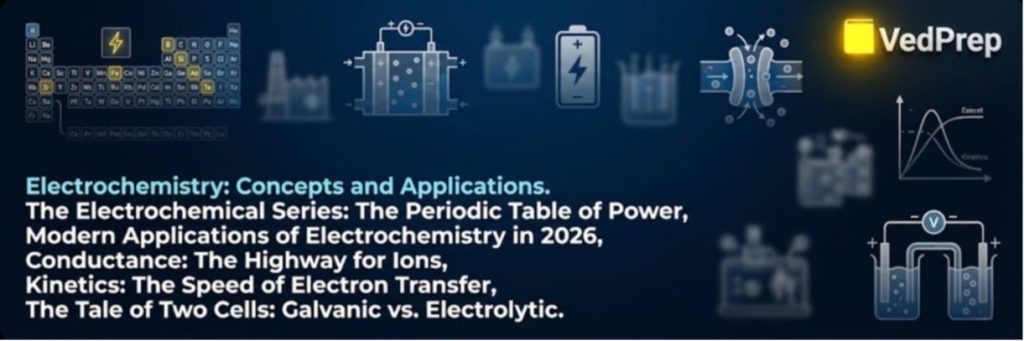
The Tale of Two Cells: Galvanic vs. Electrolytic
While most blogs give you a simple table of differences, let’s analyze the physics behind these two systems, as understanding them is crucial for mastering Electrochemistry.
Galvanic Cells: The Spontaneous Engine
A Galvanic (or Voltaic) cell is an energy generator. It harnesses a spontaneous chemical reaction ($\Delta G < 0$) to produce electricity.
- The 2026 Context: The lithium-ion battery in your phone is essentially a galvanic cell during discharge. The graphite anode wants to give up electrons, and the metal-oxide cathode wants to take them. The voltage produced is simply the difference in their “desire” for electrons.
- The Polarity Flip: In a Galvanic cell, the Anode is Negative. This confuses many students. Why? Because the anode is the source of electrons (oxidation happens there), so it accumulates a negative charge relative to the wire.
Electrolytic Cells: The Driven Machine
An Electrolytic cell is an energy consumer. We use external electrical work to force a non-spontaneous reaction ($\Delta G > 0$) to occur.
- The 2026 Context: Green Hydrogen production is the prime example. We pump electricity (from solar or wind) into water to split it into Hydrogen and Oxygen. The water doesn’t want to split; we force it to.
- The Polarity Flip: Here, the Anode is Positive. Why? Because we are sucking electrons out of it using an external battery to force oxidation.
Shutterstock
Explore
The Thermodynamics of Electrochemistry: The Nernst Equation and Beyond
Thermodynamics tells us what is possible. In Electrochemistry, the potential (Voltage) is a direct measure of the free energy change.
The Fundamental Link
The relationship that binds chemistry to electricity is:
$$\Delta G = -nFE$$
- $\Delta G$: Gibbs Free Energy (The available work).
- $n$: Number of electrons transferred.
- $F$: Faraday’s Constant (The charge of a mole of electrons).
- $E$: Cell Potential.
This equation proves that if $E$ is positive (cell voltage), $\Delta G$ is negative (spontaneous). It is the mathematical proof that batteries work naturally.
The Nernst Equation: Reality vs. Standard Conditions
Standard potentials ($E^\circ$) assume concentrations of 1 Molar. But in real life—and in the exams you face—concentrations change. As a battery dies, reactants are consumed. The Nernst equation allows us to calculate the voltage at any moment:
$$E_{cell} = E^\circ_{cell} – \frac{RT}{nF} \ln Q$$
In 2026, understanding Nernst is critical for “State of Health” (SOH) monitoring in EVs. The car’s computer uses modified versions of this Electrochemistry principle to tell you how many miles you have left before you need to recharge.
Kinetics: The Speed of Electron Transfer
This is where your competitors stop, but where true understanding begins. Thermodynamics tells us a battery can work, but Kinetics tells us how fast it can charge.
The Electrical Double Layer (EDL)
When an electrode sits in a solution, it doesn’t just sit there. Ions align themselves on the surface to balance the charge, creating a capacitor-like structure called the “Double Layer.”
- Why it matters: In Supercapacitors (used in regenerative braking in trains), we store energy not in chemical bonds, but in this physical double layer. Understanding the EDL is the frontier of Electrochemistry.
Overpotential: The Tax on Energy
Have you noticed your phone heats up when fast-charging? That is due to “Overpotential.”
To drive a reaction fast, we must apply a voltage higher than the thermodynamic requirement. This extra voltage is wasted as heat.
- Activation Overpotential: The energy needed to push the electron across the electrode-electrolyte interface.
- Concentration Overpotential: The traffic jam of ions trying to reach the electrode surface.
Mastering Electrochemistry means minimizing these overpotentials to create highly efficient systems.
Conductance: The Highway for Ions
For electrons to flow in the wire, ions must flow in the solution. This is electrolytic conductance.
Kohlrausch’s Law of Independent Migration
This law states that at infinite dilution, every ion contributes a definite share to the total conductance, regardless of its co-ion.
- The Application: In 2026, this principle is used in designing “Solid State Electrolytes.” Scientists use Kohlrausch’s concepts to find solid materials where lithium ions can hop freely, eliminating the fire risk of liquid electrolytes.
Molar Conductivity vs. Concentration
A classic exam trap:
- Conductivity ($k$) decreases with dilution (fewer ions per unit volume).
- Molar Conductivity ($\Lambda_m$) increases with dilution (ions are far apart and move more freely without dragging each other down).
Modern Applications of Electrochemistry in 2026
The reason Electrochemistry is the buzzword of the decade is its applications. We have moved far beyond galvanizing steel buckets.
1. The Hydrogen Economy (Fuel Cells & Electrolyzers)
Hydrogen is the fuel of the future, and Electrochemistry is the only clean way to make it and use it.
- PEM Electrolyzers: Using polymer membranes to split water with high efficiency.
- Fuel Cells: Cars and heavy trucks now run on hydrogen fuel cells, which are essentially “refillable batteries” that emit only water. The catalyst design (often Platinum) is a major area of electrochemical research.
2. Next-Gen Energy Storage
- Solid-State Batteries: Replacing the liquid acid/organic solvent with a solid ceramic. This makes batteries safer and more energy-dense.
- Flow Batteries: For grid storage, we use huge tanks of liquid electrolytes (like Vanadium) that are pumped past electrodes. This allows cities to store renewable energy for days.
3. Bio-Electrochemistry and Sensors
Your smartwatch in 2026 might track your lactate levels during a workout. How?
- Enzymatic Biosensors: These devices use an enzyme to react with a biological molecule (like glucose), producing electrons. An electrode captures these electrons, giving a reading. This fusion of biology and Electrochemistry is revolutionizing healthcare.
4. Corrosion Engineering
Rust costs the global economy trillions. Modern Electrochemistry uses “Cathodic Protection” not just for pipelines, but for the reinforced concrete in our skyscrapers and bridges, using impressed currents to stop oxidation in its tracks.
The Electrochemical Series: The Periodic Table of Power
To predict what reacts with what, we look at the Electrochemical Series. It ranks elements by their Standard Reduction Potential ($E^\circ$).
- Top of the list (High +ve $E^\circ$): Strong Oxidizing Agents (Fluorine). They love electrons.
- Bottom of the list (High -ve $E^\circ$): Strong Reducing Agents (Lithium). They love to give away electrons.
The 2026 Perspective: This series explains why Lithium is the king of batteries. It has the lowest potential (-3.05 V) and is the lightest metal. It creates the largest voltage gap (potential difference) when paired with a strong oxidizer, giving us high energy density.
Master Electrochemistry with VedPrep
Electrochemistry is notoriously difficult. It combines the abstract math of thermodynamics with the invisible world of atomic physics. Standard textbooks often confuse students with sign conventions (Is the anode positive or negative?) or get lost in the derivation of the Debye-Hückel theory without explaining why it matters.
This is where VedPrep transforms your preparation.
At VedPrep, we believe that Electrochemistry should be visualized, not just memorized.
- Visualizing the Invisible: Our modules use 3D animations to show you exactly what happens at the “Double Layer” interface, making concepts like Overpotential intuitive rather than abstract.
- Problem-Solving Strategy: We teach you the “Sign Convention Hacks” that ensure you never get the Anode/Cathode polarity wrong in a GATE or CSIR NET exam question.
- Bridging the Gap: We connect the classical Nernst equation to modern battery technology, ensuring that you aren’t just learning for an exam, but learning for a career in science.
- Advanced Topics: Whether it is Polarography, Cyclic Voltammetry, or Potentiometric Titrations, our expert faculty breaks down the complex instrumentation into simple, digestible concepts.
If you are aiming to crack the toughest exams in India, you need a partner who understands the depth of the subject. VedPrep provides the structured, concept-driven approach you need to turn this challenging unit into your strongest asset.
Conclusion
Electrochemistry is the bridge between chemical matter and electrical energy. It is the science that allows us to carry energy in our pockets and is the key to a carbon-neutral future. From the microscopic movement of ions in a neuron to the gigawatt-scale storage of a flow battery, the principles remain the same.
In 2026, the importance of Electrochemistry has transcended the laboratory. It is now a geopolitical and economic force. Understanding the Nernst equation, the kinetics of the electrode interface, and the laws of conductance is not just academic exercises—they are the blueprints for the next generation of technology.
As you continue your studies, remember that every time you charge your device, start your electric car, or see a solar panel, you are witnessing Electrochemistry in action. It is a vibrant, evolving field waiting for the next generation of scientists to explore its depths.
Frequently asked questions (FAQs)
1. How is Electrochemistry defined in the modern era of 2026?
Ans: While traditional definitions focus on chemical processes moving electrons, in 2026, Electrochemistry is viewed as "Electron Transfer Dynamics" and the "science of the interface". It is considered the central pillar of global sustainability, bridging the gap between the chaotic world of chemistry and the organized world of physics
What is the fundamental difference between oxidation and reduction?
Ans: Oxidation is the loss of electrons, which can be thought of as "letting go" of energy. Reduction is the gain of electrons, or "accepting" potential. In a controlled system, we force electrons to travel through a wire between these two processes to extract work.
What is the relationship between Gibbs Free Energy and Cell Potential?
Ans: The relationship is defined by the equation $\Delta G = -nFE$6. This proves that if the Cell Potential ($E$) is positive, the Gibbs Free Energy ($\Delta G$) is negative, meaning the reaction is spontaneous and the battery works naturally7.
What is the main difference between Galvanic and Electrolytic cells?
Ans: A Galvanic cell is an energy generator that harnesses a spontaneous reaction ($\Delta G < 0$) to produce electricity, like a discharging battery8. An Electrolytic cell is an energy consumer that uses external work to force a non-spontaneous reaction ($\Delta G > 0$), such as splitting water into hydrogen9999
Why is the Anode negative in a Galvanic cell but positive in an Electrolytic cell?
Ans: In a Galvanic cell, the anode is the source of electrons (where oxidation happens), creating a negative charge relative to the wire. In an Electrolytic cell, the anode is positive because an external source sucks electrons out of it to force oxidation to occur.
Why is Lithium considered the "King of Batteries"?
Ans: According to the Electrochemical Series, Lithium has the lowest standard reduction potential (-3.05 V) and is the lightest metal. This allows it to create the largest voltage gap (potential difference) when paired with a strong oxidizer, resulting in high energy density.
What are Solid-State Batteries?
Ans: Solid-state batteries are next-generation storage devices that replace liquid acid or organic solvents with a solid ceramic electrolyte. This change makes the batteries significantly safer and more energy-dense.
What are Flow Batteries and how are they used?
Ans: Flow batteries use large tanks of liquid electrolytes (like Vanadium) that are pumped past electrodes. They are primarily used for grid storage, allowing cities to store renewable energy for days.
What is the Nernst Equation used for in 2026?
Ans: Beyond calculating voltage at non-standard concentrations, the Nernst equation is critical for monitoring the "State of Health" (SOH) in electric vehicles. Car computers use it to estimate how many miles remain before a recharge is needed.
hat is "Overpotential" and why does it cause batteries to heat up?
Ans: Overpotential is the extra voltage required to drive a reaction fast, exceeding the thermodynamic requirement. This excess energy is wasted as heat, which is why devices get warm during fast-charging.