




The 2026 edition of “Blackbody Radiation and Its Laws:
The Quantum Key to Unlocking the Universe “We take quantum technologies for granted in the year 2026, which is a scientific year. The quantum world is a part of our everyday lives, from the quantum sensors that keep an eye on our climate to the atomic clocks that help our GPS work. Yet, the door to this strange microscopic realm wasn’t opened by a particle accelerator or a supercomputer.
A simple, burning question about a hot object opened it. This is the story of Blackbody radiation, the event that changed classical physics and gave rise to the modern world. Standard textbooks may depict blackbody radiation as a mere compilation of formulas, yet it fundamentally serves as the Rosetta Stone for thermodynamics and quantum mechanics. It tells you why stars shine in different colors, why the universe has a background temperature, and how thermal cameras can see in the dark.
In this long guide, we will go beyond what other people say are the basic definitions. We will look at the historical crisis that made physicists rethink what is real, the beautiful laws that govern thermal emission, and how Blackbody radiation is still a key part of cutting-edge astrophysics and climate science in 2026.
The “Perfect” Absorber: What is a black body?
We need to know about the body before we can understand the radiation. In physics, a “blackbody” is a theoretical object that absorbs all electromagnetic radiation that hits it. It doesn’t reflect or send anything. It must also be the perfect emitter to stay in thermal equilibrium because it absorbs all energy.
A blackbody should look completely black at room temperature because it doesn’t reflect any light. But as it gets hotter, it starts to give off its own light, which is a glow that is unique to its temperature, not its material. We call this light Blackbody radiation.
The Perfect vs. The Real (The Box’s Hole)In nature, there is no such thing as a perfect blackbody.
But physicists came up with a smart way to get close: a hollow cavity with a small hole. The Trap: When light goes into the hole, it bounces around inside the cavity and is absorbed by the walls each time it hits them. It’s very unlikely that it will get out of the hole again. So, the hole works like a perfect sponge.
The Emission: If we heat the walls of the cavity, radiation will fill the inside of the cavity until it reaches thermal equilibrium. The light that comes through that tiny hole is the clearest example of Blackbody radiation we can see.
Why “Black” is the Wrong Word It’s hard to understand what “blackbody” means because these things are often very bright.
In our solar system, the Sun is one of the best examples of a blackbody. It absorbs almost all radiation that hits it and emits a spectrum of light determined purely by its surface temperature (~5800 K).Iron Bar Example: Imagine a blacksmith heating up a piece of iron. It’s black when it’s at room temperature.
As it gets hotter, it goes from dull red to bright orange to yellow and finally to “white hot.” This shift in color is the visible signature of Blackbody radiation shifting its peak wavelength.
The Ultraviolet Catastrophe:
The Crisis that Ruined Physics Physics in the late 1800s was sure of itself. Newton talked about how things move, Maxwell talked about how light works, and thermodynamics talked about how heat works. But something went wrong. Blackbody radiation’s curve could not be explained by classical physics.
Classical Physics Comes to a Standstill Classical theories, like the Rayleigh-Jeans Law, say that an object should give off more and more energy as the frequency of light goes up The Prediction:
The energy given off should go up to infinity as the wavelength gets shorter (into the ultraviolet and beyond).The Reality: Experimental data demonstrated that radiation reaches a maximum at a specific wavelength and subsequently declines to zero at elevated frequencies (UV range).
The Disaster People called this difference the “Ultraviolet Catastrophe.”
If classical physics were right, opening the door to your oven (a hot space) would expose you to deadly amounts of X-ray and ultraviolet radiation. The fact that we don’t die every time we bake a cake showed that classical physics was not complete. This failure made it possible for Max Planck to figure out the mystery of Blackbody radiation.
The Rules That Control the Glow Three main laws explain how Blackbody radiation works.
Your competitors will list them, but we will explain why they are important and how they are connected.
1. The Power of Heat:
The Stefan-Boltzmann Law This law connects the temperature of a blackbody to the total energy it gives off. The Equation: $E = \sigma T^4$ is the amount of energy that comes out of a unit of surface area. The Stefan-Boltzmann constant, $\sigma$ (Sigma), is $5.67 \times 10^{-8} \, \text{W/m}^2\text{K}^4$.
The absolute temperature in Kelvin is $T$.The Insight: Four is a very strong number. When you double the temperature of a star, its energy output doesn’t just double; it goes up by $2^4 = 16$ times! This is why stars that are hotter are much brighter than stars that are cooler, even if they are the same size. Blackbody radiation is very sensitive to changes in temperature.
2. Wien’s Law of Displacement:
The Color of FireThis law tells us why heated objects change color. It says that the temperature is inversely related to the wavelength ($\lambda_{\text{max}}$) at which the radiation is strongest.The Equation: $\lambda_{\text{max}}$ T = b$$b$ is Wien’s displacement constant ($2.898 \times 10^{-3} \, \text{m}\cdot\text{K}$).
The Application: Cool Stars (3000 K): Peak in the infrared/red. For example, Betelgeuse looks red.
Stars like the Sun (5800 K): The yellow-green color is the brightest. They look yellow and white.
Hot Stars (10,000+ K): The highest point is in the blue/ultraviolet. For example, Rigel looks blue-white.
People (310 K): We are also black bodies! But our temperature is so low that our $\lambda_{\text{max}}$ is in the infrared range. This is why we can’t be seen in the dark but shine brightly in night-vision goggles that pick up infrared Blackbody radiation.
Planck’s Law:
The Quantum Resolution Max Planck came up with a radical idea that solved the Ultraviolet Catastrophe in 1900. He suggested that energy is not continuous (like a stream of water) but comes in separate packets (like drops of water), which he called “quanta.”
The Equation: Planck came up with a complicated equation that perfectly matched the experimental curve of Blackbody radiation for all wavelengths.$$E_{\lambda} = \frac{8\pi hc}{\lambda^5} \times \frac{1}{e^{hc/\lambda k T} – 1}$$$$By adding the constant $h$ (Planck’s constant), Planck didn’t just fix a formula; he started the Quantum Revolution.
He proved that at high frequencies, the energy needed to send out a “packet” is so high that the chance of sending one out goes down, which keeps the energy from going to infinity. This put an end to the Ultraviolet Catastrophe.
The Curve of the Spectral Distribution To understand Blackbody radiation, you need to be able to see it.
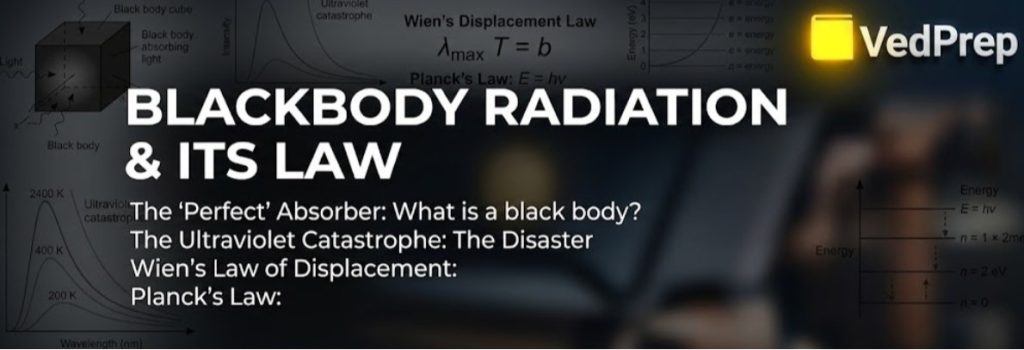
When you graph Intensity (Y-axis) against Wavelength (X-axis) at different temperatures, you get a bell-shaped curve. Things about the Curve: Not the same: Energy is not spread out evenly. There is a clear top. Change in Temperature: As the temperature goes up, the peak moves to the left (Wien’s Law).The area under the curve: The area under the curve shows the total energy (Stefan-Boltzmann Law).
The curve for a higher temperature is completely above the curve for a lower temperature because it gives off more radiation at all wavelengths.
Blackbody Radiation
In the Real World (2026 Viewpoint)Blackbody radiation is not just a chapter in a physics book in 2026; it is used in many different fields.
Astrophysics:
How to Read the Universe Astronomers don’t often go to the things they study. They depend on the light they get. They can figure out the star’s surface temperature with amazing accuracy by looking at its Blackbody radiation spectrum.
CMB (Cosmic Microwave Background): The universe has a temperature. The “afterglow” of the Big Bang is really just Blackbody radiation that has cooled down to about 2.7 K since the beginning of the universe. Mapping this radiation helps us learn about the shape and age of the universe.
Climate Science:
The Amount of Energy on Earth The Earth takes in sunlight and sends it back out as infrared Blackbody radiation. Certain wavelengths of this re-emitted radiation are trapped by greenhouse gases. To model global warming and build satellites that can measure surface temperatures from space, you need to know how the Earth’s blackbody curve works.
Thermal Imaging and Health Blackbody radiation principles are used in modern thermography.
For industry: Finding electrical parts that are getting too hot before they break. Medical: Finding inflammation or tumors, which usually have a higher temperature (and so a different blackbody emission) than the tissue around them. Surveillance: Using body heat to see people in total darkness.
Hawking Radiation:
The Blackbody of Black Holes Hawking Radiation is one of the most important theoretical uses. Stephen Hawking suggested that black holes, which are the best “black” absorbers, actually give off Blackbody radiation because of quantum effects near the event horizon. This means that black holes have a temperature and can eventually disappear, which connects thermodynamics with general relativity.
Kirchhoff’s Law of Thermal Radiation Gustav Kirchhoff came before Planck and Stefan.
His law connects absorption and emission. The statement says that for any object in thermal equilibrium, the ratio of its emissive power ($E$) to its absorptive power ($a$) is always the same and equal to the emissive power of a perfect blackbody at that temperature.$$E_{\text{body}} / a_{\text{body}} = E_{\text{blackbody}}$$
The Meaning: “Good absorbers are also good emitters. “If you heat up a shiny metal ball (which doesn’t absorb well) and a soot-covered ball (which does), the soot-covered ball will glow much more brightly. This is why the “Hole in the Box” is such a good emitter of Blackbody radiation: it is the best absorber.
Experimental Verification:
How We Know It’s True Science needs proof. The proof of Blackbody radiation laws was a big win for experimental physics in the 1800s.
Lummer and Pringsheim: These physicists made advanced “blackbody cavities” (ovens with small holes) and used prisms to spread the light. They used sensitive bolometers (heat detectors) to map the energy at different wavelengths.
The outcome: Their data points fell perfectly on the curve that Planck’s formula predicted, proving that energy is quantized.In 2026, undergraduate physics labs will do this experiment again, this time with digital sensors. They will see the curve that led to quantum mechanics.
Things People Get Wrong About Blackbody RadiationMyths still exist, even among students.
Let’s get rid of them.
Myth 1: Black bodies are black. Fact: They are only black when they are cold. When they get hot, they make great light sources, like the filaments in old light bulbs.
Myth 2: They only give off one color. Fact: They give off a wide range of colors. A “red hot” poker gives off mostly red light, but it also gives off a little bit of orange and yellow light. We can only see the color that stands out.
Myth 3: People don’t give off radiation. We do! We give off about 100 Watts of power, which is about the same as a light bulb, but all of it is in the infrared part of Blackbody radiation.
Learn Quantum Physics with VedPrep The first step into the world of Quantum Mechanics is to understand Blackbody radiation.
But let’s be honest: it’s hard to go from classical intuition to quantum reality. Planck’s Law and the Stefan-Boltzmann constant can be hard for people who want to take the CSIR NET or GATE exams. This is where VedPrep can help you do better in school. We don’t just tell you to remember $E = \sigma T^4$ at VedPrep.
We also help you picture the thermodynamics that go along with it. Our Physics modules are meant to connect the past with the present. Why VedPrep is the Best Place to Get Ready for Physics
Clear Ideas: We use easy-to-understand charts and animations to explain the “Ultraviolet Catastrophe” and show you why classical physics didn’t work.
Exam-Oriented Approach: We focus on the specific numbers that come up often in tests like the CSIR NET Physical Sciences and GATE that have to do with Wien’s Law and Stefan-Boltzmann ratios.
Learning by seeing: You can change the temperature and see how $\lambda_{\text{max}}$ changes in real time with our 3D models of blackbody cavities and interactive spectral curves.
Expert Mentorship: Our professors have PhDs and can link these 19th-century laws to research topics in 2026, such as Dark Matter and Cosmic Background Radiation. VedPrep gives you the clear, structured help you need, whether you’re having trouble with Planck’s function or the idea of emissivity. Don’t be afraid of the quantum world. Join VedPrep and make Blackbody radiation your best unit, even though it’s a hard subject.
The End
The tale of Blackbody radiation exemplifies the potency of scientific inquiry. The Ultraviolet Catastrophe, a mistake on a graph, caused the classical view of the universe to fall apart and ushered in the quantum era. Blackbody radiation is the universal language of heat and light, from the filament of a light bulb to the birth of the universe.
We use its laws—Stefan-Boltzmann, Wien’s, and Planck’s—to figure out how hot distant stars are, keep an eye on the health of our planet, and make the technologies that will shape the world in 2026.For a physics student, it is very important to understand Blackbody radiation. It connects the big world of thermodynamics to the tiny world of quantum mechanics.
As you continue to learn, remember that the heat of the sun and the light of a toaster are both examples of blackbody physics.
Frequently Asked Questions (FAQs)
What is a "blackbody" in physics?
Ans: A blackbody is a theoretical object that absorbs all electromagnetic radiation hitting it (reflecting nothing) and is also a perfect emitter, releasing energy to stay in thermal equilibrium.
Why is the term "blackbody" considered misleading?
Ans: The term is confusing because while these objects absorb all light (appearing black at room temperature), they can be incredibly bright when heated, like the Sun or a light bulb filament
What is the "Ultraviolet Catastrophe"?
Ans: It was a failure of classical physics which predicted that a blackbody would emit infinite energy as wavelengths got shorter (into the UV range), implying that opening a hot oven could expose you to deadly radiation.
How do we simulate a perfect blackbody in real life?
Ans: Physicists use a hollow cavity with a tiny hole. Light enters the hole, bounces around inside, and is absorbed by the walls, making the hole act like a perfect absorber.
Why does a heated iron bar change color?
Ans: As the iron gets hotter, the peak wavelength of its radiation shifts. It moves from infrared (invisible) to dull red, bright orange, yellow, and finally "white hot" as the temperature increases.
What does the Stefan-Boltzmann Law tell us?
Ans:
-
It states that the total energy emitted by a blackbody is proportional to the fourth power of its temperature ($T^4$). This means a small increase in temperature results in a massive increase in brightness6666.
-
How does Wien’s Displacement Law explain star colors?
Ans:
-
Wien's Law states that the hotter an object is, the shorter its peak wavelength. This is why cooler stars (3000 K) look red, while very hot stars (10,000+ K) look blue-white.
-
What was Max Planck’s solution to the Ultraviolet Catastrophe?
Ans: Planck proposed that energy is not continuous but comes in discrete packets called "quanta." This limited the energy emitted at high frequencies, solving the "catastrophe".
What is Kirchhoff’s Law of Thermal Radiation?
Ans: It states that for an object in thermal equilibrium, a good absorber is also a good emitter. This explains why a soot-covered ball (good absorber) glows brighter when heated than a shiny metal one
What does the area under a blackbody radiation curve represent?
Ans: The total area under the curve represents the total energy emitted by the object, as described by the Stefan-Boltzmann Law.