
Understanding the IIT JAM Chemistry Topic Wise Weightage is the initial step of developing a strategic preparation plan. Historically, the exam keeps up a balanced distribution across the three vital sections—Physical, Organic, and Inorganic Chemistry—roughly splitting the 100 marks equally. Nevertheless, particular sections like Coordination Chemistry, Thermodynamics, and Stereochemistry reliably hold greater importance (10-15%) in contrast to broad yet less fruitful areas such as Main Group Elements.
Decoding the IIT JAM Chemistry Section Wise Marks Distribution
A proactive analysis of the IIT JAM Chemistry Topic Wise Weightage highlights that not all chapters demand equal importance. While the official syllabus is extensive, previous year trends represents that probably 70% of the paper originates from core high-yield chapters.
IIT candidates often mistake syllabus while considering key concepts of IIT JAM Chemistry Topic Wise Weightage. A sophisticated method involves examining the proportion of Organic versus Inorganic Chemistry to apportion study time well. For instance, whereas Inorganic Chemistry heavily depends on four key units—Coordination, Organometallics, Bonding, and Bioinorganic—Organic Chemistry demands a fundamental grasp of reaction pathways and spatial arrangements. Physical Chemistry, conversely, is the mathematical and numerical concept of the paper, rewarding those who master numerical precision in topics like Kinetics and Thermodynamics.
Inorganic Chemistry: Prioritizing High-Yield Clusters
Inorganic Chemistry is the most scoring part if prepared effectively by understanding the weightage. The IIT JAM Chemistry Topic Wise Weightage for this part is considered toward Coordination Chemistry and Organometallics, which together can support your success in this domain.
Coordination Chemistry and Bonding
Coordination Chemistry forms the bedrock of the Inorganic portion. Key topics center related to Isomerism, frequently appearing in questions linked to stereochemistry. Crystal Field Theory (CFT) highlights another vital area, focusing on key calculations related to Crystal Field Stabilization Energy (CFSE). These elements constitute a significant section of the IIT JAM Chemistry Topic Wise Weightage. On the other hand, Microstates, Color Theory, and Term Symbols highlights straightforward questions acting as “sure points” for well-prepared candidates. In Chemical Bonding, the concept of Steric Number is critical for determining geometry and hybridization, while Molecular Orbital Theory (MOT) remains foundational for evaluating conceptual grasp.
Organometallics and Bioinorganic Chemistry
Organometallic Chemistry (OMC) holds substantial importance. The 18-Electron Guideline, Metal Carbonyls, and Metal Carbenes constitute conventional subjects. A vital aspect sometimes neglected is Beta-Hydride Ejection; even as learners concentrate on Oxidative Addition, this particular segments gain IIT JAM Chemistry Topic Wise Weightage. Bioinorganic Chemistry represents a concise yet valuable section. Concentrating on metalloenzymes featuring Zinc, Iron, and Copper is strongly advised since these are routinely assessed.
Physical Chemistry High Scoring Topics and Numerical Focus
Physical Chemistry represents a unique approach, focusing on mathematical understanding and strong knowledge on calculations. The IIT JAM Chemistry Topic Wise Weightage here favors chapters with predictable numerical patterns, making them reliable sources of marks for those strong in calculation.
Thermodynamics and Equilibrium
Chemical Thermodynamics poses a significant challenge. Core principles encompass the Thermodynamic Laws, conditions for self-process initiation, and Maxwell Relations. Calculating the alteration in Entropy and the Energy Expended throughout both constant-temperature and no-heat-exchange processes are frequent assessment topics. Another extensive yet vital area is Equilibrium. It is necessary to address Phase Equilibrium, Ionic Equilibrium, and Chemical Equilibrium, as the examination focus on in these key areas of IIT JAM Chemistry Topic Wise Weightage.
Kinetics, Electrochemistry, and Quantum Mechanics
Chemical Kinetics is reliable for generating approximately two questions annually, often revolving around the Arrhenius Equation and determining the Order of Reaction. Electrochemistry questions test the Nernst Equation and Kohlrausch’s Law frequently. However, Quantum Chemistry provides assessment points via distinct subjects such as the Particle in a 1D Box model and fundamental Operators. Solid State Chemistry is viewed as a crucial domain within the IIT JAM Chemistry Topic Wise Weightage, especially for Numerical Answer Type (NAT) problems concentrating on Lattice Energy and crystalline arrangements, such as FCC and BCC.
Organic Chemistry: Mechanisms and Stereochemistry
Organic Chemistry weightage is distributed across interconnected topics. Unlike the modular nature of Inorganic Chemistry, success here depends on linking concepts. The Important Topics for IIT JAM Chemistry 2026 in this section rely heavily on understanding reaction pathways and spatial arrangements.
Stereochemistry and Spectroscopy
Stereochemistry is arguably the most critical foundation. R/S Configuration, determining the number of stereoisomers, and Specific Rotation are recurring themes. Practical analysis shows that NAT questions in the Organic section are frequently based on Specific Rotation or spectroscopic data. Speaking of Spectroscopy, mastery of NMR (number of signals and chemical shifts), IR (functional group ranges), and UV-Vis (Woodward-Fieser rules) is essential for structure elucidation problems.
Reaction Mechanisms and Reagents
The bulk of Organic Chemistry questions stem from Name Reactions and Reagents. High-priority reactions include the Aldol, Cannizzaro, and Favorskii reactions. The Pinacol-Pinacolone rearrangement is also a favorite for testing carbocation stability concepts which are considered as IIT JAM Chemistry Topic Wise Weightage. In Pericyclic Reactions, the Diels-Alder reaction is the primary focus area. Additionally, knowing the reactivity of intermediates like Carbenes (e.g., Simmons-Smith reaction) can provide an edge in unconventional questions.
Critical Analysis: Bioinorganic vs Main Group Chemistry
A frequent strategic misstep among hopefuls is dedicating equal study time to Main Group Chemistry because of its extensive curriculum. A careful examination of the IIT JAM Chemistry Topic Wise Weightage indicates an opposing strategy: favor Bioinorganic Chemistry above Main Group elements.
Bioinorganic Chemistry is more important, and questions regarding the biological roles of metals (Fe, Zn, Cu) are often simple and swiftly resolved. In contrast, Main Group Chemistry is extensive. While explorations into Boranes, Silicates, and Oxoacids do arise, the yield for the energy expended is substantially lower than with Bioinorganic Chemistry. If time is scarce, focusing Main Group study on particular topics such as Borazine and Boranes is a wiser adaptation than skipping Bioinorganic Chemistry altogether.
Strategic Planning Using Weightage Data
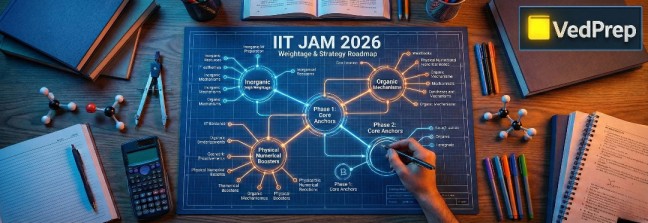
Leveraging the IIT JAM Chemistry Topic Wise Weightage is not just about knowing which chapters have more marks; it is about sequencing your preparation.
Phase 1: The Core Anchors
Begin with the topics that have the highest certainty of appearing. This includes Coordination Chemistry in Inorganic, Stereochemistry in Organic, and Chemical Kinetics in Physical Chemistry. These chapters build the momentum and secure the “safe” marks.
Phase 2: The Numerical Boosters
Once candidates conceptualize key numerical parts, target the Physical Chemistry High Scoring Topics that feed into the NAT section. Solid State (Lattice Energy), Electrochemistry (Nernst Equation), and Thermodynamics are prime candidates here. Since NAT questions have no negative marking, accuracy in these formula-based topics directly boosts your rank.
Phase 3: The Differentiators
Finally, focus on IIT JAM Chemistry Topic Wise Weightage to understand the path of scoring high as top rankers from the rest. This includes specific Name Reactions (Favorskii, McMurry), Quantum Mechanics (Operators), and Organometallic reaction mechanisms like Beta-Hydride Elimination. These topics are often perceived as difficult, meaning fewer students attempt them correctly.
Final Thoughts
Mastering the syllabus requires both smart and hard work; it demands a strategic approach considered in the IIT JAM Chemistry Topic Wise Weightage. By matching your learning times with VedPrep’’s expertly assembled units, you make certain that crucial topics—spanning Coordination Chemistry through to Kinetics—receive the right focus. Go beyond simply reviewing the material; maximize your scoring capacity using VedPrep to manage the intricate scoring layout and claim your spot in a leading institution.
Frequently Asked Questions (FAQs)
How is the weightage distributed across sections in IIT JAM Chemistry?
The exam typically maintains a balanced distribution, with Physical, Organic, and Inorganic Chemistry each carrying approximately 33–35% of the total 100 marks. However, within these broad sections, specific chapters like Coordination Chemistry or Stereochemistry often hold significantly higher individual weightage than others.
Which Inorganic Chemistry chapters have the highest weightage?
Coordination Chemistry and Organometallic Chemistry (OMC) are the dominant chapters. Together, they frequently account for a major portion of the Inorganic section marks. Chemical Bonding and Bioinorganic Chemistry are also high-yield areas that should be prioritized over vast topics like Main Group Elements.
What are the most important topics in Physical Chemistry for IIT JAM?
Chemical Kinetics, Thermodynamics, and Electrochemistry are consistently high-scoring. Solid State Chemistry is also crucial, particularly for Numerical Answer Type (NAT) questions involving lattice structure and energy calculations. These topics reward formula application and numerical precision.
Does Organic Chemistry have a specific high-weightage chapter?
Organic Chemistry relies less on isolated chapters and more on interconnected concepts. However, Stereochemistry forms the foundation and carries substantial weight. Beyond that, Name Reactions, Reagents, and Reaction Mechanisms constitute the bulk of the scoring opportunities in this section.
Is Bioinorganic Chemistry important for IIT JAM?
Yes, Bioinorganic Chemistry is highly efficient to study. It covers a concise syllabus—primarily metalloenzymes involving Iron, Zinc, and Copper—and yields direct questions. The effort-to-reward ratio for this chapter is often better than for more expansive topics.
How should I prioritize topics based on weightage?
Start with "Core Anchors" like Coordination Chemistry, Stereochemistry, and Chemical Kinetics to secure baseline marks. Next, move to "Numerical Boosters" in Physical Chemistry like Solid State and Electrochemistry for the NAT section. Finally, tackle complex "Differentiators" like Quantum Mechanics.
How do I prepare for Numerical Answer Type (NAT) questions?
Target Physical Chemistry chapters with defined formulas. Practice calculations for Lattice Energy (Solid State), EMF and Nernst Equation (Electrochemistry), and Entropy changes (Thermodynamics). Accuracy is key here since there are no options to guide you.
Are 18-Electron Rule questions common in IIT JAM?
Yes, the 18-Electron Rule is a staple of the Organometallic Chemistry section. You should also be proficient with Metal Carbonyls and identifying stability in organometallic complexes, as these are frequent exam themes.
What should I do if I find Quantum Chemistry difficult?
Do not skip it entirely. Focus on the elementary aspects like Operators, Eigenvalue equations, and the Particle in a 1D Box. These topics often yield straightforward questions. You can afford to skip deeper, complex derivations if they are hindering your progress in other high-yield areas.
Is it safe to skip Main Group Elements?
Skipping it entirely is risky, but strategic selective study is acceptable. Instead of reading the whole block, focus on specific high-yield compounds like Boranes, Silicates, and Interhalogens. This minimizes effort while covering the most likely question areas.
How can I improve my score in Inorganic Chemistry?
Shift focus from memorizing trends to understanding concepts in Coordination and Bonding. Master Crystal Field Theory (CFT) and Isomerism. For Bioinorganic and OMC, frequent revision of key structures and rules (like the 18-electron rule) is more effective than deep reading.
What are the "Differentiator" topics in IIT JAM Chemistry?
Topics like Beta-Hydride Elimination in Organometallics, specific complex Name Reactions (e.g., McMurry), and advanced Quantum Mechanics concepts are differentiators. Most students answer standard questions; correctly answering these separates the top rankers.
Does the weightage change significantly every year?
While slight fluctuations occur, the core hierarchy remains stable. Coordination Chemistry, Kinetics, and Reagents consistently hold the top spots. It is safer to rely on these long-term trends than to gamble on a sudden shift in the exam pattern.
Are there questions that combine multiple chemistry sections?
Yes. You might encounter questions linking Thermodynamics with Chemical Equilibrium, or Stereochemistry with Reaction Mechanisms. Interdisciplinary understanding is particularly tested in the Organic and Physical sections.