


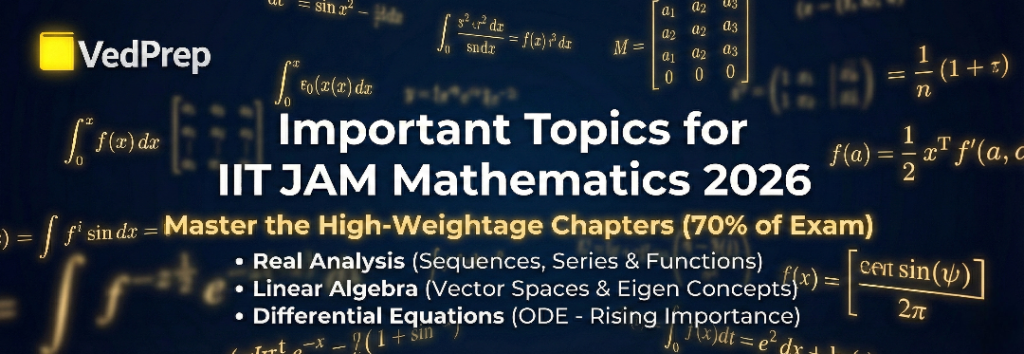

To secure a top rank, candidates must prioritize high-yield areas. The most Important Topics for IIT JAM Mathematics include Real Analysis (Sequences, Series, Functions of One Variable) and Linear Algebra (Vector Spaces, Eigenvalues), which together constitute nearly 70% of the exam. With the recent removal of Vector Calculus, Ordinary Differential Equations (ODE) has also gained significant weightage.
Understanding the IIT JAM Mathematics Chapter-wise Weightage
Success in competitive exams often comes down to resource allocation. You cannot afford to spend equal time on every chapter. A smart preparation strategy begins with a deep analysis of the IIT JAM Mathematics Chapter-wise Weightage. Recent trends indicate a clear hierarchy in topic importance, allowing students to maximize output with focused effort.
Real Analysis consistently dominates the paper, carrying approximately 30–35% of the total marks. Following closely is Linear Algebra, which contributes roughly 20 marks. The third pillar of your preparation should be Ordinary Differential Equations (ODE), which now holds increased importance, accounting for 15–20 marks. Group Theory generally accounts for about 15 marks, while Integral Calculus covers the remaining portion. Understanding this distribution helps in prioritizing the Important Topics for IIT JAM Mathematics during your study sessions.
These high-weightage sections ensures high scores as Important Topics for IIT JAM Mathematics. However, weightage can fluctuate slightly each year, so a balanced coverage of the syllabus is still necessary to avoid losing easy marks in lower-weightage sections.
Real Analysis: The Backbone of the Syllabus
Real Analysis is arguably the most critical section among the Important Topics for IIT JAM Mathematics. It tests a student’s logical reasoning and understanding of proofs rather than just formula application. This section is often split into Sequences and Series of Real Numbers and Functions of One Real Variable.
Sequences and Series
This unit is highly conceptual. Students must master convergence and divergence, monotonicity, and boundedness. The Most Repeated Concepts in IIT JAM Mathematics in this area include the Bolzano-Weierstrass theorem and Cauchy sequences. For series, familiarity with various tests of convergence—specifically the Comparison, Ratio, and Root tests—is a non-negotiable part of Important Topics for IIT JAM Mathematics. Power series questions focusing on the radius and interval of convergence are also frequent.
Functions of One Real Variable
This subsection covers limits, continuity, and differentiability to highlight Important Topics for IIT JAM Mathematics. Special attention should be given to the Intermediate Value Property and Mean Value Theorems (Rolle’s and Lagrange’s). Theoretical proofs regarding Taylor’s theorem and Maxima-Minima problems are standard. Riemann Integration and the Fundamental Theorem of Calculus also appear regularly, requiring a blend of theoretical understanding and calculation speed.
Linear Algebra: The Scoring Section
Linear Algebra is often considered the most scoring section if your concepts are clear. It forms a significant portion of the IIT JAM Mathematics Chapter-wise Weightage and rewards precision. Unlike Real Analysis, which can be abstract, Linear Algebra problems often have definitive computational paths.
Vector Spaces and Linear Maps
The core of this section involves Vector Spaces and Subspaces. You must be able to determine if a set forms a subspace and identify linear independence or dependence indicating Important Topics for IIT JAM Mathematics. Calculating the basis and dimension of vector spaces is a fundamental skill. Questions on Linear Transformations, specifically determining rank, nullity, and using the Rank-Nullity Theorem, are ubiquitous.
Matrices and Eigen Concepts
Matrices are central to the Important Topics for IIT JAM Mathematics. You should be proficient in solving systems of linear equations, analyzing rank, and finding determinants. The concepts of Eigenvalues and Eigenvectors are critical, particularly regarding diagonalization and the Cayley-Hamilton Theorem. These topics frequently appear in both Multiple Choice Questions (MCQ) and Numerical Answer Type (NAT) sections.
Ordinary Differential Equations (ODE): Rising Importance
With the syllabus changes in recent years, specifically the removal of Vector Calculus, ODE has become one of the most vital Important Topics for IIT JAM Mathematics. The weightage for this section has seen a significant increase, making it a high-priority area for aspirants.
First-order differential equations, including Bernoulli’s, exact, and homogeneous equations, are foundational. A specific topic that frequently appears is Orthogonal Trajectories, which tests geometric interpretation alongside calculus.
For second-order linear differential equations, focus on the method of variation of parameters and equations with constant coefficients. The Most Repeated Concepts in IIT JAM Mathematics here include the Wronskian and its properties. Understanding Abel’s Formula for determining the Wronskian is often the key to solving complex linear dependence problems quickly.
Group Theory and Integral Calculus
While Real Analysis and Linear Algebra take center stage, neglecting Group Theory and Integral Calculus is a strategic error. These sections provide opportunities for “easy marks” if prepared smartly.
Group Theory Essentials
Group Theory questions are often theoretical. Key areas include Cyclic and Abelian groups, Permutation groups, and Normal subgroups. Sylow’s Theorems and Lagrange’s Theorem are advanced concepts that distinguish top rankers. Understanding Group Homomorphisms and counting the number of possible homomorphisms is also a standard question type. Hence, one can determine this part as Important Topics for IIT JAM Mathematics to succeed the exam.
Integral Calculus Applications
Integral Calculus focuses heavily on multivariable techniques. Mastery of Double and Triple integrals is essential, particularly the “Change of Order of Integration,” which is a highly expected topic. Applications involving surface area and volume calculations also contribute to the IIT JAM Mathematics Chapter-wise Weightage.
The Trap of Ignoring “Low Weightage” Topics
A common mistake is solely relying on the heavy hitters like Real Analysis and ignoring smaller sections. While analyzing the IIT JAM Mathematics Chapter-wise Weightage is crucial, totally skipping topics like Integral Calculus can be fatal for your rank. Even 2–3 questions from these chapters can significantly alter your final standing. A balanced approach ensures you can attempt easy questions from every section by analyzing Important Topics for IIT JAM Mathematics, rather than being forced to solve only the difficult ones from high-weightage topics.
Furthermore, concepts often overlap. For instance, understanding integration techniques is often required to solve differential equations or analyze functions in Real Analysis. A holistic view of the Important Topics for IIT JAM Mathematics prevents you from getting stuck on interdisciplinary questions.
Effective Revision and Formula Management
As the exam approaches, your strategy must shift from deep learning to consolidation. This is where a structured IIT JAM Mathematics Last Minute Revision plan becomes essential.
Utilizing Short Notes
You should maintain condensed notes or flashcards throughout your preparation. These should include key theorems, counterexamples for Real Analysis, and standard results for Linear Algebra. Short notes are effective to enhance self-learning accuracy while fining Important Topics for IIT JAM Mathematics.
Regular revision of these notes helps reinforce memory and ensures you don’t blank out on basic definitions during the exam.
The Role of Formula Lists
Accessing a verified IIT JAM Mathematics Formula List PDF or creating your own is a game-changer. Key formulas for Taylor series expansions, Wronskian properties, and standard integrals should be at your fingertips. However, remember that JAM tests conceptual depth while considering Important Topics for IIT JAM Mathematics. While formulas are necessary for speed, relying on them without understanding the underlying logic—especially in Group Theory and Analysis—will not work.
Practical Application: Real-World Exam Scenarios
Knowing the Important Topics for IIT JAM Mathematics is only half the battle; executing them under pressure is the other half. In the exam, you will face three sections: MCQs, Multiple Select Questions (MSQs), and Numerical Answer Types (NATs).
MSQs and NATs have no negative marking, which encourages attempting them, but they demand high accuracy. Topics like Sequences and Series often appear in NATs, requiring precise calculation. Conversely, Linear Algebra problems regarding subspaces often appear in MSQs, where you must identify multiple correct properties.
When performing your IIT JAM Mathematics Last Minute Revision, simulate exam conditions. If you encounter a problem on a high-weightage topic that is taking too long, skip it. The goal is to maximize marks, not to prove your mastery of a specific hard question. Efficient time management, practiced through mock tests, ensures you can navigate across the different sections effectively.
Conclusion on Topic Prioritization
To summarize, your preparation should revolve around the Important Topics for IIT JAM Mathematics: Real Analysis, Linear Algebra, and Differential Equations. These three pillars support the bulk of your score. However, strategic study of Group Theory and Integral Calculus will provide the edge needed for a top rank.
Maintain a clear view of the IIT JAM Mathematics Chapter-wise Weightage to allocate your study hours efficiently. Use a IIT JAM Mathematics Formula List PDF for quick recalls, but prioritize understanding the proofs and logic behind the formulas. Finally, ensure your IIT JAM Mathematics Last Minute Revision includes solving previous year papers to recognize the Most Repeated Concepts in IIT JAM Mathematics. For students seeking structured guidance to master these high-yield areas, platforms like VedPrep can offer the strategic support needed to excel. Consistency and smart prioritization are your best tools for cracking IIT JAM 2026.
Frequently Asked Questions (FAQs)
What are the most important topics for IIT JAM Mathematics 2026?
Real Analysis (Sequences, Series, Functions of One Variable) and Linear Algebra (Vector Spaces, Eigenvalues) are critical. Together, they account for nearly 70% of the exam weightage. Ordinary Differential Equations (ODE) has also gained significant importance following recent syllabus updates.
How much weightage does Real Analysis carry in IIT JAM Mathematics?
Real Analysis is consistently the highest-weightage section, typically contributing 30–35% of the total marks. This includes questions on sequences and series of real numbers and functions of one real variable.
Is Vector Calculus still part of the IIT JAM Mathematics syllabus?
No, Vector Calculus has been removed from the IIT JAM Mathematics syllabus. Consequently, the weightage for Ordinary Differential Equations (ODE) has increased to compensate for this change.
What are the key topics in Linear Algebra for IIT JAM?
Focus on Vector Spaces, Subspaces, Basis, and Dimension. Linear Transformations, Rank-Nullity Theorem, Eigenvalues, Eigenvectors, and Systems of Linear Equations are also high-yield topics that appear frequently in the exam.
Which topics should I study first for IIT JAM Mathematics?
Start with Real Analysis and Linear Algebra due to their high weightage and foundational nature. Once these are secure, move to Ordinary Differential Equations. This strategy covers the bulk of the marks early in your preparation.
How should I prepare for Group Theory in IIT JAM?
Focus on understanding fundamental definitions like Cyclic and Abelian groups. Study Lagrange’s Theorem, Normal Subgroups, and Group Homomorphisms. While the weightage is lower than Analysis, the questions are often standard and scoring.
Is it safe to skip Integral Calculus for IIT JAM Math?
Skipping it entirely is risky. While it has lower weightage compared to Analysis, topics like Change of Order of Integration and Surface Area calculations are predictable and can yield easy marks that boost your rank.
What is the best way to revise for IIT JAM Mathematics?
Use condensed short notes for theorems and formulas. Regularly solve Previous Year Questions (PYQs) to identify recurring patterns. Focus your last-minute revision on high-weightage topics and standard results in Linear Algebra and ODE.
How important are Previous Year Questions (PYQs) for IIT JAM?
Solving the last 5–10 years of PYQs is essential. They reveal the exam pattern, difficulty level, and frequently asked concepts. Many questions in JAM are based on concepts tested in previous years.
How do I manage time between sections in the IIT JAM exam?
Don't get stuck on a single difficult problem. If a question takes too long, skip it and return later. Prioritize answering questions from your strong areas first to secure baseline marks before attempting harder ones.
How can I reduce calculation errors in NAT questions?
Practice with the virtual calculator used in the exam. Write down your steps clearly to avoid sign errors. For topics like numerical integration or eigenvalues, double-check your arithmetic before entering the final value.
How do I handle Multiple Select Questions (MSQs)?
MSQs require verifying every option. Treat each option as a separate True/False question. Use counterexamples to discard incorrect statements. Conceptual clarity in Linear Algebra and Real Analysis is vital for MSQs.
Does the weightage of topics change every year?
Yes, it varies slightly. While Real Analysis and Linear Algebra remain dominant, the specific number of questions from Group Theory or Integral Calculus can fluctuate. A balanced preparation is safer than strict reliance on past weightage trends.
Can I crack IIT JAM by only studying Real Analysis and Linear Algebra?
It is risky. Together they form about 50-55 marks. To secure a top rank and admission into a prestigious IIT, you typically need a score significantly higher, which requires contributions from ODE and other sections.