




What is the Theory of Island Biogeography?
Nature has always interested us because it has so many different kinds of plants and animals and many of them are not found anywhere else. But have you ever thought about why some islands have such interesting plants and animals? The Theory of Island Biogeography offers an interesting way to study how biodiversity changes on islands.
Robert MacArthur and E.O. Wilson came up with this idea in the 1960s. It has completely changed the way we think about how species move to and live on remote land masses. This blog will go into great detail about the main ideas of the Theory of Island Biogeography, as well as why they are important and how they can be used in real life.
Learning about the Island Biogeography Theory
The Theory of Island Biogeography says that the size of an island’s land and how isolated it is affect its biodiversity and the number of species it can support. The theory examines the interaction between two fundamental processes, immigration and extinction, in shaping the diversity and composition of species on islands over time.
We need to look at immigration and extinction as two opposing forces and how they affect the physical features of an island in order to fully understand the Theory of Island Biogeography.
Moving to a new country
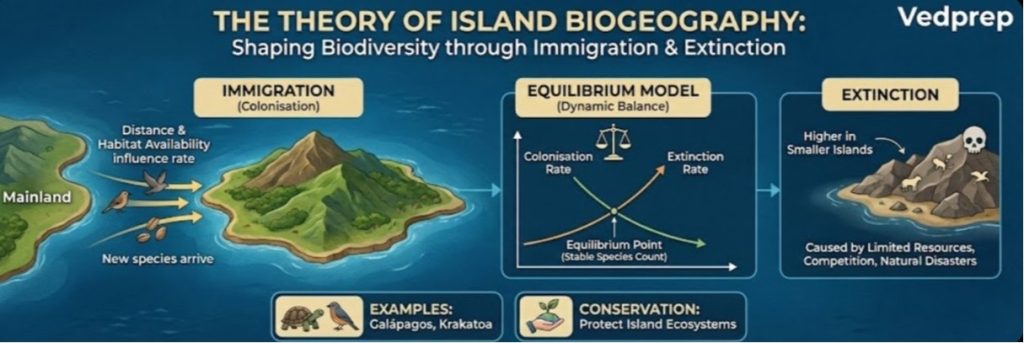
The immigration process is when new species come to an island and settle there. It happens when people spread out and settle on the island from a source population, which is usually the mainland.
There are a number of things that affect the rate of immigration:
Distance: The rate is affected by how far the island is from the nearest source of the species.
Dispersal Capacity: The species’ ability to spread out determines if they can get to the island.
Habitat: The island’s availability of suitable habitats affects a species’ ability to settle.
The Theory of Island Biogeography says that bigger islands tend to get more new people than smaller ones. This is because bigger islands have more places for animals to live, which makes it more likely that animals that are moving away from the mainland will find them. Also, bigger islands often have a wider range of ecosystems and ecological niches, which draws in more species.
Extinction
The extinction process is when species go extinct on an island. It happens when a species on an island can’t live and either goes extinct completely or locally.
There are a number of things that can cause extinction:
Not enough resources.
Competing with other species.
Predation.
Natural disasters.
The Theory of Island Biogeography says that smaller islands are more likely to have higher rates of extinction than larger ones. This is because smaller islands have fewer places for animals to live and fewer resources, which makes it harder for species to survive. Small populations on small islands are also more likely to go extinct because of random events.
The Equilibrium Model of Island Biogeography
The concept of equilibrium is fundamental to the Theory of Island Biogeography. The theory posits that an equilibrium point will be reached when the rates of species immigration and extinction on an island remain relatively stable. At this point of balance, the number of species will stay the same because the rates of immigration and extinction will be the same.
Understanding the Curves
A graph that shows the number of species and the rates of colonisation (immigration) and extinction can help you see the relationship.
Colonisation Rates: Islands that are close to the mainland have higher colonisation rates than islands that are far away from the mainland (remote).
Extinction Rates: Small islands have higher extinction rates than large islands.
The intersection of these curves shows the number of species that the island can support at equilibrium
Dynamic Balance
The Theory of Island Biogeography stresses that islands are always changing and are not fixed objects. Over time, the factors that affect the rates of immigration and extinction may change, which would change the balance of species richness. For example, an increase in the number of habitats available, such as through volcanic activity or changes in sea level, could lead to more immigration and more species diversity.
Examples of the Theory of Island Biogeography in the Real World
We can see the Theory of Island Biogeography at work by looking at classic examples from ecology.
The Islands of Galápagos
The Theory of Island Biogeography is best shown by the Galápagos Islands, which are in the Pacific Ocean off the coast of Ecuador. People know a lot about the unique and varied plants and animals that live on these volcanic islands.
The Theory of Island Biogeography says that the Galápagos Islands would have low immigration rates because they are so isolated. This would mean that species would change more slowly. Many of the species that live on the Galápagos Islands are only found there, which means they can’t be found anywhere else on Earth.
Krakatoa
In 1883, a huge explosion destroyed all of Krakatoa’s plants and animals. Krakatoa is a volcanic island in Indonesia. Different kinds of plants and animals eventually came back to Krakatoa, starting with those that could travel long distances, like seeds that float or birds. This process of recolonisation supports the Theory of Island Biogeography, which says that immigration plays a big role in the island’s biodiversity.
Learn about ecology with Vedprep
Are you getting ready to take the UGC NET or CSIR NET Life Sciences tests? To do well on the ecology unit, you need to understand complicated ideas like the Theory of Island Biogeography.
We at Vedprep are committed to making your preparation process as smooth as possible. With our complete study materials, coaching from experts, and thorough explanations of important topics, you’ll never miss a concept. Vedprep can help you succeed whether you are having trouble with island biogeography graphs or understanding how species interact with each other.
Join the Vedprep community now to get:
Detailed notes on important topics.
Mock tests that are meant to be like the real test.
Professional tips for easily answering hard questions.
Let Vedprep help you pass the test and reach your academic goals!
In conclusion
The Theory of Island Biogeography provides valuable insights into the complex interactions of biodiversity on isolated landmasses. We can better understand the factors that influence species richness and composition on islands by examining the processes of immigration and extinction.
This theory has important effects on conservation efforts as well, since it shows how important it is to protect island ecosystems in order to protect their unique and diverse biota. The Theory of Island Biogeography helps us understand how fragile nature really is.
Frequently Asked Questions (FAQs)
What is the Theory of Island Biogeography?
Ans: The Theory of Island Biogeography suggests that the biodiversity and number of species an island can support are determined by the island's land size and its degree of isolation.
Who proposed the Theory of Island Biogeography?
Ans: This concept was developed by Robert MacArthur and E.O. Wilson in the 1960s.
What are the two fundamental processes examined in this theory?
Ans: The theory examines the interaction between immigration and extinction to understand how they shape species diversity on islands.
Is the Theory of Island Biogeography only applicable to islands?
Ans: While the text focuses on islands, it notes that the theory changed how we think about species moving to "remote land masses" in general.
What does "immigration" mean in the context of this theory?
Ans: Immigration is the process where new species spread out from a source population (usually the mainland), arrive on an island, and settle there.
What factors affect the rate of immigration?
Ans: The rate is influenced by the distance from the source, the species' dispersal capacity (ability to travel), and the availability of suitable habitats.
How does island size affect immigration?
Ans: Larger islands tend to receive more new species than smaller ones because they offer more living space, making them easier for species moving from the mainland to find.
Why do bigger islands attract more species?
Ans: Beyond just physical size, bigger islands often possess a wider range of ecosystems and ecological niches, which attracts a greater variety of species.
How does distance from the mainland impact colonisation rates?
Ans: Islands located closer to the mainland typically have higher colonisation (immigration) rates compared to remote islands.
What defines the extinction process in this theory?
Ans: Extinction occurs when a species cannot survive on the island and dies out either locally or completely.
What are the primary causes of extinction on islands?
Ans: Extinction can be caused by insufficient resources, competition with other species, predation, and natural disasters.
Which islands have higher extinction rates?
Ans: Small islands generally experience higher rates of extinction compared to large islands.
Why are small islands more vulnerable to extinction?
Ans: Small islands have fewer resources and places to live, and their small populations are more susceptible to being wiped out by random events.
What is the "equilibrium point"?
Ans: The equilibrium point is reached when the rates of species immigration and extinction become relatively stable.
Does the number of species change at equilibrium?
Ans: At the point of balance (equilibrium), the number of species remains the same because the rate of new arrivals (immigration) equals the rate of species leaving (extinction)