



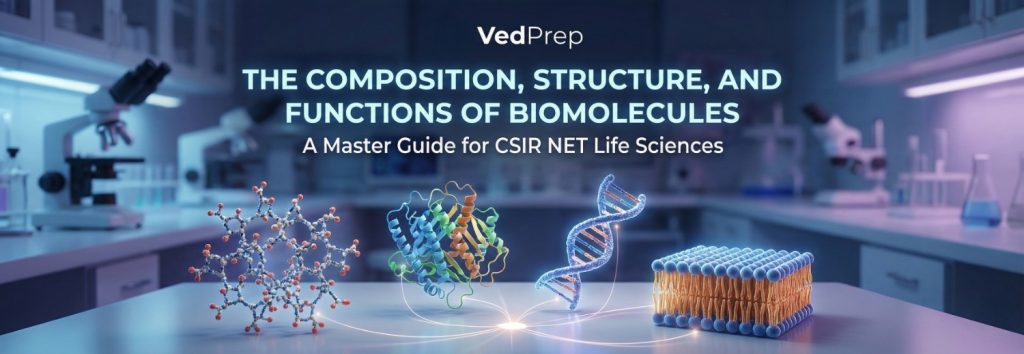

The Composition, Structure, and Functions of Biomolecules: A Master Guide for CSIR NET Life Sciences
Finding the Molecular Logic of Life: A Close Look at Biomolecules compositions
The biological world is a complicated web made up of tiny threads. There is a certain group of organic compounds at the center of every biological process, from the firing of a neuron to the replication of a cell. These are biomolecules, which are the non-living molecules that fight to keep life going. For people who want to take the CSIR NET Life Sciences exam, knowing how biomolecules are made up, how they are structured, and what they do is not only a requirement for the test, but also the basis of biochemistry compositions.
Many sources list the different types of biomolecules, but this guide goes into more detail about their chemical makeup, the order in which they are put together, and the complex link between their structure and their physiological functions.
The Building Blocks of Biomolecules compositions
To comprehend life, we must initially examine the components that constitute it. There are about 30 trillion cells in the human body, and they all work together. There are more than 25 naturally occurring elements in the organic molecules that drive these cells.
Carbon, hydrogen, oxygen, phosphorus, and sulfur are the main parts of these molecules. Carbon is especially important because it can make stable covalent bonds, which lets it make the different backbones of life. Biomolecules are often seen as hydrocarbons with functional groups like alcohols, amines, aldehydes, ketones, and carboxylic groups replacing the hydrogen atoms. This exact combination of elements determines how the molecule will behave chemically. For example, it will tell you if it will dissolve in water, interact with DNA, or create a barrier against the outside world.
Carbohydrates: The Energy Currency and Builders of Structures of compositions
Some people say that carbohydrates are the most common biomolecules on Earth. People often call them sugars, but chemically they are polyhydroxy aldehydes or polyhydroxy ketones.
What chemicals are in it and how to classify it
Carbohydrates are mostly made up of carbon, hydrogen, and oxygen. They are put into three groups based on how many sugar units are made when they are hydrolyzed:
Monosaccharides: These are the most basic type, made up of just one unit. They are clear, crystalline solids that can dissolve in water. Glucose and fructose are two examples of important sugars that the body needs to make energy.
Disaccharides: Made up of two sugar units that are linked by an O-glycosidic bond. Sucrose (glucose + fructose) and lactose (galactose + glucose) are two common examples. Sucrose is made during photosynthesis, and lactose is a major source of energy for animals.
Polysaccharides are big polymers that have more than two sugar units. They are also called glycans.
Diversity in Structure: Compositions of Homopolysaccharides and heteropolysaccharides compositions
Because of their structure, polysaccharides can do many things, such as store energy and provide mechanical stability.
Homopolysaccharides: Made up of just one kind of sugar unit.
Structural: Chitin is important for the cell walls of fungi, and cellulose makes up the fibrous structure of plants.
Storage: Starch stores energy in plants, and glycogen stores food in animals, bacteria, and fungi.
Heteropolysaccharides compositions: They are made up of two or more different kinds of sugar units. These complicated molecules have glycosaminoglycans in them, such as Hyaluronic acid (which absorbs shock) and Heparin (which stops blood from clotting).
Proteins: The Cell’s Flexible Workers
Proteins are essential biomolecules that make up about half of the dry weight of cells. They are different from other macromolecules because they can do so many different things, which is due to how complicated their structure is.
Peptide Bonds and Amino Acid Compositions
Proteins are long chains of amino acids that don’t branch. There are about 22 different amino acids that make up proteins. Peptide bonds link these amino acids together in a specific order, which is what makes up a protein. The nucleotide sequence in the gene that codes for that protein determines this order.
Hierarchical Structure: From Primary to Quaternary
Proteins are the best example of how “structure and functions of biomolecules” are connected. The way a polypeptide chain folds up decides what it does.
Primary Structure: The linear arrangement of amino acids connected by peptide bonds.
Secondary Structure: The polypeptide folds in on itself in a specific way, and hydrogen bonds between the amide hydrogen and carbonyl oxygen keep it stable. The alpha-helix and beta-sheet are two common shapes.
Tertiary Structure: The shape of the whole thing in three dimensions. Hydrophobic interactions, electrostatic interactions, hydrogen bonds, and Van der Waals forces help keep this level of structure stable.
Quaternary Structure: This is the structure of proteins that have two or more polypeptide subunits, like hemoglobin. These subunits come together to make a functional unit by forming non-covalent bonds.
Functional Diversity Based on Compositions
Proteins can do different things because they are made up of different amino acids:
Biological catalysts like DNA polymerase and lipase lower activation energy to speed up metabolic reactions.
Fibrous proteins like collagen and keratin make bones and hair strong. These are called structural proteins.
Actin and myosin are motor proteins that make muscles contract.
Toxins: Bacteria use some proteins, like Diphtheria toxin, to attack other living things.
Nucleic Acids: The Plans for Inheritance
Proteins do the work, but nucleic acids make the decisions. These large molecules are in charge of storing and moving genetic information.
The makeup of nucleotides and phosphodiester linkages
Nucleotides are the building blocks of nucleic acids. It has three different parts: a nitrogenous base, a pentose sugar, and a phosphoric acid ion.
Nitrogenous Bases: These are the bases that make up DNA and RNA. They are Purines (Adenine and Guanine) and Pyrimidines (Cytosine, Thymine, and Uracil).
Sugars: DNA has deoxyribose, and RNA has ribose.
A $3^{\prime}$ and $5^{\prime}$ phosphodiester bond links these nucleotides together to make long chains.
DNA vs. RNA: The Double Helix and Beyond
Watson and Crick found that DNA has a double helix shape, which is made up of two strands that run in opposite directions and are held together by hydrogen bonds. It’s interesting that DNA doesn’t have the 2′ hydroxyl group that RNA does. This makes DNA chemically more stable and better for long-term genetic storage.
RNA is usually a single strand, but it can also make complicated secondary structures. The “RNA World” hypothesis posits that RNA was probably the first genetic material because it can both store information and act as an enzyme (ribozyme).
Lipids: More Than Just Fat Storage
Lipids are different from other biomolecules because they aren’t polymers. They are defined by how well they dissolve: they don’t dissolve in water (hydrophobic) but do dissolve in organic solvents.
Diversity and Compositions of Hydrophobic Materials
The fact that lipids are made up of mostly hydrocarbon chains makes them hydrophobic.
Fatty acids are the most basic lipids. They are made up of hydrocarbon chains (4–36 carbons) and an acidic group.
Waxes are esters made from fatty acids and long-chain alcohols.
Eicosanoids: These are made from 20-carbon polyunsaturated fatty acids and work as local signaling molecules, like prostaglandins for inflammation.
Roles in the Structure of Membranes
Lipids are not only energy stores; they also build cellular compartments. Phospholipids, which have a phosphate group and an alcohol group, make up the lipid bilayers that make up cell membranes. Because they have both hydrophilic and hydrophobic parts, they can naturally arrange themselves into membranes that keep the cell separate from its surroundings. Steroids, such as cholesterol, are also important parts of these membranes and are needed to make hormones.
VedPrep’s Insight: Why Compositions is Important for CSIR NET Unit 1
At VedPrep, we know that just knowing what a biomolecule is isn’t enough for someone who wants to take the CSIR NET; they also need to be able to use this knowledge in real life. Unit 1 (Molecules and their Interaction Relevant to Biology) is a high-yield section, and questions often test your deep understanding of chemical compositions rather than rote memorization.
Hot Topics to Watch on VedPrep
Our VedPrep experts have looked at recent trends and figured out how the “structure and functions of biomolecules” affect exam scores:
Ramachandran Plot: It’s not just about the structure of proteins; it’s also about how the specific atomic makeup and steric hindrance of amino acids affect how freely they can change shape.
pH and Titration Curves: A lot of questions ask you to figure out how much charge a peptide has at a certain pH. To do this, you need to have a good understanding of the ionizable groups in the amino acid composition.
DNA Structure: It’s easy to understand the double-helical structure, but using it to Link Number and Supercoiling is where the “structure and function” idea really gets put to the test.
VedPrep makes sure you aren’t just reading biochemistry by focusing on these deep conceptual links.
In conclusion
The examination of the composition, structure, and functions of biomolecules constitutes the study of life itself. Nature uses the simple building blocks of carbon and hydrogen to make complex carbohydrates for energy, flexible proteins for machines, stable nucleic acids for memory, and a wide range of lipids for structure. As we keep studying biochemistry, we learn more about how these molecules work together to keep life going, which is a very complicated process.
Knowing exactly what these molecules are made of helps us understand how biological systems work, which is an important lesson for anyone who wants to take the CSIR NET Life Science exam.
The compositions determines the function: The stability of a molecule can depend on the difference of just one atom, like H and OH in DNA/RNA compositions.
There is a hierarchy to structure: Small molecules like sugars, amino acids, and nucleotides join together to make macromolecules.
Function is very specific: Proteins fold into exact 3D shapes to work as enzymes or motors, while lipids form barriers on their own.
Frequently asked Questions (FAQs)
Why is the study of biomolecules crucial for the CSIR NET Life Sciences exam?
Ans: Understanding the composition, structure, and functions of biomolecules is not only a requirement for the test but also serves as the fundamental basis of biochemistry. Furthermore, Unit 1 (Molecules and their Interaction Relevant to Biology) is a high-yield section where deep understanding is tested over rote memorization.
What are the primary elements that constitute biomolecules?
Ans: The organic molecules driving cells primarily consist of Carbon, hydrogen, oxygen, phosphorus, and sulfur
Why is carbon considered the most important element in biomolecules?
Ans: Carbon is crucial because it can form stable covalent bonds, allowing it to create the diverse backbones of life.
How are carbohydrates chemically defined?
Ans: While often called sugars, chemically they are defined as polyhydroxy aldehydes or polyhydroxy ketones.
What are the three main classifications of carbohydrates?
Ans: They are classified based on the number of sugar units produced upon hydrolysis: Monosaccharides, Disaccharides, and Polysaccharides
What bond links the sugar units in a disaccharide?
Ans: Two sugar units in a disaccharide are linked by an O-glycosidic bond.
What is the difference between Homopolysaccharides and Heteropolysaccharides?
Ans: Homopolysaccharides consist of just one kind of sugar unit , whereas Heteropolysaccharides are made up of two or more different kinds of sugar units.
Which polysaccharides are responsible for structural support?
Ans: Chitin provides support for fungal cell walls, and cellulose forms the fibrous structure of plants.
What determines the specific order of amino acids in a protein?
Ans: The specific order is determined by the nucleotide sequence in the gene that codes for that protein
How is the secondary structure of a protein stabilized?
Ans: It is stabilized by hydrogen bonds formed between the amide hydrogen and carbonyl oxygen as the polypeptide folds.
What forces maintain the stability of a protein's tertiary structure?
Ans: Hydrophobic interactions, electrostatic interactions, hydrogen bonds, and Van der Waals forces help stabilize the tertiary structure.
What is the quaternary structure of a protein?
Ans: Quaternary structure refers to proteins containing two or more polypeptide subunits, such as hemoglobin, held together by non-covalent bonds.
What function do fibrous proteins like collagen serve?
Ans: Fibrous proteins like collagen and keratin are structural proteins that provide strength to bones and hair.
What are the three components of a nucleotide?
Ans: A nucleotide consists of a nitrogenous base, a pentose sugar, and a phosphoric acid ion.
What is the key structural difference between DNA and RNA regarding stability?
Ans: DNA lacks the 2' hydroxyl group found in RNA, making DNA chemically more stable and better suited for long-term genetic storage.